Need help?
Do you have a question about the Jimi VL502 and is the answer not in the manual?
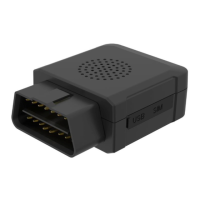
Visual identification of device components and ports.
Description of the device's OBDII connector pin assignments and functions.
Explains the meaning of different LED indicator light patterns for device status.
Step-by-step guide for inserting the Nano-SIM card into the device.
Instructions on connecting the device to the vehicle's OBDII port.
Guide to setting network APN and server parameters via SMS commands.
Details on default device settings for movement and ignition detection.
Highlights the device's capabilities, communication features, and alerts.
Technical specifications for the GNSS positioning system.
Details on cellular network, power, input voltage, OBD interface, and general device interfaces.
Device dimensions, weight, operating temperature, and humidity.
Lists sensors, BLE, ignition detection, scenarios, and driving behavior analysis.
Safety guidelines for handling, using, and protecting the device's battery.
General notes on product upgrades, appearance, and warranty card requirements.
Conditions, exclusions, and validity period for the product's warranty coverage.
Details on warranty duration, replacement policy, and free repair services.
Common device issues, their potential causes, and recommended solutions.
Form for customer information, maintenance records, and important warranty notes.
Regulatory compliance statement regarding FCC rules and radio frequency exposure limits.
This document describes the VL502 LTE OBDII GNSS Tracker, a device designed for vehicle tracking and monitoring. It offers a comprehensive set of features for both real-time location tracking and detailed vehicle data acquisition, making it suitable for various applications, from personal vehicle management to fleet tracking.
The VL502 is primarily an LTE OBDII GNSS tracker. Its core function is to provide accurate location information using two complementary positioning systems (GPS/BDS) and transmit this data over 4G LTE networks to a cloud platform. This dual positioning system ensures reliable location display, even in challenging environments. Beyond basic tracking, the device excels at obtaining real-time vehicle data directly from the OBDII port. This includes crucial information such as accurate mileage, fault codes, ACC status, fuel consumption statistics, battery voltage, and engine speed. This rich data collection allows for in-depth vehicle diagnostics and performance monitoring.
A key aspect of the VL502's functionality is its ability to detect and alert users about various events. It can provide instant alerts for four types of dangerous driving behavior, which can be configured based on specific needs. Additionally, it generates instant alerts for atypical events, including car faults, collisions, overspeeding, device pull-out (unplugging from the OBDII connector), engine idling, low battery conditions, and geo-fence entry/exit. These alerts are crucial for proactive management and immediate response to critical situations.
The device also supports constant tracking, even in areas with poor GPS signals or in their complete absence, further enhancing its reliability. This ensures that vehicle movements are continuously monitored, regardless of external signal conditions.
The VL502 is designed for ease of use and installation. It simply plugs into the vehicle's OBDII socket, eliminating the need for professional installation. This plug-and-play design makes it accessible to a wide range of users.
Configuration of the device is straightforward, primarily done through SMS commands. Users can configure critical parameters such as APN settings and server parameters by sending specific SMS commands to the VL502. This flexibility allows users to adapt the device to their specific network operator and platform service provider. For instance, APN settings can be adjusted with or without a username and password, and server parameters can be set using either a domain name or an IP address, with support for TCP protocol.
The device incorporates intelligent detection mechanisms. Vehicle movement is detected by an accelerometer, while ignition status is determined by monitoring the vehicle's power voltage (between 9-36V). These detections trigger various alerts and data logging, providing a comprehensive overview of vehicle activity.
Driving behavior analysis is a significant feature, allowing the device to identify and report harsh acceleration, harsh braking, harsh cornering, and collisions. This capability is invaluable for improving driver safety and optimizing fleet operations.
Furthermore, the VL502 offers Bluetooth connectivity, which enables users to configure parameters, upgrade software, and debug the device. This provides an alternative and convenient method for managing the device's settings and ensuring it operates optimally.
Maintenance of the VL502 primarily involves ensuring proper SIM card attachment and adhering to battery precautions. The device requires a Nano-SIM card, which needs to be correctly placed in the SIM card tray and inserted into the slot. It's important to disable any PIN requests on the SIM card for proper operation. The device can power on using its backup battery after the SIM is inserted, but if the battery is low, it should be connected to the vehicle's OBDII connector for power.
The manual emphasizes several precautions regarding the battery to ensure its longevity and safe operation. Users are advised to use only manufacturer-specified batteries and avoid metal objects that could cause short circuits. Bending or forcibly opening the battery, soaking it in water, or exposing it to fire are strictly prohibited. Using deformed, discolored, spilled, or package-damaged batteries is also forbidden, as is disassembling or modifying the battery. These guidelines are crucial for preventing damage to the device and ensuring user safety.
Troubleshooting guidance is provided for common issues such as poor signal, power-on failure, failed SIM card attachment, and inability to access the network or query a location. Solutions range from checking SIM card insertion and cleaning to contacting the network service provider or dealer. This self-help section empowers users to resolve minor issues independently.
The device's LED indicators provide visual feedback on its status, aiding in troubleshooting. A red power indicator shows battery status (low, charging, complete, normal operation, or internal failure). A blue GNSS indicator shows satellite signal search, fixed position, or sleep mode. A green network indicator shows GMS initialization, online status, or network errors/no SIM card. These indicators are vital for quickly assessing the device's operational state.
The warranty information outlines terms for repair, replacement, and refund services, emphasizing the importance of keeping the warranty card and original purchase receipt. This ensures that users can avail themselves of maintenance services when needed, covering damages not caused by human factors for a specified period. Specific conditions for replacement and free repair services are detailed, ensuring clarity on warranty coverage.
 General
| Model | VL502 |
|---|---|
| Category | GPS |
| GSM frequency | 850/900/1800/1900 MHz |
| GSM antenna | Internal |
| GNSS antenna | Internal |
| Tracking sensitivity | -165dBm |
| Acquisition sensitivity | -148dBm |
| LED indicator | Yes |
| Water Resistance | IP65 |
| Display | No |
| Operating temperature | -20°C to +70°C |
| GPS Accuracy | <10m |
| TTFF (Open Sky) | 1 second |
| GPS Chipset | MTK |

 To Next Page