EasyManua.ls Logo

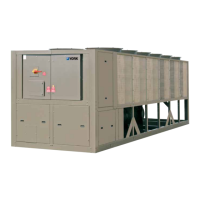
Johnson Controls York YCIV0267 - User Manual

Johnson Controls York YCIV0267
334 pages
Print Icon
To Next Page IconTo Next Page
Loading...
R134A
YCIV STYLE A
MODELS
YCIV0157-0397, 60 HZ
(150-260 TONS)
AIR-COOLED SCREW LIQUID CHILLERS
E/V HIGH EFFICIENCY AND S/P STANDARD EFFICIENCY
AIR-COOLED SCREW LIQUID CHILLERS
INSTALLATION, OPERATION, MAINTENANCE
Supersedes: 201.23-NM2 (610) Form 201.23-NM2 (315)
035-21506-101
Issue Date:
March 9, 2015

Table of Contents

Questions and Answers

Johnson Controls York YCIV0267 Specifications

General IconGeneral
BrandJohnson Controls
ModelYork YCIV0267
CategoryChiller
LanguageEnglish

Summary

SECTION 1 - GENERAL CHILLER INFORMATION AND SAFETY

WARRANTY

Details Johnson Controls' warranty terms for equipment and materials, including exclusions and conditions.

SAFETY

Outlines safety standards, responsibilities, and potential hazards associated with the equipment.

SECTION 2 - PRODUCT DESCRIPTION

General System Description

Describes the Latitude (YCIV) chiller line's integration of screw compressor design and VSD technology for efficiency.

Compressor

Details the direct-drive semi-hermetic rotary twin-screw MTS compressor, its lubrication, and bearing design.

Evaporator

Explains the high-efficiency shell and tube type Direct Expansion Evaporator, its design pressures, and construction.

Condenser

Describes the fin and tube condenser coils, fan motors, and blade construction for efficiency and low sound.

Capacity Control

Explains how capacity is controlled by varying compressor speed via VSD, eliminating the need for Hot Gas Bypass.

Power and Control Panel

Details the factory-wired and tested controls, VSD, and panel enclosures designed to NEMA 3R rating.

SECTION 3 - RIGGING, HANDLING AND STORAGE

SECTION 4 - INSTALLATION

LOCATION REQUIREMENTS

Emphasizes selecting a site for optimal performance, trouble-free service, and adequate access space.

LOCATION CLEARANCES

Details necessary clearances around the unit for unrestricted airflow and to prevent re-circulation.

CHILLED LIQUID PIPING

Offers recommendations for satisfactory unit operation, covering pipework arrangement and connection types.

ELECTRICAL CONNECTION

Outlines recommendations for safe and satisfactory unit operation, covering power and control wiring.

POWER WIRING

Details requirements for electrical wiring, including cable routing, overcurrent protection, and using copper wiring.

SECTION 5 - COMMISSIONING

PREPARATION

Outlines essential steps before commissioning, including electrical lockout/tagout and initial inspection.

FIRST TIME START-UP

Emphasizes the need for sufficient heat load during commissioning for proper unit setup and logging.

CHECKING SUBCOOLING AND SUPERHEAT

Provides methods for checking subcooling and superheat, crucial for correct refrigerant charge and system stabilization.

Superheat

Details how to check suction superheat, its purpose, and how it's controlled by the Drain Valve controller.

SECTION 6 - TECHNICAL DATA

WATER PRESSURE DROP CHARTS

Presents charts showing pressure drop through two-circuit YCIV evaporators for English units.

ELECTRICAL DATA

Presents wiring diagrams and connections for 2 and 3 compressor power configurations.

REFRIGERANT FLOW DIAGRAM

Illustrates the refrigerant flow path through the chiller system components.

PROCESS AND INSTRUMENTATION DIAGRAM

Depicts the chiller's process and instrumentation, including system components and microprocessor control functions.

VSD (Variable Speed Drive)

Introduces the VSD as a liquid-cooled, transistorized PWM inverter composed of four major sections.

VSD Logic Board

Details the VSD Logic Board's control operations, communication, safeties, and microprocessor functions.

SECTION 7 - OPERATION

OPERATING CONTROLS

Covers the primary operating controls including anti-recycle timers, evaporator pump/heater control, and alarms.

BASIC OPERATING SEQUENCE

Outlines the steps and conditions required to initiate the chiller's start sequence and loading.

MINIMUM VSD COMPRESSOR START; RUN FREQUENCY

Details how minimum start and run frequencies are determined by ambient temperature.

Fuzzy Logic Control

Describes how fuzzy logic makes decisions for speed adjustments based on error, rate of change, and timers.

LOAD LIMITING CONTROL

Explains load limiting controls intended to prevent safety trips by monitoring motor current, pressure, and temperature.

Suction Pressure Load Limiting;Unloading

Covers suction pressure load limiting to protect the evaporator from freezing, including loading inhibition and forced unloading.

VSD Internal Ambient Temperature Load Limiting

Explains VSD internal ambient temperature limiting to prevent tripping on high cabinet temperature safety.

VSD Baseplate Temperature Load Limiting

Details VSD baseplate temperature load limiting to protect against high safety limits.

CONDENSER FAN CONTROL

Explains how condenser fan control is based on discharge pressure and utilizes multiple stages for optimization.

SOUND LIMIT CONTROL

Explains how sound limit control reduces chiller noise levels by setting a Sound Limit Setpoint.

SECTION 8 - MICROPANEL

VSD OPERATION AND CONTROLS

Covers VSD Logic Board functions, communication, start/run initiation, and PWM generator operation.

VSD SAFETIES (FAULTS)

Covers VSD safeties monitored by software and hardware circuitry to protect against various fault conditions.

Pre-charge Low DC Bus Voltage (Software) Fault

Details the fault condition when DC Bus voltage does not reach the required level within the pre-charge interval.

Pre-charge DC Bus Voltage Imbalance (Software) Fault

Explains the fault when 1/2 DC Bus voltage magnitude deviates significantly from the total DC Bus voltage.

High DC Bus Voltage (Hardware) Fault

Covers the hardware-determined trip level for high DC Bus voltage, causing immediate shutdown.

Low DC Bus Voltage (Software) Fault

Describes the software-determined trip level for low DC Bus voltage, causing shutdown.

High Motor Current (Hardware) Fault

Details the hardware monitoring of output current per phase and the trip level for peak current.

Motor Current Overload (Software) Fault

Explains how software compares motor current to FLA setting and trips if exceeded continuously.

Motor Current Overload (Hardware) Fault

Covers hardware comparison of motor current to overload adjust potentiometer setting for tripping.

IGBT Gate Driver (Hardware) Fault

Describes the hardware fault triggered by IGBT saturation voltage exceeding the limit or power supply voltage falling below permissible levels.

High Baseplate Temperature (Software) Fault

Explains the software fault when inverter power module baseplate temperature exceeds trip points.

High VSD Internal Ambient Temperature (Software) Fault

Details the software fault when VSD internal ambient temperature rises above the cutout.

Single Phase Input (Hardware) Fault

Covers the hardware fault detected when any of the three phase mains voltages are not present.

Power Supply (Hardware) Fault

Explains the hardware fault when DC power supplies fall outside allowable limits.

Run Relay (Software) Fault

Details the software fault that occurs if a missing run signal is not asserted within the specified window.

VSD Logic Board Failure (Software) Fault

Covers the software fault that occurs if the microprocessor does not receive a handshake within the specified time.

VSD CT Plug (Hardware) Fault

Explains the hardware fault detected if CT plugs are not installed or if a low value is read on the digital input.

UNIT SAFETIES

Lists unit safeties that cause compressor shutdowns when safety thresholds are exceeded, and their auto-reset behavior.

High Ambient Temp Fault

Details the fault condition when ambient temperature rises above 130°F, causing controlled shutdown.

Low Ambient Temp Fault

Explains the fault when ambient temperature falls below the programmable low ambient cutout.

Low Leaving Chilled Liquid Temp Fault

Covers the fault that protects the chiller from evaporator freeze-up due to low chilled liquid temperature.

VSD Communications Failure Fault

Explains the fault preventing unit operation if the Chiller Control Board fails to initialize or maintain communication with the VSD Logic Board.

System Safeties (Faults)

Lists system safeties that cause individual systems to shut down if a safety threshold is exceeded.

High Discharge Pressure Cutout (Software) Fault

Details the software fault for high discharge pressure, causing a controlled shutdown.

High Discharge Pressure Cutout (HPCO) (Hardware) Fault

Explains the hardware fault from mechanical HPCO contacts opening due to dangerously high discharge pressure.

Low Suction Pressure Cutout (Software) Fault

Covers the software fault acting as a backup to the flow switch to protect against low refrigerant charge.

Low Motor Current Cutout Fault

Describes the fault detected by the microprocessor when it senses the absence of motor current.

High Differential Oil Pressure Cutout Fault

Explains the fault protecting the compressor from low oil flow or insufficient lubrication due to high discharge-to-oil differential pressure.

Low Differential Oil Pressure Cutout Fault

Details the fault protecting the compressor from low oil flow when differential between oil and suction pressure falls below cutout.

High Discharge Temperature Cutout Fault

Explains the fault protecting the motor and compressor from overheating due to high discharge temperature.

High Oil Temperature Cutout Fault

Covers the fault protecting the compressor from insufficient lubrication due to high oil temperature.

Low Suction Superheat Cutout Fault

Explains the fault that protects the compressor from liquid floodback due to low suction superheat.

Low Discharge Superheat Cutout Fault

Details the fault protecting the compressor from liquid floodback via the economizer line due to high flash tank level.

Sensor Failure Cutout Fault

Covers the fault that prevents system running when a critical sensor is not functioning properly.

High Motor Temperature Cutout Fault

Explains the fault that prevents compressor running when motor temperature is too high.

High Flash Tank Level Cutout Fault

Details the fault that prevents system running when the liquid level in the flash tank is too high.

System Control Voltage Cutout Fault

Covers the fault alerting the operator to missing 115VAC control voltage to a system.

STATUS KEY

Explains the function of the STATUS key for viewing chiller or system operational status and fault messages.

PROGRAM KEY

Explains the PROGRAM key for accessing and modifying various programmable operating parameters.

Suction Pressure Cutout

Details the suction pressure cutout's function in protecting the chiller from low refrigerant and freeze-up.

Low Ambient Cutout

Explains the low ambient temperature cutout for shutting down the chiller based on outdoor temperature.

Low Leaving Liquid Temp Cutout

Covers the cutout programmed to prevent evaporator freezing due to excessively low chilled liquid temperatures.

Motor Current Limit

Details the programmable motor current limit (%FLA) to prevent faults on high current.

Pulldown Current Limit

Explains the programmable pulldown current limit for peak time energy savings.

OPTIONS KEY

Explains the OPTIONS key for viewing and modifying unit configuration settings.

MANUAL OVERRIDE KEY

Describes the MANUAL OVERRIDE key's function for overriding schedule shutdowns and its limitations.

SERVICE KEY

Describes the SERVICE key for viewing chiller system electronics data and controlling outputs for troubleshooting.


SECTION 9 - MAINTENANCE

Scheduled Maintenance

Outlines maintenance operations to be performed by a qualified Service Engineer, with minor services every 3-6 months and major service annually.

MAINTENANCE REQUIREMENTS FOR YCIV CHILLERS

Presents a table detailing required maintenance tasks at weekly, quarterly, semi-annually, annually, and every 5 years intervals.

TROUBLESHOOTING GUIDE

Provides a guide to diagnose and address common problems with possible causes and recommended actions.

LIMITED WARRANTY

Details the warranty terms for new equipment and reconditioned/replacement materials, including exclusions and voiding conditions.

Table 35 - COMPRESSOR MOTOR OVERLOAD SETTINGS AND MAX. VSD FREQUENCY

Details compressor motor overload settings and maximum VSD frequency for 2-compressor standard and high static fan models.

Related product manuals