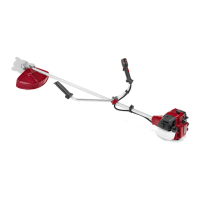
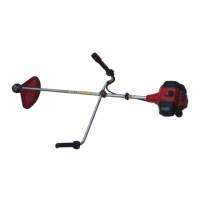
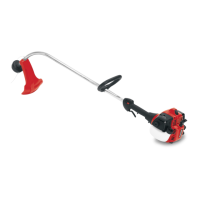
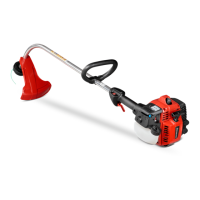
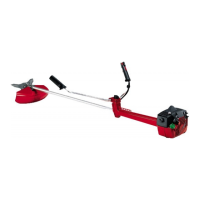
This document is the operator's manual for the Jonsered BC 2228 brushcutter/trimmer. It provides essential information for safe operation, maintenance, and technical specifications of the machine.
Function Description
The Jonsered BC 2228 is a versatile outdoor power tool designed for trimming grass, grass clearing, and forestry clearing. It is equipped with a two-stroke engine and can be fitted with various cutting attachments, including a trimmer head for grass trimming and metal grass blades for coarser grass and clearing. The machine is designed to be worn with a harness for comfortable and balanced operation.
Important Technical Specifications
- Engine:
- Cylinder displacement: 28 cm³
- Cylinder bore: 35 mm
- Stroke: 28.7 mm
- Idle speed: 2800-3200 rpm
- Recommended max. fast idle speed: 11000 rpm
- Speed of output shaft: 8000 rpm
- Max. engine output (acc. to ISO 7293): 0.8 kW
- Catalytic converter muffler: Yes
- Speed-regulated ignition system: Yes
- Ignition System:
- Spark plug: NGK BPMR6A
- Electrode gap: 0.6 mm (0.024 inch)
- Fuel and Lubrication System:
- Fuel tank capacity: 343 cm³
- Fuel mixture: Unleaded gasoline and two-stroke oil mixed at a ratio of 50:1 (2%).
- Weight:
- Weight without fuel, cutting attachment, and guard: 5.21 kg
- Noise Emissions (LWA dB(A)):
- Measured sound power level: 106 dB(A)
- Guaranteed sound power level: 115 dB(A)
- Noise Levels at Operator's Ear (dB(A)):
- Equipped with grass blade (original): 94 dB(A)
- Equipped with trimmer head (original): 95 dB(A)
- Equipped with saw blade (original): 95 dB(A)
- Vibration Levels (ahv, eq m/s²):
- Equipped with grass blade (original), left/right: 4.21 / 4.23 m/s²
- Equipped with trimmer head (original), left/right: 5.89 / 4.61 m/s²
- Approved Accessories:
- Center hole in blades/cutters: Ø 25.4 mm
- Trimmer head: Tap-N-Go 25 (2.4 mm line)
- Metal grass blade: Grass 255-4 1 inch (Ø 250 4-teeth)
- Cutting Attachment Guard Part No.: 503 93 42-04 (for both trimmer head and metal grass blade)
Usage Features
The BC 2228 is designed for user safety and efficiency. Key usage features include:
- Personal Protective Equipment (PPE): Emphasizes the mandatory use of approved PPE such as hearing protection, eye protection (goggles and/or face screen), and gloves. A helmet is recommended for clearing brush taller than 2 meters.
- Harness System: A standard harness is provided for supporting the machine, distributing weight evenly across the shoulders, and ensuring correct balance and height for different tasks (forestry clearing, grass clearing). It includes a quick-release mechanism for emergency situations.
- Throttle Control: Features a throttle lock-out to prevent accidental operation and a start throttle button for controlled engine starting.
- Stop Switch: A push-and-release stop switch ensures the engine can be quickly turned off.
- Cutting Attachments: Supports both trimmer heads for grass trimming and metal grass blades for coarser vegetation. The manual details proper assembly and guard selection for each attachment.
- Fuel Handling: Requires a specific mixture of unleaded gasoline and two-stroke oil (50:1 ratio). Detailed instructions are provided for safe mixing, fueling, transport, and storage to prevent fire and explosion risks.
- Starting Procedures: Covers cold and warm engine starting, including the use of the primer bulb and choke control.
- Working Techniques: Describes specific techniques for grass clearing with a blade (sideways swinging movement, using the left-hand side of the blade) and grass trimming with a trimmer head (holding at an angle, clearing, cutting, sweeping). It advises working at full throttle when cutting with a blade and slowing to idle speed after each operation.
- Safety Zone: Operators must ensure no persons or animals come closer than 15 meters (50 feet) to the machine during operation.
Maintenance Features
Regular maintenance is crucial for extending the machine's lifespan and ensuring safe operation. The manual outlines a comprehensive maintenance schedule:
- General Safety: Stresses the importance of disconnecting the spark plug before performing maintenance (except for carburetor adjustments) and never using a machine with faulty safety equipment.
- Cutting Equipment Maintenance:
- Grass Blades/Cutters: Instructions for sharpening using a single-cut flat file, ensuring all edges are sharpened equally for balance. Emphasizes discarding bent, twisted, cracked, or damaged blades.
- Trimmer Head: Advises ensuring the trimmer line is wound tightly and evenly, and checking the cutter on the trimmer guard for integrity.
- Guards: Regular inspection for damage or cracks, and replacement if necessary.
- Locking Nut: Checking for captive force and correct tightening torque (35-50 Nm).
- Carburetor:
- Function: Explains how the carburetor governs engine speed and mixes air/fuel.
- Idle Speed Adjustment (T-screw): Instructions for fine-tuning the idle speed to prevent the cutting attachment from rotating at idle.
- Start Throttle Speed Adjustment: Procedure for adjusting the start throttle speed using an Allen screw.
- Muffler:
- Spark Arrestor Mesh: Regular checking and cleaning of the spark arrestor mesh. Replacement if damaged.
- Catalytic Converter: Caution about the muffler getting very hot and the presence of carcinogenic chemicals inside.
- Spark Plug:
- Inspection: Checking for deposits on electrodes, cleaning, and verifying the electrode gap (0.6 mm or 0.024 inch).
- Replacement: Recommended replacement after about a month of operation or earlier if needed.
- Air Filter:
- Cleaning: Regular cleaning (every 25 hours or more frequently in dusty conditions) by washing in warm, soapy water.
- Replacement: Replacing if damaged or after prolonged use.
- Bevel Gear: Checking that the bevel gear is three-quarters full with special grease.
- Fuel Filter and Hose: Checking for contamination, cracks, or other defects, and replacing if necessary.
- Cables and Connections: Regular inspection.
- Clutch: Checking the clutch, clutch springs, and clutch drum for wear, and replacing if necessary by an authorized service workshop.
The manual provides a detailed weekly, monthly, and annual maintenance schedule, highlighting that more extensive work should be carried out by an authorized service workshop.

 Need help?

 To Next Page
 General