11
139681_R06 F 500 Oslo 1/20
When reloading the stove while it is still hot and a bed of hot
embers still exists, follow this reloading procedure:
• Always wear gloves when tending to the stove.
• Push the air control lever to the full open position (far right).
• Wait a few seconds before opening the door.
• Use a stove tool or poker to distribute the hot embers equally
around the firebox and away from the air inlet ports at the
front center of the firebox floor.
• Load the fuel, usually with smaller logs first.
• Close the door, be sure to latch the door tightly.
• Wait 5 – 10 minutes before adjusting the primary air to the
desired heat output setting. (If you have at least a 2” thick
ember bed when reloading, it may be possible to close the
door and immediately adjust the air control setting).
6.0 Maintenance
Regular maintenance will prolong the life of your stove and
ensure satisfactory performance.
6.1 Annual Stove Inspection
• Empty stove of all soot and ashes. Only use a vacuum for
this job if the vacuum is specifically designed for ashes.
• Inspect the stove seams. Use a utility light to inspect the
stove inside and out for cracks or leaks. Replace all cracked
parts and repair any cement leaks with furnace cement. For
your protection always wear safety gloves when handling
the ash pan.
6.2 Ash removal
Ash removal will be required periodically depending on how
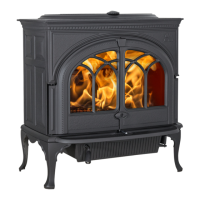
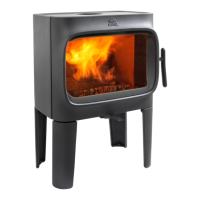
frequently the stove is used. Conveniently, the Jøtul F 500 is
equipped with an ash pan assembly for easy ash removal, without
the need for opening the front doors.
The ash pan door is located under the front ashlip of the stove.
To open the ash door, rotate the door knob counterclockwise to
unlatch the door and clockwise to latch the door. Always use
stove gloves when handling the ash pan.
When the stove is in operation always close the ash door before
leaving to dispose of the ashes.
The ashes should be placed in a metal container equipped
with a tight sealing lid. The container should be placed on a
noncombustible floor or on the ground, well away from all
combustible materials, pending final disposal. If the ashes are
disposed of by burial in soil or otherwise locally dispersed, they
should be retained in the closed container until all cinders have
thoroughly cooled. Only use a vacuum for this job if the vacuum
is specifically designed for ashes.
It is advisable to keep a thin (1”) bed of ashes on the firebox floor
to help maintain a hot charcoal be.
ATTEMPTS TO ACHIEVE HEAT OUTPUT RATES THAT
EXCEED HEATER DESIGN SPECIFICATIONS CAN RESULT
IN PERMANENT DAMAGE TO THE HEATER.
Creosote and Soot Formation and
the Need for Removal
When wood is burned slowly, it produces tar and
other organic vapors which combine with expelled
moisture to form creosote. These creosote vapors
condense in the relatively cool chimney flue of a slow
burning fire. The creosote that accumulates in the
flue is highly flammable and is the fuel of chimney
fires. To prevent a chimney fire, the creosote needs
to be removed by sweeping the chimney and flue
connector. The frequency of sweeping will depend
on how you operate your stove. An accumulation
of 1/4” or more on the sides of the flue or connector
is considered hazardous and should be removed.
In the event that creosote in your chimney or
flue connector ignites, the resulting fire is often
accompanied by a roaring noise and a crackling sound
as flakes of burned creosote break loose. lf you suspect
you are having a chimney fire, immediately close the
primary air control and make sure the stove door is
closed. Call the fire department and get everyone
safely out of the house.
Trying to extinguish the fire in the stove will not help.
In fact it can make the matter worse by allowing more
oxygen through the door, which then accellerates the
fire in the chimney. When the roaring and crackling
has stopped, you should resist the temptation to
open the door and look at the fire. The fire may have
suffocated, but could rekindle when you open the
door. After a chimney fire, do not use your stove until
the chimney and the flue connector has been cleaned
and inspected to ensure that no damage has occured.
5.7 Adding Fuel


 To Next Page