8
F 602 CB 139677_R04 April 2017
temperature will continue to climb until the fuel burns down
somewhat. Once the fire is out and the stove has cooled to
room temperature, continue the break-in procedure. Never
attempt to reduce the temperature by removing burning
logs from the fire.
NOTE: It is normal for a new painted stove to emit an odor
and smoke during its first several fires. This is caused by the
seasoning of the high temperature paint and will diminish
with each fire. Opening a window or door to provide
additional ventilation will alleviate this condition.
5.6 Building a Fire
The most important element is seasoned, dry fuel. A well-built
fire will burn efficiently, keep the door glass clean, minimize
emissions, and require less time and attention to maintain.
We recommend using the top-down method of fire-starting
as that will quickly warm the flue and establish a strong draft.
• Set the air control lever fully to the right. Place two,
quarter-split logs to either side of the firebox, oriented
front-to-back.
• Criss-cross three or four smaller splits on top of the
bottom logs.
• Place several thin, dry kindling sticks across the second
layer of logs.
• Place a few balls of crumpled paper on top of the kindling,
followed by a handful or two of logpile tinder.
• Ignite the paper evenly and close the door.
• The burning paper and tinder will fall and quickly ignite
the kindling. As the burning kindling sticks fall, the second
layer of logs will ignite and fall between the base logs.
• Now you can add a couple more quarter-spits and let
the fire become established for several minutes before
adjusting the air valve position or adding more fuel.
At this point, you should see little or no smoke exiting the
chimney.
5.7 Reloading
Reload the stove while it is still hot and there are plenty of
hot to ignite the fresh fuel load. It is a good idea to include
a smaller piece or two of wood at the base of the new load
to help the stove recover more quickly to its operating
temperature.
Reloading Procedure
• Always wear gloves when tending your stove.
• Push the air control to the right to the full open position.
• Wait a few seconds and open the door.
• Use a stove shovel or similar tool to break up any
remaining charcoal and to drag some live embers toward
the front where combustion air enters.
• Load the fuel (Smaller pieces first) and close the door.
• Wait 5-10 minutes and adjust the air control to desired
setting.
Secondary air allows combustion of volatile gas and other by-
products of primary combustion that would otherwise enter
the atmosphere unburned. This unregulated air is preheated
as it passes through a manifold at the back of the stove and
is then directed to the fire through a stainless steel manifold
at the top of the firebox. This additional hot oxygen allows
any unburned gasses to be burned inside the stove. The
action of secondary combustion can be readily seen through
the viewing glass a slow, rolling flames suspended over the
main fuel bed and smaller jets of flame extending from the
secondary manifold ports. At the same time, no smoke will
be observed exiting the chimney. This is evidence that the
stove is operating at the so-called ”sweet-spot” wherein
optimum efficiency is realized.
When first starting or reviving the fire: the primary control
lever should be set to the far right position, which permits
the maximum amount of air into the stove. The greater the
amount of air entering the stove, the hotter and faster the
fire will burn. Moving the lever to the left reduces the airflow
into the stove which prolongs the fire at a lower heat output.
See figure 20, page 15.
Using a Stove-top Thermometer
Determining the primary air setting for the best overall
performance for your particular needs and installation
will be established over time through trial and error. Each
installation has unique characteristics that will affect stove
performance. You should use a stove-top thermometer to
monitor the status of the fire. Once the temperature has
reached 400°F - 600°F, set the air control to a mid-range
position to allow adequate oxygen to support efficient
combustion throughout the burn cycle.
5.5 New Stove Break-In Procedure
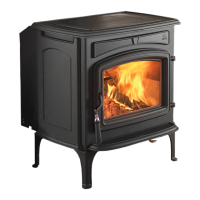
The Jøtul F 602 CB is constructed of cast iron and stove furnace
cement. Cast iron, while very durable, expands and contracts as it
is heated and cooled. This type of construction requires the stove
to be “broken-in” gradually so that thermal expansion does not
occur too quickly. The following steps describe the proper break-in
procedure for the Jøtul F 602 CB:
1. Light a small fire of newspaper and kindling. Only allow the
stove to reach a maximum surface temperature of 200°F (93°
C). Burn for approximately 1 hour.
2. Allow the stove to cool to room temperature.
3. Light a second fire, allowing the stove to reach a maximum
temperature of 300°F (149°C) for 1 hour.
4. Cool the stove to room temperature.
5. Light a third fire and gradually allow the stove to reach a surface
temperature of 400°F (204°C).
6. Cool stove to room temperature. This completes the “break-in”
procedure.
Note: Keep the stove under 400°F (204°C) surface temperature
during any “break-in fire”, with the exception of the last
“break-in” fire. If the temperature exceeds 400°F, move the
primary air control lever all the way to the left to shut off
the air supply completely. It is normal that the stove top



 To Next Page