– 27 –
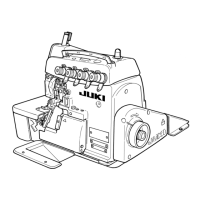
Adjustment procedures
Results of Improper adjustment
1) Adjusting the thread cam
1. Adjust the position of the thread cam
❽
by its setscrew
❶
with
the needle
at their upper dead point so that the straight section
of the thread cam
❽
is leveled.
2. Laterally position the thread cam
❽
so that the thread cam nail
❻
is located at the center of groove
A
of the thread cam
❽
.
[How to check for proper positioning]
Check that the thread cam
❽
releases the looper thread when the
needle
tip begins to come out of the bottom surface of the throat
plate
by 1 to 2 mm.
2) Adjusting the thread cam thread guides A and B and the
thread cam nail
1. Install looper thread cam thread guides A
❷
and B
❸
to the direc-
tion
B
until the full length of the elongated hole with setscrews A
❹
and B
❺
.
⊕
means to have more thread amount while sewing.
⊖
means to have less thread amount while sewing.
2. Install thread cam nail
❻
with setscrew
❼
so that the straight
section of the forked portion is leveled.
3) Positioning the chain looper thread guide
1. Fix the chain looper thread guide
by the setscrew
so that a
thread path provided between the double chain looper
and the
thread cam thread guide base
❾
is straight line.
o
If the timing of the thread cam
❽
is too early, the needle
tip
will fail to enter a thread triangle,
resulting in looper thread stitch
skipping.
o
If the timing of the thread cam
❽
is too late, puckering and
loose looper thread stitches will
results.
o
If the thread cam thread guide is
moved away from you, the take-
up amount of the lower looper
thread will decrease. In this
case, puckering may result there
by impairing the feeling of the
nished product.
o
In the case the looper thread
is not appropriately adjusted,
thread loops cannot be formed
with consistency. (Thread can be
excessively loosened or thread
loops cannot be formed.)
o
If a thread path has not been
straight line, stitch perforation
becomes unstable. Also, looper
thread is caught by the thread
guide base stopper
.



 To Next Page
 Loading...