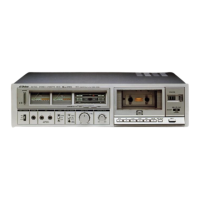
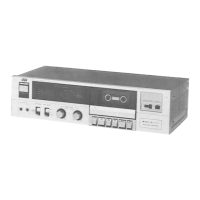
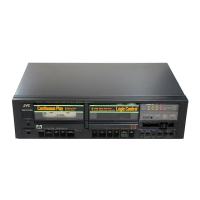
This document is a service manual for the JVC KD-A11 A/B/C/E/J/U Stereo Cassette Deck, providing comprehensive information for its maintenance, adjustment, and repair.
Function Description
The JVC KD-A11 is a stereo cassette deck designed for high-fidelity audio recording and playback. It incorporates an IC-built Dolby Noise Reduction System to minimize tape hiss and enhance sound quality, making it comparable to professional open-reel tapes. The deck features a METAPERM head for recording/playback and a 2-gap ferrite head for erasure, ensuring optimal performance across various tape types. An automatic input select feature simplifies operation.
Important Technical Specifications
- Type: Stereo cassette deck
- Track system: 4-track, 2-channel
- Tape speed: 1-7/8 inch/sec (4.8 cm/sec)
- Frequency response (0 VU recording):
- Metal tape: 40-11,000 Hz (±3 dB)
- SA/Chrome tape: 40-8,000 Hz (±3 dB)
- SF/Normal tape: 40-8,000 Hz (±3 dB)
- Frequency response (-20 VU recording):
- Metal tape: 30-16,000 Hz / 40-15,000 Hz (±3 dB)
- SA/Chrome tape: 30-16,000 Hz / 40-15,000 Hz (±3 dB)
- SF/Normal tape: 30-15,000 Hz / 40-14,000 Hz (±3 dB)
- All frequency responses surpass DIN 45 500.
- S/N ratio: 60 dB (from peak level, weighted, Metal tape). Improved by 5 dB at 1 kHz and 10 dB above 5 kHz with DOLBY N.R. on (DIN 45 500 weighted).
- Wow and flutter: 0.05% (WRMS), 0.15% (DIN 45 500)
- Crosstalk: 65 dB (1 kHz)
- Harmonic distortion: K3; 0.5%, THD; 1.0% (metal tape, 1 kHz 0 VU)
- Bias: AC bias
- Erasure: AC erasure
- Heads: 2 heads (METAPERM head for recording/playback and 2-gap ferrite head for erasure)
- Motor: Electronic governed DC motor
- Fast forward/Rewind time: 95 sec. with C-60 cassette
- Semiconductors: 3 ICs, 21 transistors, 17 diodes, 1 LED
- Input terminals:
- Mic jack x 2: Max. sensitivity; 0.2mV (-72 dBs), Matching impedance; 600Ω – 10kΩ
- Input jack x 2: Min. input level; 80mV (-20 dBs), Input impedance; 100kΩ
- Output terminals:
- Output jack x 2: Output level; 300mV, Output impedance; 5kΩ
- Phones jack x 1: Output level; 0.3mW (8Ω), Matching impedance; 8Ω – 1kΩ
- DIN socket: Min. input level; 0.1mV/kΩ, Input impedance; 10kΩ, Output level; 380mV, Output impedance; 5kΩ
- Power requirement:
- KD-A11A: AC 240V, 50Hz
- KD-A11B/C/E/J: AC 240/220/120V, 50/60Hz
- KD-A11U: AC 240/220/120/100V, 50/60 Hz
- Power consumption: 10W
- Dimensions: 16-1/2" (420 mm)W x 5-1/4" (134 mm)H x 10-3/8"(264mm)D
- Weight: 9.9 lbs (4.5 kg)
Usage Features
The KD-A11 offers user-friendly controls for recording and playback. Key controls include:
- VU meters: For monitoring audio levels.
- Recording indicator (REC): To show when the unit is in recording mode.
- Cassette holder: For easy loading and unloading of cassettes.
- Tape COUNTER/counter reset button: For tracking tape position and resetting the counter.
- POWER switch: To turn the unit on/off.
- PHONES jack: For private listening with headphones.
- MIC jacks: For connecting microphones.
- REC LEVEL controls: To adjust recording input levels.
- TAPE SELECT switch: A single lever 4-stage switch for selecting tape types (Metal, SA/Chrome, SF/Normal) to optimize recording and playback characteristics.
- Dolby noise reduction switch (DOLBY NR): To engage or disengage the Dolby Noise Reduction System.
- Cassette operation buttons: Including STOP/EJECT, REWIND, Record (REC), PLAY, FF (Fast Forward), and PAUSE.
- Voltage select switch: Available on KD-A11 B/C/E/J/U models for adapting to different power supplies.
- LINE IN (REC) terminals: For connecting external audio sources for recording.
- DIN (REC/PLAY) socket: A multi-purpose socket for both recording and playback connections.
- LINE OUT (PLAY) terminals: For connecting to an amplifier or other audio output devices.
- Power cord: For connecting to the mains power supply.
Maintenance Features
The manual emphasizes the importance of regular maintenance for long, trouble-free service.
- Cleaning:
- Heads: The REC/PB head and Erase head should be cleaned regularly using a head cleaning stick (moistened with alcohol if necessary) to prevent imperfect erasing, high-frequency drop-off, and noise.
- Pinch roller and capstan: These components should be cleaned using the same method as the heads to avoid unstable tape speed, wow, and flutter.
- Cabinet: Can be wiped with a soft cloth soaked in a neutral cleaning solution; thinners or benzine should not be used.
- Demagnetizing:
- Heads can become magnetized over time, leading to increased noise. A head demagnetizer should be used with care, ensuring the power switch is OFF and the demagnetizer tip is wrapped to prevent damage. The demagnetizer should be moved slowly across the head surface and gradually moved away before switching off. The erase head does not require demagnetization, but the capstan shaft and tape guide should be demagnetized.
- Metallic objects (e.g., screwdrivers) should be kept away from the heads to prevent magnetization.
- Removal of Main Parts: Detailed instructions are provided for disassembling various parts of the deck, including the cassette lid, top cover, control knobs, bottom cover, front plate, front panel, and mechanical assembly. This facilitates access for repairs and component replacement.
- Electrical Adjustments: The manual outlines procedures for adjusting playback level, VU meter sensitivity, recording bias current, and recording level using specific test tapes and measuring equipment (electronic voltmeter, audio frequency oscillator, attenuator).
- Mechanical Adjustments: Instructions are given for checking and adjusting motor speed, playback torque, fast forward torque, and rewind torque.
- Troubleshooting Wow and Flutter: A dedicated section provides a table for diagnosing and repairing common causes of increased wow and flutter, such as capstan shaft run-out, heavy flywheel rotation, rough pinch roller rotation, incorrect pinch roller angular position or pressure, undue belt run-out, dirty/slippery belt, irregular/strong back tension, and oily/dusty motor shaft/pulley.

 Need help?
 General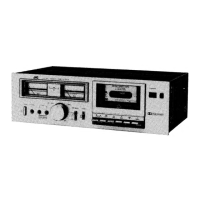

 To Next Page