EasyManua.ls Logo

JVC PC-X95B - Deck Adjustment

JVC PC-X95B
44 pages
Print Icon
To Next Page IconTo Next Page
To Previous Page IconTo Previous Page
Loading...
'C-X95ee/eewe
|
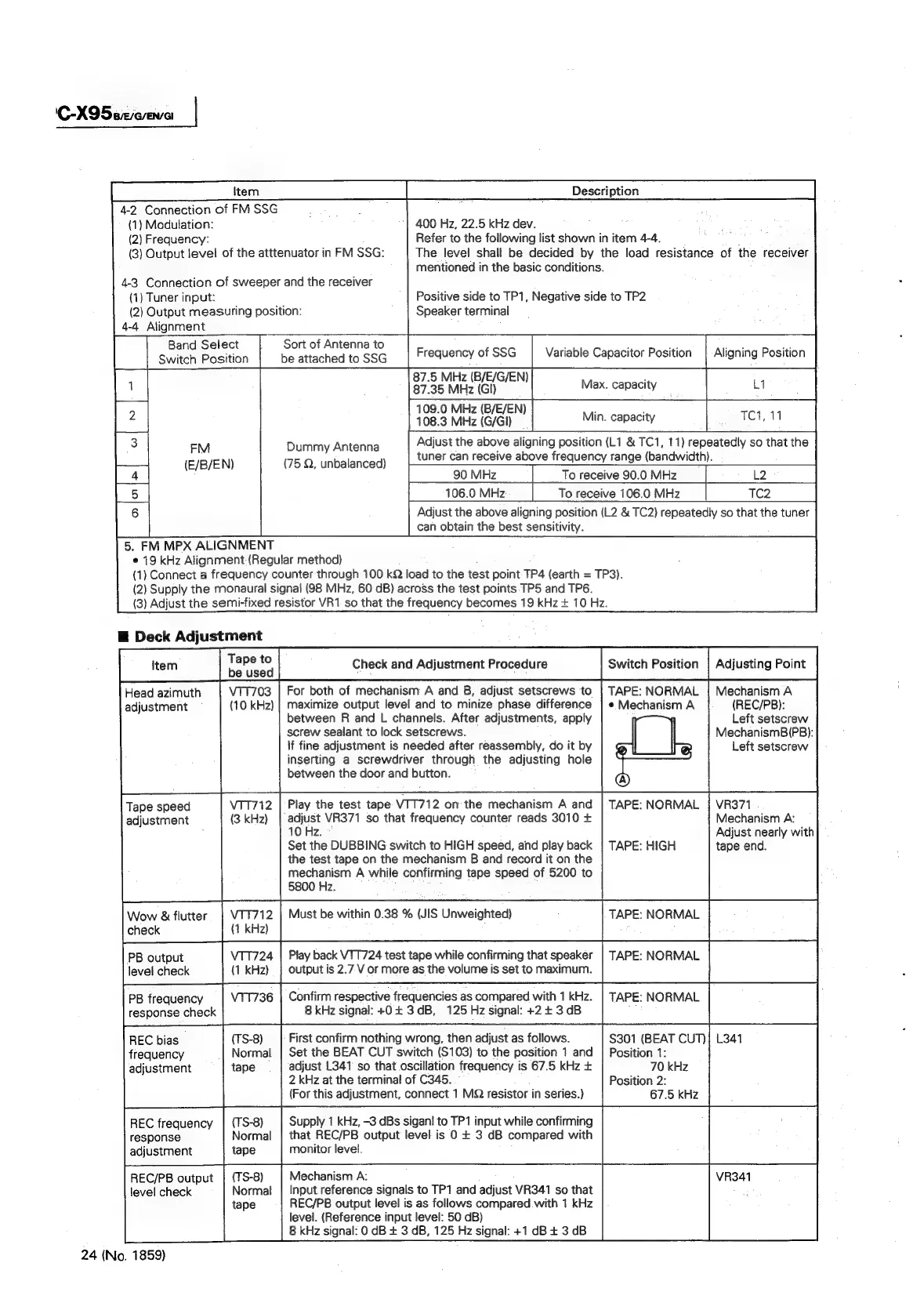
4-2
Connection
of
FM
SSG
;
oe
(1)
Modulation:
(2)
Frequency:
(3)
Output
level
of
the
atttenuator
in
FM
SSG:
400
Hz,
22.5
kHz
dev.
Refer
to
the
following
list
shown
in
item
4-4.
;
The
level shall
be
decided
by
the
load
resistance
of
the
receiver
mentioned
in
the
basic
conditions.
4-3
Connection
of
sweeper
and
the
receiver
(1)
Tuner
input:
(2)
Output
measuring
position:
4-4
Alignment
|
Band
Select
|
Sortof
Antenna
to
Switch
Position
be
attached
to
SSG
Positive
side
to
TP1,
Negative
side
to
TP2
Speaker
terminal
Frequency
of
SSG
Variable
Capacitor
Position
7.5
MHz
(B/E/G/EN
;
ersten
|
Macanscty
109.0
MHz
(B/E/EN)
108.3
MHz
(G/GI)
Adjust
the
above
aligning
position
(L1
&
TC1,
11)
repeatedly
so
that
the
tuner
can
receive
above
frequency
range
(bandwidth).
To
receive
90.0
MHz
To
receive
106.0
MHz
Adjust
the
above
aligning
position
(L2
&
TC2)
repeatedly
so
that
the
tuner
can
obtain
the
best
sensitivity.
Aligning
Position
Min.
capacity
_
Ct,
11
FM
Dummy
Antenna
(E/B/EN)
(75
Q,
unbalanced)
L2
5.
FM
MPX
ALIGNMENT
©
19
kHz
Alignment
(Regular
method)
(1)
Connect
a
frequency
counter
through
100
kQ
load
to
the
test
point
TP4
(earth
=
TP3).
(2)
Supply
the
monaural
signal
(98
MHz,
60
dB)
across
the
test
points
TP5
and
TP6.
(3)
Adjust
the
semi-fixed
resistor
VR1
so
that
the
frequency
becomes
19
kHz
+
10
Hz.
Check
and
Adjustment
Procedure
Adjusting
Point
Head
azimuth
VTT703
|
For
both
of
mechanism
A
and
B,
adjust
setscrews
to
|
TAPE:
NORMAL
|
Mechanism
A
adjustment
(10
kHz)
|
maximize
output
level
and
to
minize
phase
difference
|
«
Mechanism
A
(REC/PB):
between
R
and
L
channels.
After
adjustments,
apply
Left
setscrew
screw
sealant
to
lock
setscrews.
MechanismB(PB):
If
fine
adjustment
is
needed
after
reassembly,
do
it
by
3
3
Left
setscrew
inserting
a
screwdriver
through
the
adjusting
hole
between
the
door
and
button.
:
Ht
Deck
Adjustment
Tape
speed
VT1712
|
Play
the
test
tape
VTT712
on
the
mechanism
A
and
|
TAPE:
NORMAL
|
VR371
adjustment
adjust
VR371
so
that
frequency
counter
reads
3010
+
Mechanism
A:
i
10
Hz.
Adjust
nearly
with
Set
the
DUBBING
switch
to
HIGH
speed,
and
play
back
|
TAPE:
HIGH
tape
end.
the
test
tape
on
the
mechanism
B
and
record
it
on
the
mechanism
A
while
confirming
tape
speed
of
5200
to
5800
Hz.
Wow
&
flutter
|
V11712
|
Must
be
within
0.38
%
(JIS
Unweighted)
TAPE:
NORMAL
check
(1
kHz)
PB
output
V11724
|
Play
back
VIT724
test
tape
while
confirming
that
speaker
|
TAPE:
NORMAL
level
check
(1
kHz)
|
output
is
2.7
V
or
more
as
the
volume
is
set
to
maximum.
PB
frequency
V1TT736
|
Confirm
respective
frequencies
as
compared
with
1
kHz.
|
TAPE:
NORMAL
response
check
8
kHz
signal:
+0
£
3dB,
125
Hz
signal:
+2
+
3
dB
REC
bias
(TS-8)
First
confirm
nothing
wrong,
then
adjust
as
follows.
$301
(BEAT
CUT)|
L341
frequency
Normal
|
Set
the
BEAT
CUT
switch
(S103)
to
the
position
1
and
|
Position
1:
adjustment
tape
adjust
L341
so
that
oscillation
frequency
is
67.5
kHz
+
70
kHz
2
kHz
at
the
terminal
of
C345.
Position
2:
(For
this
adjustment,
connect
1
MQ
resistor
in
series.)
67.5
kHz
REC
frequency
Supply
1
kHz,
-3
dBs
sigan!
to
TP1
input
while
confirming
response
that
REC/PB
output
level
is
0
+
3
dB
compared
with
adjustment
monitor
level.
REC/PB
output
|
(TS-8)
Mechanism
A:
level
check
Normal
|
Input
reference
signals
to
TP1 and
adjust
VR341
so
that
tape
REC/PB
output
level
is
as
follows
compared
with
1
kHz
level.
(Reference
input
level:
50
dB)
8
kHz
signal:
0
dB
+
3
dB,
125
Hz
signal:
+1
dB
+
3
dB
24
(No.
1859)

Related product manuals