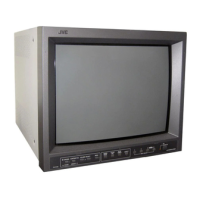
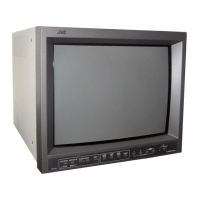
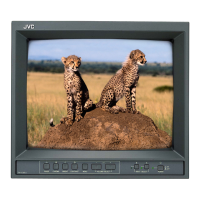
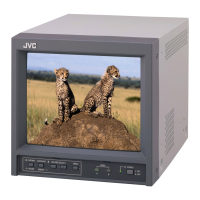
This document provides instructions for the JVC Color Video Monitor models TM-H1950CG and TM-H1750CG. It covers basic operations, menu functions, external control, and troubleshooting.
Safety Precautions
To ensure safe operation and prevent accidents, users should be aware of several warnings and precautions. The monitor should not be exposed to rain or moisture, and the back cover should not be removed due to dangerous high voltages inside. Servicing should only be performed by qualified personnel. This apparatus must be earthed.
The monitor complies with Machine Noise Information Ordinance 3. GSGV, January 18, 1991, with a sound pressure level at the operator position equal to or less than 70 dB(A) according to ISO 7779. Improper operations, such as altering high voltage or changing the tube type, may result in considerable X-ray emission, rendering the unit non-compliant with certification standards.
This monitor is equipped with a 3-blade grounding-type plug to satisfy FCC rules. If the plug cannot be inserted into an outlet, an electrician should be contacted.
For U.S.A. users, changes or modifications not approved by JVC could void the user's authority to operate the equipment. The equipment has been tested and found to comply with Class B digital device limits, providing reasonable protection against harmful interference in residential installations. If interference occurs, users are advised to reorient the receiving antenna, increase separation between equipment and receiver, connect the equipment to a different circuit, or consult a radio/TV technician.
This product contains a Cathode Ray Tube (CRT) and other components with lead. Disposal of these materials may be regulated by local communities due to environmental considerations. For disposal or recycling information, users can contact local authorities or the Electronics Industries Alliance.
General Precautions:
- Use only the specified power source (120 V AC/230 V AC, 50 Hz/60Hz).
- Disconnect the power plug from the AC outlet when not in use for extended periods or during cleaning.
- Do not allow anything to rest on the power cord, and avoid placing the unit where the cord might be stepped on. Overloading wall outlets or power cords can lead to fire or electric shock.
- Avoid using the unit in extremely hot, cold, or humid places; dusty places; near strong magnetic fields; in direct sunlight; in badly ventilated places; or in automobiles with closed doors.
- Do not cover ventilation slots during operation to ensure proper airflow.
- Clean the screen surface with a soft cloth when dust accumulates.
- Unplug the unit and refer servicing to qualified personnel if the power cord is frayed or damaged, if liquid has been spilled into the unit, if the unit has been dropped or the cabinet damaged, or if the unit exhibits a distinct change in performance.
- Do not attempt to service the unit yourself, as opening covers may expose you to dangerous voltage or other hazards.
- When replacement parts are required, ensure they have the same safety characteristics as the original parts to prevent fire, shock, or other hazards.
- After servicing or repair, ask service personnel to perform a safety check.
- Improper disposal at the end of the unit's useful life could result in a picture tube implosion. Qualified service personnel should dispose of the unit.
Power Connection
The monitor is designed for AC 120 V (U.S.A. and Canada) and AC 230 V (European countries or United Kingdom). The attached power cord conforms to the respective power supply voltage and countries. It is crucial to use the designated power cord to ensure safety and EMC regulations.
Warning: Do not use a power cord designed for AC 120 V with an AC 230 V supply, as this may cause malfunction, electric shock, or fire.
Note for United Kingdom Power Cord: The plug on the United Kingdom power cord has a built-in fuse. When replacing the fuse, use only a correctly rated, approved type and re-fit the fuse cover. Consult your dealer or qualified service personnel for assistance. To replace the fuse, open the fuse compartment with a blade screwdriver and replace the fuse.
Screen Burn
It is not recommended to display a static image or extremely bright images on the screen for long periods. This can cause a "burning" or "sticking" phenomenon on the cathode-ray tube. This issue does not occur with normal video playback motion images.
Supplementary Explanation for Monitor Operation:
This monitor uses a high-precision CRT. For stable operation, approximately 30 minutes of running time are required after power-on. When installed, the monitor can be affected by surrounding magnetic fields, which may cause irregular colors on the screen. If this is difficult to eradicate, degauss from outside using a degausser.
Controls and Features
Front View:
- Tally lamp: Lights when the tally control signal is ON, received via the REMOTE (external control) terminal.
- Chroma/Phase button [CHROMA/PHASE]: Activates picture color density adjustment mode or picture hue adjustment mode. Each press toggles between these items. Adjust values using VOLUME/SELECT buttons. Also functions as a control button in menu mode.
- Contrast/Brightness button [CONTRAST/BRIGHT]: Activates picture contrast adjustment mode or picture brightness adjustment mode. Each press toggles between these items. Adjust values using VOLUME/SELECT buttons. Also functions as a control button in menu mode.
- Volume/Select buttons [VOLUME/SELECT –/+]: Adjusts speaker volume. Also functions as a control button in menu mode.
- Menu button [MENU]: Displays and hides the
- Under Scan button [UNDER SCAN]: Reduces screen size to display the entire image. Press again to cancel. Lights when selected.
- Color Off button [COLOR OFF]: Cuts color signals to display a black and white image. Press again to restore color. Lights when selected. This function is invalid with RGB input.
- Blue Check button [BLUE CHECK]: Cuts red and green signal components, showing only blue. Press again to restore normal image. Lights when selected.
- Aspect button [ASPECT]: Changes aspect ratio between 4:3 and 16:9.
- Input A (VIDEO) button [INPUT SELECT A]: Selects video and audio signals from VIDEO A and AUDIO A terminals on the rear panel. Lights when selected.
- Input B (VIDEO Y/C) button [INPUT SELECT B]: Selects video and audio signals from VIDEO B or VIDEO B (Y/C) and AUDIO B terminals on the rear panel. Lights when selected.
- Note: VIDEO B terminals include a video terminal (BNC) and a Y/C terminal (mini-DIN 4-pin). The Y/C (S-video) terminal has priority.
- Input C/D (Slot) buttons [INPUT SELECT C/D (SLOT)]: Selects signals from input cards installed in the rear panel card slots. C and D select images from specific input cards.
- Power indicator:
- Unlit: Main power OFF.
- Orange: Main power ON, monitor in stand-by mode.
- Green: Main power ON, monitor in normal operation mode.
- Power switch [POWER]: Turns monitor power ON or OFF when main power is ON.
- Note: If RUSH DELAY is set to SLOW, power takes about three seconds to supply after the switch is pressed.
- Speaker: Built-in speaker located inside the right side panel.
Rear View:
- Input card slot (SLOT): For optional input cards, not provided with the monitor.
- REMOTE (external control) terminal: Connects to an external control unit for remote operation.
- Video A terminals [VIDEO A IN/OUT]: Video signal input (IN) and bridge-connected output (OUT) terminals. Input signal is automatically terminated if no cable is connected to OUT.
- Video B terminals [VIDEO B IN/OUT]: Video signal input (IN) and bridge-connected output (OUT) terminals. Input signal is automatically terminated if no cable is connected to OUT.
- Video B (Y/C) terminals [VIDEO B Y/C IN/OUT]: Y/C (S-video) signal input (IN) and bridge-connected output (OUT) terminals. Input signal is automatically terminated if no cable is connected to OUT.
- Audio A terminals [AUDIO A IN/OUT]: Input (IN) and bridge-connected output (OUT) terminals for audio signals corresponding to VIDEO A.
- Audio B terminals [AUDIO B IN/OUT]: Input (IN) and bridge-connected output (OUT) terminals for audio signals corresponding to VIDEO B or VIDEO B (Y/C).
- Main power switch: Turns main power ON or OFF. When ON, the front panel power indicator lights orange (stand-by mode).
- AC inlet [AC IN]: Power input connector for the AC power cord.
- Power cord: Connects to the AC IN connector.
- Caution: In North America, one power cable is provided. In Europe and the UK, two power cables are provided (one for continental European countries, one for the UK). Use the appropriate cable for your region.
COMPONENT/RGB INPUT CARD (OPTIONAL: IF-C01COMG):
- Video input/output terminals: Input (IN) and output (OUT) terminals for component (color difference) or RGB signals. Bridge-connected. Input signal automatically terminated if no cable is connected to OUT. Select component signal with INPUT SELECT C button, RGB signal with INPUT SELECT D button.
- Synchronized signal input/output terminals: Input (IN) and output (OUT) terminals for vertical, horizontal, or complex synchronized signals. External sync available only with RGB input. Bridge-connected. Input signal automatically terminated if no cable is connected to OUT. G on SYNC cannot be used with RGB input.
- Audio input/output terminals: Input (IN) and output (OUT) terminals for audio signals. Bridge-connected.
- Connection terminal (to a Color Video Monitor): Attaches to the monitor's connection terminal.
SDI INPUT CARD (OPTIONAL: IF-C01SDG):
- Output terminal for a selected component serial digital signal: Output terminal for a selected digital signal (displayed on screen). Cable-compensated. No digital signal output when monitor's main power is OFF. In standby mode, signal from SDI 1 terminal is output.
- Input terminals for component serial digital signals: Input terminals for the digital signal. Select SDI 1 with INPUT SELECT C button, SDI 2 with INPUT SELECT D button.
- Audio input/output terminals: Input (IN) and output (OUT) terminals for analog signals corresponding to SDI 1 and SDI 2. This input card cannot decode audio data from the input digital signal.
- Connection terminal (to a Color Video Monitor): Attaches to the monitor's connection terminal.
Note: The optional input cards IF-C01PNG, IF-C01HSDG, and IF-C12HSDG cannot be used with this device. Using them will void your warranty and may result in damage or malfunction.
Preparation
Installing the Input Card:
- Turn off the monitor's main power and unplug the power cable.
- Unscrew and remove the slot cover from the desired slot on the rear of the monitor.
- Insert the green-colored Input Card board into the slot, fitting it into the guide rails on the top and bottom.
- Push the Input Card until its front panel touches the monitor's rear panel.
- Secure the Input Card by replacing the screws removed in step 2.
Note: Do not touch the terminal connected to the monitor or board pattern. Do not remove slot covers from unused slots.
Attaching the Power Cord Holder:
The provided Power Cord Holder prevents accidental disconnection of the AC power cord. It consists of a case and a cover.
- Attach the Power Cord Holder case to the AC inlet on the back of the monitor using the 2 provided screws.
- Attach the Power Cord Holder cover to the AC power cord.
- Connect the AC power cord to the AC inlet, and join the Power Cord Holder cover with the case until it clicks.
Caution: A different plug shape will result in the cover being attached in a different position. Ensure the plug does not pull out after the cover is attached.
Note: To disconnect the power cord, click the tab to open the cover.
How to Handle Basic Operations
Basic Operation:
- Press the main power switch to turn on the power.
- Press the POWER switch to turn on the monitor.
- ON: Power indicator lights green (normal operation).
- OFF: Power indicator unlit.
- Orange: Main power ON, monitor in stand-by mode.
- Unlit: Main power OFF.
- Press the INPUT SELECT buttons to choose input. The selected button lights green.
- Input A (VIDEO): VIDEO A terminal, AUDIO A terminal.
- Input B (VIDEO/Y/C): VIDEO B terminal, VIDEO B (Y/C) terminal, AUDIO B terminal.
- Input C/D: Refer to page 7 for details on input cards.
- Note: The Y/C (S-video) terminal has priority.
- Press the VOLUME/SELECT buttons to adjust the speaker volume. The volume level (00-50) is displayed on screen. Screen indication disappears after about 10 seconds or when the MENU button is pressed.
Picture Adjustment:
- Press the select buttons corresponding to the item you want to adjust. The selected item is displayed on screen.
- Chroma control: Press CHROMA/PHASE once.
- Phase control: Press CHROMA/PHASE twice.
- Contrast control: Press CONTRAST/BRIGHT once.
- Brightness control: Press CONTRAST/BRIGHT twice.
- Pressing CHROMA/PHASE and CONTRAST/BRIGHT alternately while the item is shown on screen restores previous status. If no item is shown, CHROMA and CONTRAST have priority.
- Adjust with the VOLUME/SELECT buttons.
- CHROMA (Chroma): Lighter to deeper.
- PHASE (Phase): Reddish to greenish.
- CONTRAST (Contrast): Lower to higher.
- BRIGHT (Brightness): Darker to brighter.
- Screen indication disappears after about 10 seconds or when the MENU button is pressed.
Notes:
- Phase control is effective only in NTSC color system mode.
- Chroma control is not effective with RGB or B/W input (except for component signal input).
- When CHROMA is adjusted to "-40," the picture becomes less colorful.
- "NO EFFECT" is displayed for about 3 seconds if the selected function has no effect.
- To change the display position, set UPPER or LOWER with ADJ. BAR POSI.
Video Signal Controls
Under Scan:
Press the UNDER SCAN button to reduce the display area, showing the entire picture on screen. Use to check the picture frame.
Color Off:
Press the COLOR OFF button to display a black and white picture (luminance signal only). Use to check noise in the luminance signal or for white balance adjustment. No effect with RGB input.
Blue Check:
Input a standard color-bar signal for your TV system. Press the BLUE CHECK button to cut red and green signals, displaying only blue. This function adjusts and checks CHROMA (COLOR) GAIN and PHASE. Ensure COMPO. LEVEL has been initialized when a component signal is input.
Procedure for Blue Check:
- Input standard color-bar signal.
- Press BLUE CHECK button.
- Adjust chroma with CHROMA button so left and right blue bars have same brightness.
- (NTSC only) Adjust phase with PHASE button so two center blue bars have same brightness.
- (NTSC only) Repeat steps 3 and 4 until all four blue bars have same brightness.
- Press BLUE CHECK button to deactivate.
Initializing COMPO. LEVEL (with IF-C01COMG card):
When a component signal is input, adjust (initialize) the COLOR offset in COMPO. LEVEL.
Procedure for Initializing COMPO. LEVEL:
- Input standard color-bar signal.
- Press BLUE CHECK button.
- Select COMPO. LEVEL in the
- Quit
- Ensure left and right blue bars have same brightness.
- Repeat steps 3, 4, and 5 for adjustment.
Display and Selection in the
You can set various menu items: APERTURE, ADJ. BAR POSI., COLOR TEMP., COLOR SYSTEM, COMPO. LEVEL, RUSH DELAY.
- Press the MENU button to display the
- Press the CHROMA/PHASE or CONTRAST/BRIGHT button to select menu items. A selection mark (►) appears next to the selected item.
- CHROMA/PHASE: Moves selection mark forward.
- CONTRAST/BRIGHT: Moves selection mark backward.
- Press the VOLUME/SELECT buttons to set values.
- VOLUME/SELECT (+): Increases value, moves setting forward.
- VOLUME/SELECT (-): Decreases value, moves setting backward.
Menu Items and Settings:
- APERTURE: Picture aperture level (00 to +40).
- ADJ. BAR POSI: Volume bar position (LOWER, UPPER).
- COLOR TEMP: Color temperature of white balance (6500, 9300).
- COLOR SYSTEM: Color system (AUTO, NTSC, PAL). For normal use, set to AUTO. If reception is unsatisfactory, set to NTSC or PAL.
- COMPO. LEVEL: Component level (-40 to +10). Displayed only with component serial digital (SDI) input.
- RUSH DELAY: Delay time (STD., SLOW).
- STD.: Power turns on in approximately 1 second.
- SLOW: Power turns on in approximately 3 seconds.
- Recommended for multiple monitors to reduce rush current.
- Repeat steps 2 and 3 to set other menu items.
- Press the MENU button to quit.
Display and Selections in the Mode (Setting)
You can set additional set-up menu items: PICTURE SUB ADJ., H. POSITION, V. POSITION, WHITE BALANCE, CONTROL LOCK, STATUS DISPLAY, REMOTE SYSTEM, INPUT REMOTE.
Notes:
- Parameters for PICTURE SUB ADJ., H. POSITION, and V. POSITION can be set separately for each input (VIDEO A, VIDEO B, INPUT C, INPUT D). Select the desired video input first.
- WHITE BALANCE can be set independently at 6500 or 9300. Set COLOR TEMP. in the
- INPUT REMOTE is shown only when REMOTE SYSTEM is set to MAKE.
- While pressing the MENU button, press the CHROMA/PHASE button to display the screen. The screen disappears automatically after about five minutes of inactivity.
- Press the CHROMA/PHASE or CONTRAST/BRIGHT button to select the desired menu item. A selection mark (►) appears next to the selected item.
- Press the VOLUME/SELECT buttons to set values.
- VOLUME/SELECT (+): Increases value, moves setting forward.
- VOLUME/SELECT (-): Decreases value, moves setting backward.
Set-up Menu Items and Settings:
- PICTURE SUB ADJ.: Image sub adjustment. Selects CONTRAST/BRIGHT/CHROMA/PHASE.
- CONTRAST: Adjusts contrast (-10 to +10).
- BRIGHT: Adjusts brightness (-10 to +10).
- CHROMA: Adjusts color density (-10 to +10).
- PHASE: Adjusts hue (-10 to +10).
- H. POSITION: Adjusts horizontal position (-5 to +5).
- V. POSITION: Adjusts vertical position (-5 to +5).
- WHITE BALANCE: Adjusts white balance. Selects DRIVE or CUT OFF adjustment.
- R. DRIVE: Adjusts red level (-20 to +20).
- B. DRIVE: Adjusts blue level (-20 to +20).
- R. CUT OFF: Adjusts red cut off (-20 to +20).
- G. CUT OFF: Adjusts green cut off (-20 to +20).
- B. CUT OFF: Adjusts blue cut off (-20 to +20).
- CONTROL LOCK: Sets front panel button operation to lock mode (OFF, ON).
- When ON, "CONTROL LOCK ON!" message appears for 3 seconds.
- Lock is maintained even when power is turned off.
- To turn off, hold MENU and press CHROMA/PHASE.
- Power switch, volume control, and display are still available when locked.
- STATUS DISPLAY: Sets status display of color system (OFF, ON).
- REMOTE SYSTEM: Sets external control function method (MAKE, TRG.).
- INPUT REMOTE: Sets external control of input selection (A-D, A/B). Shown only when REMOTE SYSTEM is MAKE.
- Repeat steps 2 and 3 for other set-up menu items.
- Press the MENU button to quit.
How to Initialize the Setting
You can reset
- Press the Power (✔) switch to turn the power OFF (activate stand-by mode).
- While pressing both MENU and CHROMA/PHASE buttons, press the Power (✔) switch to turn the power ON. The RESET screen is displayed.
- Note: If MENU or CHROMA/PHASE buttons are pressed for a very short time, the RESET screen will not appear. Keep pressing until it appears.
- Setting:
- To initialize: Press the VOLUME/SELECT [+] button. Initialization is completed, and the RESET screen disappears.
- To abort initialization: Press the MENU button. Initialization is aborted, and the RESET screen disappears.
Basic Connection Example
Notes:
- Turn off all units before connecting.
- Terminal connections may vary by component. Refer to unit instructions.
- Input (IN) and output (OUT) terminals are bridge-connected.
- If no equipment is connected to a bridged output (OUT) terminal, do not connect other cables to it, as this opens the terminating resistance switch.
- For bridge connections, connect IN and OUT terminals on the monitor to separate video components. Connecting to the same VCR may cause resonance (not a malfunction during playback).
- Select video input (INPUT A (VIDEO) or INPUT B (VIDEO/Y/C)) with front panel INPUT SELECT buttons. Y/C terminal has priority if both VIDEO B terminals are connected.
VIDEO A Connection Example (Select Input A (VIDEO)):
Connect a video camera to VIDEO A IN. Connect VIDEO A OUT to a VCR IN, and VCR OUT to a video monitor. Connect audio from the video camera to AUDIO A IN, and AUDIO A OUT to the VCR IN, and VCR OUT to the video monitor.
VIDEO B (VIDEO) Connection Example (Select Input B (VIDEO)):
Connect a video camera to VIDEO B IN. Connect VIDEO B OUT to a VCR IN, and VCR OUT to a video monitor. Connect audio from the video camera to AUDIO B IN, and AUDIO B OUT to the VCR IN, and VCR OUT to the video monitor.
VIDEO B (Y/C) Connection Example (Select Input B (Y/C)):
Connect a video camera to VIDEO B Y/C IN. Connect VIDEO B Y/C OUT to a VCR IN, and VCR OUT to a video monitor. Connect audio from the video camera to AUDIO B IN, and AUDIO B OUT to the VCR IN, and VCR OUT to the video monitor.
How to Use External Control
This monitor has an external control terminal. MAKE (make contact) or TRIG. (trigger) system can be selected via REMOTE SYSTEM in the .
- MAKE (make contact system): Function is controlled by short-circuiting or disconnecting each control terminal with pin 15 (GND).
- TRG. (trigger system): Function is controlled by short-circuiting with pulses (approx. 1 second) with pin 15 (GND).
Notes:
- Pin 14 (REMOTE ENABLE) is controlled with MAKE, even if TRG. is selected.
- Pin 1 (TALLY) is always controlled by MAKE, regardless of REMOTE ENABLE or REMOTE SYSTEM settings.
- When external control is active, front panel buttons (INPUT-A to D, UNDER SCAN, COLOR OFF, ASPECT) are disabled for MAKE system.
Connections:
Connect (short-circuit) the 15th terminal (GND) to terminals 1-14 in the 3-lines 15-pins D-sub connector.
Terminal Functions (Operations OFF → ON):
- 1 TALLY: Puts on the tally lamp (Put off → Put on).
- 2 INPUT A: Changes input to INPUT A (Not change → Change).
- 3 INPUT B: Changes input to INPUT B (Not change → Change).
- 4 INPUT C: Changes input to INPUT C (Not change → Change).
- 5 INPUT D: Changes input to INPUT D (Not change → Change).
- 6, 7, 9, 12, 13: Not used.
- 8 COLOR OFF: Changes picture black-and-white (Not change → Change).
- 10 ASPECT: Changes screen ratio to 16:9 (4:3 → 16:9).
- 11 UNDER SCAN: Makes screen under-scan (Over-scan → Under-scan).
- 14 REMOTE ENABLE: Makes external control valid or invalid (Invalid → Valid).
- 15 GND: Used as a ground terminal.
Notes:
- "OFF" is disconnection, "ON" is short-circuit.
- For INPUT REMOTE A/B setting, "OFF" means INPUT A, "ON" means INPUT B.
- When INPUT REMOTE is A/B, unused pins should not be connected.
- Setting REMOTE ENABLE to ON enables external control.
- INPUT REMOTE setting (MAKE system only):
- 4-pin control: Switches input by short-circuiting a specified signal line in INPUT A to D.
- 1-pin control: Switches between INPUT-A and INPUT-B only with pin 2.
- When multiple terminals (INPUT A-D) are selected under MAKE, input is prioritized alphabetically (A, B, C, D).
- For MAKE system, use an interlock switch for INPUT A-D control.
- For TRG. system, use a return switch for INPUT A-D control.
Troubleshooting
This section describes solutions to common problems. If issues persist, unplug the monitor and consult a JVC-authorized dealer or service center.
Problems and Solutions:
- No power supply:
- Power plug loose/disconnected? Firmly insert plug.
- Main power OFF? Turn main power ON (page 6).
- No picture with power on:
- Video signal output from connected component? Set component correctly.
- Input signal selected properly? Select required video input (page 10).
- Video cable disconnected? Connect video cable firmly (pages 16, 17).
- No sound:
- Audio signal output from connected component? Set component correctly.
- Volume output set to minimum? Adjust speaker volume (page 10).
- Audio cable disconnected? Connect audio cable firmly (pages 16, 17).
- Shaking picture:
- Monitor near strong magnetic field? Move device away until picture stabilizes.
- No colors, wrong color, or dark picture:
- Color system selected properly? Set COLOR SYSTEM to AUTO in
- Picture control setting changed (CONTRAST, BRIGHT, CHROMA, PHASE)? Set controls to standard (page 9). Adjust with COLOR OFF and BLUE CHECK (page 11).
- Unnatural, irregularly colored, or distorted picture:
- Monitor near speaker, magnet, or other device generating strong magnetic field? Move device away, turn monitor off for 30 minutes, then turn on again.
- Dark stripes at top/bottom, picture vertically squeezed:
- Aspect ratio set to 16:9? Switch aspect ratio to 4:3 with ASPECT button.
- Overall picture size too small:
- UNDER SCAN button pressed? Press UNDER SCAN button to turn off.
- Function buttons on front panel do not function:
- Control of buttons locked (CONTROL LOCK ON)? Set CONTROL LOCK to OFF in (pages 13, 14).
- INPUT SELECT buttons do not function:
- Input selection under external control (REMOTE ENABLE valid)? Set REMOTE ENABLE to OFF (invalid) (page 18).
Not Malfunctions:
- Colored still images: A bright still image (e.g., white cloth) displayed for a long time may appear colored due to CRT structure. This will disappear when another image is displayed.
- Mild electric shock: A mild electric shock when touching the picture tube is due to normal static electricity buildup on the CRT and is not harmful.
- Strange sound: The monitor emits a strange sound when room temperature changes suddenly. This is only a problem if an abnormality appears on screen.
- Shaking/distorted images with multiple monitors: If two or more monitors are operated next to each other, their images may shake or be distorted due to mutual interference. Move monitors apart or turn off unused monitors.
- To use the SWITCHED OUT terminal, the main power must be ON. This connector outputs relocked digital signals, unlike a bridged output.
- Signal output from the SWITCHED OUT terminal can be changed by selecting INPUT C (SDI 1) or INPUT D (SDI 2) via front panel buttons or external control.
- When INPUT-A or INPUT-B is selected, this terminal outputs the last selected signals.
- In standby mode, signals from the SDI 1 connector are output.
Y/C (Mini DIN 4 pin) terminal specification:
- Pin 1: GND (Y)
- Pin 2: GND (C)
- Pin 3: Y
- Pin 4: C


 To Next Page

 General