EasyManua.ls Logo

Kantronics KPC-4 - Page 44

Default Icon
72 pages
Print Icon
To Next Page IconTo Next Page
To Previous Page IconTo Previous Page
Loading...
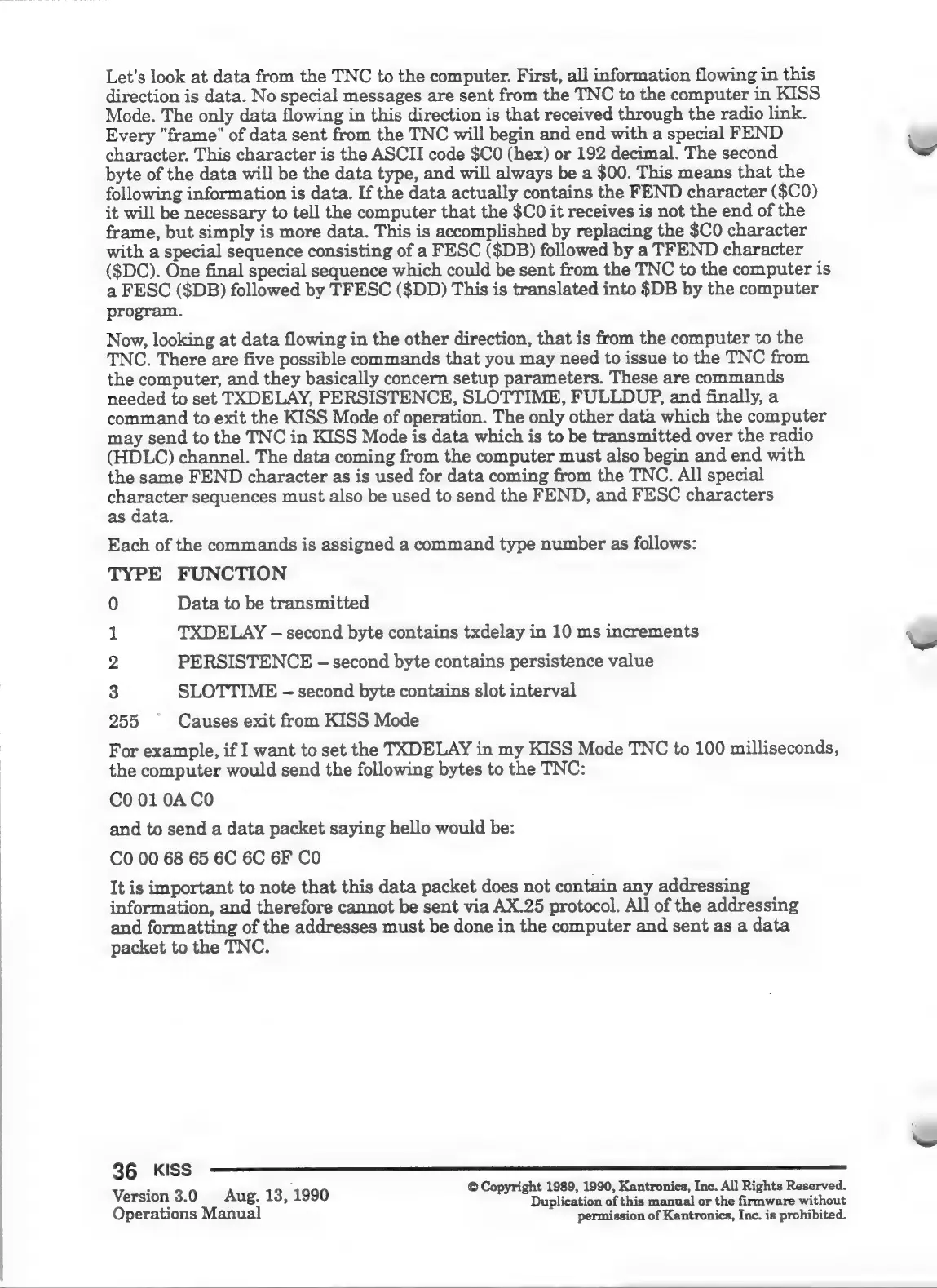
Let's
look
at
data
from
the
TNC
to
the
computer.
First,
all
information
flowing
in
this
direction
is
data.
No
special
messages
are
sent
from
the
TNC
to
the
computer
in
KISS
Mode.
The
only
data
flowing
in
this
direction
is
that
received
through
the
radio
link.
Every
"frame"
of
data
sent
from
the
TNC
will
begin
and
end
with
a
special
FEND
character.
This
character
is
the
ASCII
code
$C0
(hex)
or
192
decimal.
The
second
byte
of
the
data
will
be
the
data
type,
and
will
always
be
a
$00.
This
means
that
the
following
information
is
data.
If
the
data
actually
contains
the
FEND
character
($C0)
it
will
be
necessary
to
tell
the
computer
that
the
$C0
it
receives
is
not
the
end
of
the
frame,
but
simply
is
more
data.
This
is
accomplished
by
replacing
the
$C0
character
with
a
special
sequence
consisting
of
a
FESC
($DB)
followed
by
a
TFEND
character
($DC).
One
final
special
sequence
which
could
be
sent
from
the
TNC
to
the
computer
is
a
FESC
($DB)
followed
by
TFESC
($DD)
This
is
translated
into
$DB
by
the
computer
program.
Now,
looking
at
data
flowing
in
the
other
direction,
that
is
from
the
computer
to
the
TNC.
There
are
five
possible
commands
that
you
may
need
to
issue
to
the
TNC
from
the
computer,
and
they
basically
concern
setup
parameters.
These
are
commands
needed
to
set
TXDELAY,
PERSISTENCE,
SLOTTIME,
FULLDUP,
and
finally,
a
command
to
exit
the
KISS
Mode
of
operation.
The
only
other
data
which
the
computer
may
send
to
the
TNC
in
KISS
Mode
is
data
which
is
to
be
transmitted
over
the
radio
(HDLC)
channel.
The
data
coming
from
the
computer
must
also
begin
and
end
with
the
same
FEND
character
as
is
used
for
data
coming
from
the
TNC.
All
special
character
sequences
must
also
be
used
to
send
the
FEND,
and
FESC
characters
as
data.
Each
of
the
commands
is
assigned
a
command
type
number
as
follows:
TYPE
FUNCTION
0
Data
to
be
transmitted
1
TXDELAY
-
second
byte
contains
txdelay
in
10
ms
increments
2
PERSISTENCE
-
second
byte
contains
persistence
value
3
SLOTTIME
-
second
byte
contains
slot
interval
255
`
Causes
exit
from
KISS
Mode
For
example,
if
I
want
to
set
the
TXDELAY
in
my
KISS
Mode
TNC
to
100
milliseconds,
the
computer
would
send
the
following
bytes
to
the
TNC:
CO
01
0A
CO
and
to
send
a
data
packet
saying
hello
would
be:
CO
00
68 65
6C
6C
6F
CO
It
is
important
to
note
that
this
data
packet
does
not
contain
any
addressing
information,
and
therefore
cannot
be
sent
via
AX.25
protocol.
All
of
the
addressing
and
formatting
of
the
addresses
must
be
done
in
the
computer
and
sent
as
a
data
packet
to
the
TNC.
A
_
—_—
_——
___——______
—_—
E
AAAOAOAOS—Á
.
E
©
Copyright
1989,
1990,
Kantronics,
Inc.
All
Rights
Reserved.
Version
3.0
Aug.
13,
1990
Duplication
of
this
manual
or
the
firmware
without
Operations
Manual
permission
of
Kantronics,
Inc.
is
prohibited.

Related product manuals