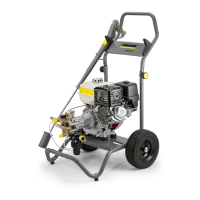
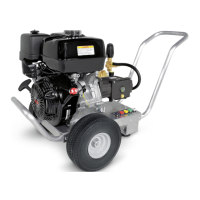
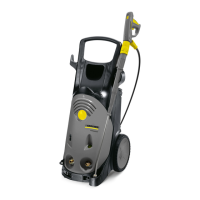
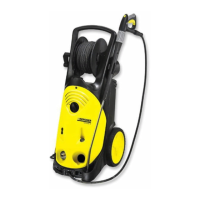
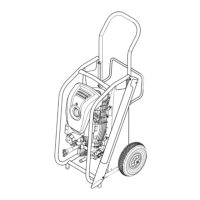
This document is an operator's manual for a series of pressure washers manufactured by KNA, Inc. It provides essential information for the safe and effective operation, maintenance, and troubleshooting of these devices. The manual covers several models, including HD 2.0/1000 Ed, HD 1.9/1300 Ed, HD 3.0/1000 Ed, HD 3.5/2000 Ea, and HD 1.8/1300 Ed, each with a specific order number (1.106-124.0, 1.106-125.0, 1.106-126.0, 1.106-127.0, and 1.106-128.0, respectively).
Function Description
The device is a pressure washer designed for cleaning various surfaces using high-pressure water. It operates by drawing water from a cold water source, pressurizing it through a pump, and then discharging it through a spray gun and wand with interchangeable nozzles. The machine is capable of applying detergents at low pressure for enhanced cleaning. A key safety feature is the unloader, which relieves pressure when the spray gun trigger is closed, preventing internal pump damage. The pump protector further safeguards the pump by cycling fresh cool water when recirculating water reaches 140°F.
Important Technical Specifications
While specific pressure (PSI) and flow rate (GPM) values are not explicitly listed for each model, the nozzle sizing (e.g., 1503.5, 2503.5, 4003.5 for HD 2.0/1000 Ed) implies varying performance characteristics. The high-pressure hose is specified as 3/8" x 50' 1W 4000PSI SW X SO, indicating a robust hose suitable for high-pressure applications up to 4000 PSI. The pump oil recommended is non-foaming SAE 10W-40. Electrical grounding is critical, with machines rated 250 volts or less, single phase, requiring a Ground Fault Circuit Interrupter (GFCI). For ratings above 250 volts or more than single phase, connection to a GFCI-protected power supply receptacle is mandatory. Inlet water must be clean, fresh, and no hotter than 90°F.
Usage Features
The pressure washer is designed for user-friendly operation with several features:
- Quick Connect Nozzles: The device includes four color-coded quick connect nozzles (black for soap, white 40°, green 25°, yellow 15°, and red 0°) that provide a wide array of spray widths. These are conveniently stored in a rubber nozzle holder on the front of the machine.
- Detergent Application: The machine allows for the application of detergents at low pressure using a dedicated black nozzle and a detergent injector system.
- Safety Latch: The spray gun is equipped with a safety latch to prevent accidental triggering.
- Thermal Pump Protection: An automatic system engages to cool the pump by discharging warm water if the circulating water reaches high temperatures (140°F) when the spray gun trigger is not pressed for 1-2 minutes.
- GFCI Protection: The power cord includes a GFCI to protect against electrical shock by tripping if voltage leaks to ground.
- Assembly: The manual provides clear, step-by-step instructions for assembling the pressure washer, including connecting the high-pressure hose, wand, nozzles, garden hose, and detergent injector.
Maintenance Features
The manual outlines a comprehensive maintenance schedule to ensure the longevity and optimal performance of the pressure washer:
- Pump Oil: Daily inspection of the oil level is recommended. Oil changes are required after the first 50 hours, then every 500 hours or annually. Non-foaming SAE 10W-40 pump oil is specified.
- High Pressure Nozzle: Replacement is recommended every 6 months.
- Quick Connects: Annual replacement is advised.
- Water Screen/Filter: Weekly cleaning is necessary.
- HP Hose: Annual replacement if there is any sign of wear.
- Grease Motor: Lubrication is recommended every 10,000 hours.
- Detergent System Flush: After each use, the detergent injection system must be flushed with clean water for 1-2 minutes to prevent damage.
- Freeze Protection: Critical instructions are provided for protecting the machine from freezing temperatures (below 32°F/0°C) by draining all water from the pump, wand, and hoses. Freeze damage is not covered by warranty.
- Troubleshooting Guide: A detailed troubleshooting section helps users diagnose and resolve common issues such as low pressure, fluctuating pressure, pump noise, water leaks, and motor problems.
- Oil Change Record: A dedicated section is provided for recording oil change dates and estimated operating hours since the last change, facilitating adherence to the maintenance schedule.

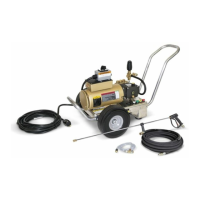

 To Next Page

 General