Need help?
Do you have a question about the Kathrein 80010735V01 and is the answer not in the manual?
Details on iRCU connector types, pin assignments, and hardware interface specifications.
Summary of iRCU adjustment time, cycles, temperature range, and protection classes.
Details on mast diameter, antenna-mast distance, material, and weight of the clamp.
Guidance on connecting control cables to the iRCU, including torque specifications.
Step-by-step instructions for replacing the iRCU unit, including safety warnings.
Description and visual identification of the bottom end cap components.
Instructions for installing the feederline connector using a torque-wrench.
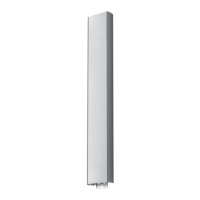
This document describes the Kathrein 80010735V01, a 2-Port Antenna with an Integrable Remote Control Unit (iRCU), designed for cellular communication systems. The antenna supports dual polarization (+45°, -45°) and operates across a frequency range of 698-894 MHz. Its integrated iRCU allows for remote control of the electrical downtilt, enhancing network optimization and reducing the need for manual adjustments.
The Kathrein 80010735V01 is a base station antenna designed to transmit and receive radio signals within the 698-894 MHz frequency band. Its primary function is to provide reliable coverage for cellular networks. A key feature is the integrated Remote Control Unit (iRCU), model 86010149, which enables operators to remotely adjust the antenna's electrical downtilt from 0° to 10°. This remote adjustability is crucial for optimizing network performance, managing interference, and adapting to changing traffic demands without requiring physical access to the antenna. The iRCU is field-replaceable without dismantling the entire antenna, simplifying maintenance. The antenna supports AISG 1.1 and 3GPP/AISG 2.0 protocols, ensuring compatibility with various remote electrical tilt (RET) systems. The daisy chain capability of the iRCU allows multiple antennas to be controlled from a single connection point, further streamlining network management.
The 80010735V01 antenna with its integrated iRCU offers several usage advantages. The continuous electrical downtilt adjustment from 0° to 10° allows for precise beam shaping, which is critical for optimizing coverage, minimizing interference, and adapting to varying network demands. The iRCU's compatibility with AISG 1.1 and 3GPP/AISG 2.0 protocols ensures broad interoperability with existing RET systems, facilitating seamless integration into diverse network infrastructures. The daisy chain functionality simplifies cabling and control for multiple antennas, reducing installation complexity and cost. The antenna's robust construction, including weather-proof aluminum and UV-resistant fiberglass radome, ensures reliable operation in harsh environmental conditions. The color-coded RF inputs on dual-band antennas help in correctly correlating each RF input to its corresponding iRCU, frequency range, and polarization, preventing installation errors. The antenna is supplied with mounting clamps suitable for mast diameters of 42-115 mm (1.7-4.5 inches), with optional clamps available for larger mast sizes.
Maintenance of the 80010735V01 is designed for ease and efficiency. The iRCU (86010149) is field-replaceable, meaning it can be exchanged without needing to dismantle the entire antenna. This significantly reduces downtime and simplifies repair procedures. The logical interface protocol of the iRCU can be switched between 3GPP/AISG 2.0 and AISG 1.1 via vendor-specific commands, offering flexibility for network upgrades or changes in RET system standards. When installing or removing control cables, it is important to turn only the threaded collar of the connector, not the body, to prevent permanent damage. Connectors should be hand-tightened to a torque of 0.5-1.0 Nm; over-tightening with wrenches or pliers can damage the iRCU. The antenna's metal parts, including the mounting kit and inner conductors, are DC grounded, ensuring safety. Regular checks of the retaining screw for the iRCU are important, as proper torque (2.5-3.0 Nm) is mandatory for earthing the iRCU to the reflector screen. The robust materials used in the antenna's construction, such as stainless steel screws and nuts, contribute to its longevity and reduce the need for frequent component replacement. The device complies with FCC Standards, ensuring it does not cause harmful interference and accepts any interference received.

 To Next Page
 General