
 Need help?
Do you have a question about the Kenmore 110.42822200 and is the answer not in the manual?
Explains safety alert symbols, hazard levels like DANGER and WARNING, and their meanings.
Details critical electrical safety precautions, including grounding and avoiding adapters or extension cords.
Lists necessary tools, parts, and general requirements before starting washer installation.
Details power supply specifications, outlet requirements, and proper grounding methods.
Instructions for removing shipping bolts and warnings about heavy weight.
Step-by-step guide for connecting hot and cold water inlet hoses to the washer.
Explains the function, location, and input/output of the CCU.
Procedures for removing the main control box and the pressure switch.
Procedures for removing the heating element and temperature sensor.
Detailed steps for removing the entire tub and drum assembly.
Tests continuity of the pressure switch at various water levels.
Tests resistance of the temperature sensor at different temperatures.
Explains how the washer detects suds during drain and spin cycles.
Details the checks performed to detect and manage load unbalance during spin.
Explains causes and procedures for the F/H error code.
Explains causes and procedures for the F/02 error code (long drain time).
Explains causes and procedures for the F/05 error code (temperature sensor error).
Explains causes and procedures for F/06 error (motor tachometer).
Explains causes and procedures for F/07 error (MCU error).
Explains causes and procedures for F/09 error (overflow condition).
Explains causes and procedures for F/10 error (MCU thermal trip).
Explains causes and procedures for F/11 error (communication error).
Explains causes and procedures for F/13 error (dispenser circuit).
Explains causes and procedures for F/14 error (EEPROM data error).
Explains causes and procedures for F/15 error (MCU multiple resets).
Explains causes and procedures for SuD error (excessive suds detected).
Explains causes and procedures for F/dL error (door cannot be locked).
Explains causes and procedures for F/dU error (door cannot be unlocked).
Steps to enter and start the washer's diagnostic test mode.
Common causes and tests for power, start, and operation problems.
Common causes and tests for dispensing and filling problems.
Common causes and tests for overfilling and drum rotation issues.
Common causes and tests for motor overheating and draining problems.
Common causes and tests for vibration and incorrect water temperature.
Wiring diagram showing connections between the CCU, motor control, and other components.
 General
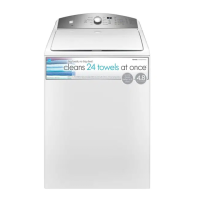
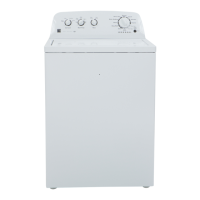
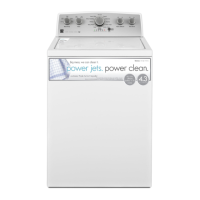
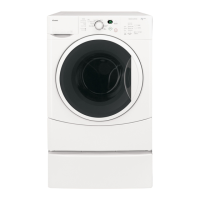
| Brand | Kenmore |
|---|---|
| Model Number | 110.42822200 |
| Color | White |
| Energy Star Certified | Yes |
| Spin Speed | 700 RPM |
| Agitator Type | Dual Action Agitator |
| Water Temperature Settings | 5 |
| Voltage | 120V |
| Type | Washer |
| Width | 27 inches |
| Depth | 27 inches |
| Cycles | Delicates, Drain & Spin, Heavy Duty, Normal, Quick Wash, Rinse & Spin, Soak |



 To Next Page