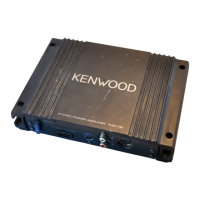
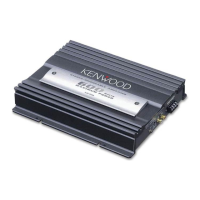
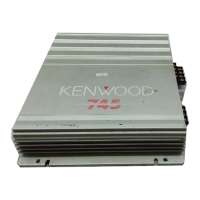
This document is an instruction manual for the Kenwood KAC-726 and KAC-526X Power Amplifiers. It provides essential information for safe installation, operation, and maintenance of these car audio components.
Function Description
The Kenwood KAC-726 and KAC-526X are power amplifiers designed to enhance the audio system in a vehicle. They amplify audio signals from a center unit (such as a cassette receiver or CD receiver) to drive speakers, providing higher power output and improved sound quality. The amplifiers feature various controls and switches to tailor the sound output to specific speaker configurations and user preferences.
Key functions include:
- Signal Amplification: Takes low-level audio signals from a head unit and amplifies them to drive speakers.
- Filtering: Equipped with a FILTER switch that allows selection between LPF (Low Pass Filter) and OFF positions. The LPF setting outputs frequencies of 80 Hz or lower, mixing the Lch and Rch signals before output. The OFF position outputs the original sound without filtering.
- Operation Mode Selection: An OPERATION switch allows selection between STEREO and MONO (Lch) amplification methods. STEREO mode uses the amplifier as a stereo amplifier, while MONO (Lch) amplifies only the left-side input signal, suitable for bridged connections as a high-power monaural amplifier.
- Input Sensitivity Adjustment: An INPUT SENSITIVITY control allows users to match the amplifier's input level to the pre-output level of the center unit or the maximum power output of a genuine-accessory car stereo. This ensures optimal signal matching and prevents distortion.
- Protection Function: The unit incorporates a protection circuit that safeguards the amplifier and connected speakers from various issues, such as speaker output contacting ground, unit malfunctions (DC signal output), internal overheating (exceeding 120°C/248°F), or improper grounding. When triggered, the Power indicator turns off, and the amplifier ceases operation.
Important Technical Specifications
The specifications differ slightly between the KAC-726 and KAC-526X models, primarily in power output and current consumption.
Audio Section:
- Max Power Output (4 Ω):
- KAC-726: Normal: 200 W x 2; Bridge: 600 W x 1
- KAC-526X: Normal: 70 W x 2; Bridge: 200 W x 1
- Rated Power Output (4 Ω, DIN45324, +B=14.4 V):
- KAC-726: Normal: 100 W x 2; Bridge (1 kHz, 0.8 % THD): 300 W x 1
- KAC-526X: Normal: 35 W x 2; Bridge (1 kHz, 0.8 % THD): 100 W x 1
- Rated Power Output (2 Ω, 1 kHz, 0.8 % THD):
- KAC-726: Normal: 150 W x 2
- KAC-526X: Normal: 50 W x 2
- Frequency Response (+0, −1 dB): 5 Hz ~ 50 kHz (both models)
- Signal to Noise Ratio: 100 dB (both models)
- Sensitivity (MAX) (rated output): 0.2 V (both models)
- Sensitivity (MIN) (rated output): 5.0 V (both models)
- Input Impedance: 10 kΩ (both models)
- Low Pass Filter (12 dB/oct.): 80 Hz (both models)
General:
- Operating Voltage: 11 ~ 16 V allowable (both models)
- Current Consumption (1 kHz, 10% THD):
- KAC-726: 28 A
- KAC-526X: 16 A
- Dimensions (W x H x D):
- KAC-726: 220 x 52 x 300 mm
- KAC-526X: 220 x 52 x 160 mm
- Weight:
- KAC-726: 3.0 kg
- KAC-526X: 1.6 kg
Usage Features
The amplifiers offer flexible usage options to suit various car audio setups:
- RCA Cable Connection: Allows connection to a center unit via RCA cables for high-quality signal transfer. A dedicated RCA cable ground lead terminal is provided for cables with attached ground leads.
- Speaker Level Input Connection: For center units without RCA pre-outputs, the amplifier can be connected using speaker-level inputs, integrating directly into the existing speaker wiring. This is suitable for genuine-accessory car stereos with a maximum power output of no more than 25 W.
- Multiple System Examples: The manual illustrates several common system configurations:
- Full-range 2-channel system: Standard stereo setup.
- High-power full-range 2-channel system: Utilizes bridged connections for higher power output to two speakers.
- Full-range 2-channel + Subwoofer system: Combines stereo speakers with a subwoofer, where the subwoofer receives a mixed L+R signal.
- Tri-mode: A more advanced setup allowing for simultaneous operation of full-range speakers and a bridged subwoofer, often requiring external coils and capacitors for frequency division.
- Bridged Connection Capability: Both models support bridging for higher power output to a single speaker, typically a subwoofer. When bridging, the speaker impedance must be no less than 4 ohms to prevent damage to the unit.
- Power Control (REMOTE) Terminal: Allows the amplifier to be turned on/off in conjunction with the ignition key switch or the head unit.
- Fuse Protection: Equipped with fuses (20A x 2 for KAC-726, 15A for KAC-526X) to protect against overcurrent.
Maintenance Features
The manual outlines several important maintenance and safety considerations:
- Installation Precautions:
- Disconnect the battery's negative terminal before installation to prevent short circuits.
- Ensure proper cable gauge (5mm² or larger automotive grade) for battery and ground cables to prevent deterioration.
- Avoid leaving metal objects inside the unit to prevent short circuits.
- Install in a location that allows heat dissipation and is not exposed to direct sunlight, high heat, humidity, water, or dust.
- Securely install the unit to prevent interference with driving.
- Do not install under carpet to avoid heat build-up.
- Wiring Precautions:
- Verify correct polarity for speaker connections (+/-).
- Ensure speaker cables are not pinched by screws or metal parts of the car body.
- Connect speaker cables to appropriate connectors separately; sharing negative speaker cables or grounding them to the car body can cause unit failure.
- Do not connect speaker output leads from another power amplifier to this unit's speaker input terminals.
- Use grommets where cables pass through metal plates (e.g., firewall) to prevent damage.
- Connect a fusible link or breaker near the battery's positive terminal to prevent fire from wiring shorts.
- Troubleshooting Guide: Provides a table of common problems (no sound, distorted sound, etc.), possible causes, and solutions, enabling users to diagnose and resolve minor issues before seeking professional service.
- Cleaning: Recommends using a silicon cloth or soft dry cloth to clean the unit's surface when the power is off. Warns against using hard cloths, paint thinner, alcohol, or other volatile solvents, as they may damage external surfaces or indicator characters.
- Fuse Replacement: If a fuse blows, check cables for shorts before replacing it with a new fuse of the same rating.
- Grounding: Emphasizes connecting the ground cable to a metal part of the car chassis that acts as an electrical ground to the battery's negative terminal. The unit should not be powered on if the ground cable is not connected.

 Need help?

 To Next Page
 General