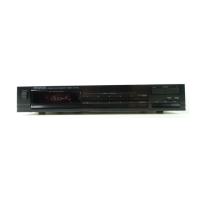
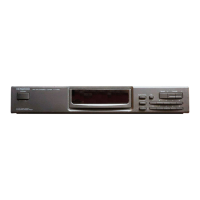
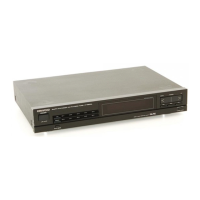
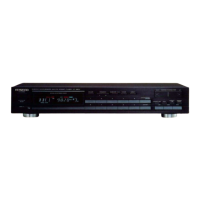
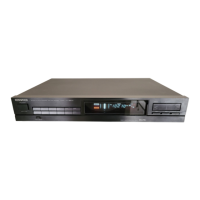
This document describes the Kenwood KT-2010/KT-2010L Quartz Synthesizer AM/FM Stereo Tuner, an audio component designed for receiving radio broadcasts.
Function Description
The Kenwood KT-2010/KT-2010L is a quartz synthesizer AM/FM stereo tuner. Its primary function is to receive and process radio signals, providing high-quality audio output for integration into a stereo system. The tuner features a digital display for showing station frequencies, station names, and time. It supports both AM and FM bands, with specific models catering to different regional broadcast standards (e.g., U.S.A. and Canada, Europe, United Kingdom, and other countries). The "L" suffix in KT-2010L indicates a model that includes the LW (Long Wave) band, in addition to AM and FM, for broader reception capabilities in certain regions.
Key operational features include:
- Tuning: The tuner employs a quartz synthesizer for precise and stable tuning. Users can tune to broadcasting stations manually using numeric keys or automatically via auto-tuning and preset scanning functions.
- Preset Stations: The device allows users to store a significant number of their favorite stations as presets. These presets can be recalled quickly, making it convenient to switch between frequently listened-to broadcasts. The manual details how to set and recall desired stations, including the ability to assign station names to presets.
- Timer Functions: The tuner incorporates a program timer and a sleep timer. The program timer allows users to schedule specific radio programs to turn on and off at set times, making it possible to record broadcasts or wake up to music. The sleep timer automatically turns off the tuner after a set period, useful for falling asleep to radio.
- Display: A clear digital display shows the tuned frequency, program number, time, and other operational indicators like stereo reception, off-time, and on-time.
- System Integration: The tuner is designed to be connected to an amplifier or receiver, and other audio components like CD players or cassette decks, to form a complete stereo system. It includes system control terminals for integrated operation with compatible Kenwood components.
Important Technical Specifications
The technical specifications vary slightly between the FM, AM, and LW tuner sections, and also between different regional models (KT-2010 and KT-2010L).
FM Tuner Section (IHF):
- Tuning frequency range: 87.5 MHz – 108 MHz
- Usable sensitivity (MONO): 0.95 µV, 10.8 dBf
- Total harmonic distortion (at 1 kHz):
- MONO: 0.1 %
- STEREO: 0.3 %
- Signal-to-Noise ratio (at 1 kHz, 65 dBf input):
- MONO: 76 dB
- STEREO: 73 dB
- Alternate channel selectivity (±400 kHz): 60 dB
- Stereo separation (at 1 kHz): 40 dB
- Frequency response (30 Hz – 15 kHz): +0.5 dB, -1.0 dB
- Output level/impedance (75 kHz dev.): 0.6 V/3.3 kohms
AM Tuner Section (KT-2010):
- Tuning frequency range:
- U.S.A., Canada: 530 kHz – 1,600 kHz (10 kHz step)
- Europe, Hawaii, Guam: 531 kHz – 1,602 kHz (9 kHz step)
- Usable sensitivity: 14 µV, 400 µV/m
- Signal-to-Noise ratio (30% mod., 1 mV input): 50 dB
- Total harmonic distortion: 0.5 %
- Selectivity: 25 dB
- Output level/impedance: 0.18 V/3.3 kohms
MW Tuner Section (KT-2010L):
- Tuning frequency range: 531 kHz – 1,602 kHz
- Usable sensitivity: 14 µV, 400 µV/m
- Signal-to-Noise ratio (30% mod., 1 mV input): 50 dB
- Total harmonic distortion: 0.5 %
- Selectivity: 25 dB
LW Tuner Section (KT-2010L):
- Tuning frequency range: 153 kHz – 281 kHz
- Usable sensitivity: 30 µV, 800 µV/m
- Signal-to-Noise ratio (30% mod., 1 mV input): 50 dB
- Total harmonic distortion: 0.5 %
- Selectivity: 30 dB
General:
- Power consumption: 8 W
- Dimensions (W x H x D): 440 mm (17-5/16") x 78 mm (3-1/16") x 267 mm (10-1/2")
- Weight: 3.1 kg (6.8 lbs)
Usage Features
The Kenwood KT-2010/KT-2010L is designed for user-friendly operation with several features enhancing its usability:
- Multi-region Compatibility: The tuner is adaptable to different broadcast standards worldwide, with specific models and internal switches (for AC voltage selection) to match local requirements. Users must ensure the correct voltage setting for their region to prevent damage.
- Antenna Connections: The manual provides detailed instructions for connecting various types of antennas, including AM loop antennas, FM indoor antennas, and AM/FM outdoor antennas. Proper antenna connection is crucial for optimal reception. For AM, a supplied loop antenna is typically used, while FM often uses a 300-ohm feeder or 75-ohm coaxial cable. For improved reception, especially in challenging environments, an outdoor antenna is recommended.
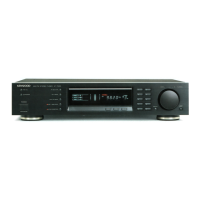
- Controls and Indicators: The front panel features a clear layout of controls, including tuning/character keys, band select keys (FM, AM, MW, LW), numeric keys (1-0), preset A/B select key, power key, display key, sleep key, direct key, program keys, execute key, adjust key, and clear key. Indicators for auto, manual (mono), stereo, off time, on time, tuned, sleep timer, preset channel, memory, and preset A/B are also present.
- Direct Tuning: Users can directly input the frequency of a desired station using the numeric keys, which is particularly useful for tuning to specific stations quickly.
- Preset Scanning: The tuner can automatically scan through preset stations, allowing users to quickly find a desired broadcast.
- Station Naming: For easier identification, users can assign custom names to their preset stations, which are then displayed on the front panel.
- System Control Terminal: This allows the tuner to be integrated with other Kenwood components, enabling synchronized power on/off and other control functions.
- Safety Precautions: The manual emphasizes important safety guidelines, such as preventing electric shock, avoiding exposure to rain or moisture, and ensuring proper ventilation. It also warns against opening the appliance or modifying it.
Maintenance Features
The Kenwood KT-2010/KT-2010L is designed for reliable operation with minimal user maintenance, but some aspects are highlighted:
- Cleaning: The manual advises against using volatile solvents like alcohol, paint thinner, or benzine for cleaning. Instead, a clean dry cloth should be used to wipe the unit.
- Troubleshooting Guide: A comprehensive "In case of difficulty" section is provided, listing common symptoms, their probable causes, and remedies. This includes issues related to power, timer operation, beat noise, buzz noise, distorted sound, reception problems (FM/AM/MW/LW), and preset/tuned station issues.
- Professional Service: For complex issues or repairs, the manual recommends consulting a Kenwood dealer or service representative, emphasizing that the user should not perform repairs themselves.
- Ventilation: Maintaining good ventilation is crucial for the longevity of the unit. The manual instructs users to place the unit at least 10 cm away from walls to ensure proper airflow and prevent overheating.
- Power Cord: Users are advised to regularly check the power cord for damage and to ensure it is securely plugged into an AC outlet.
- Storage: If the unit is to be stored for an extended period, it should be disconnected from the power supply and stored in a clean, dry place.
Overall, the Kenwood KT-2010/KT-2010L is a robust and feature-rich stereo tuner, designed to provide high-quality radio reception and integrate seamlessly into a home audio system, with clear instructions for safe and effective use.

 Need help?

 To Next Page
 General