EasyManua.ls Logo

Kenwood TR-2600A - Page 7

Kenwood TR-2600A
53 pages
Print Icon
To Next Page IconTo Next Page
To Previous Page IconTo Previous Page
Loading...
TR-2600A/E
CIRCUIT
DESCRIPTION
Rating
;
item
Symbol
Condition
Twin.
St.
St.
Tmax.
|
Unit
Vi
(off)
|
Ver
=
5V,
lo=100uA|
|
|
0.
Input
voltage
+
V1
(on)
|
Vo
=0.3V,lo=
2mA
|
3.0
|
-
Vv
Qutout
voltage
|
Vo
fon)
|
lo=10mA,li=0.5mA|
[0.1]
03
|
V
|
Input
current
li
V1
=5V
rT
Output
current
|
lo
(off)
|
Vec
=
30V,
V1
=
OV
|
OC
current
gain
Gl
lo
=
5mA,
Vo
=
5V
68
|
Input
impedance
R4
_
47
1/0
impedance
Table
8
DTC144ES
Electrical
characteristic
(TX
unit
7,16)
@
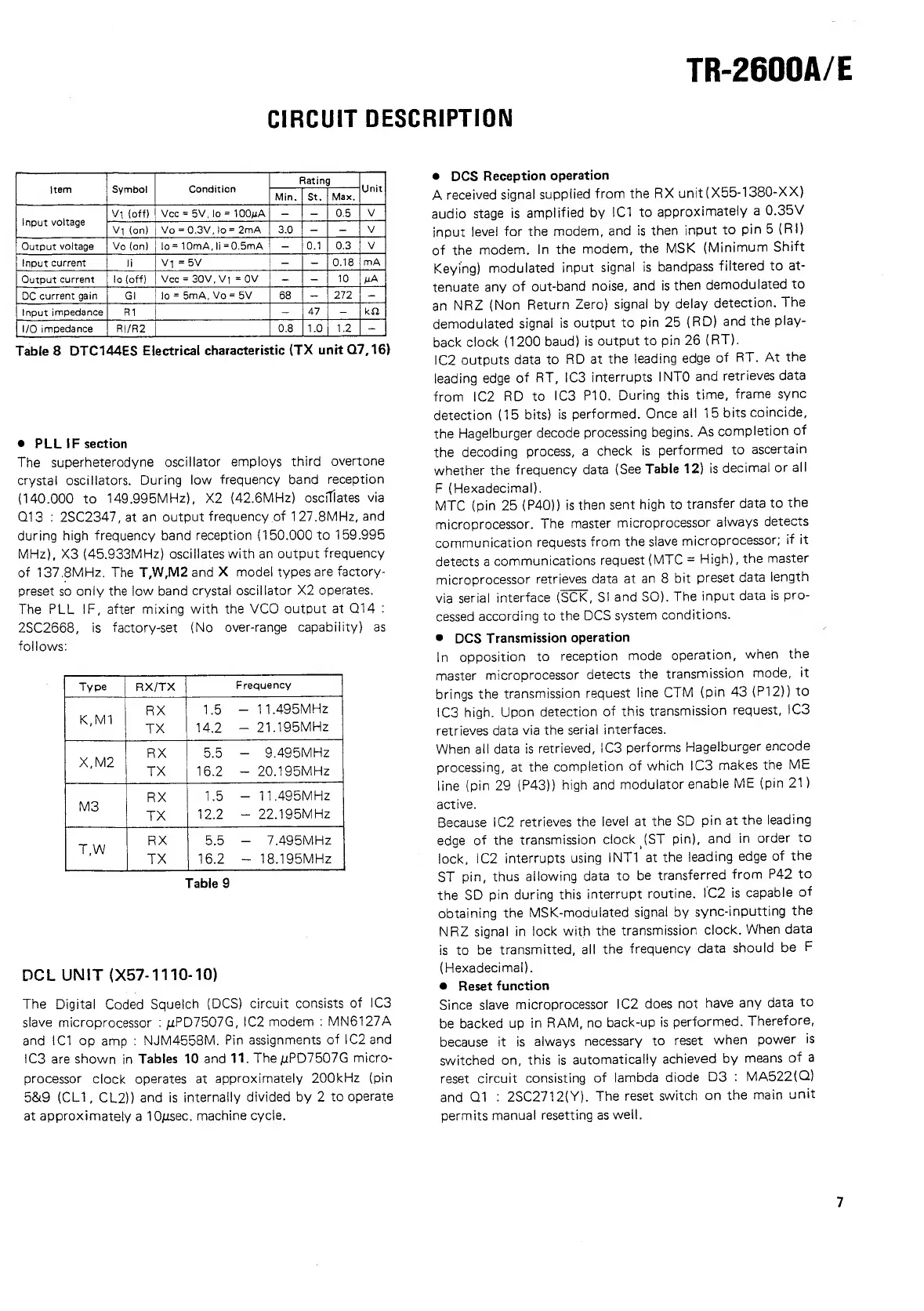
PLL
IF
section
The
superheterodyne
oscillator
employs
third
overtone
crystal
oscillators.
During
low
frequency
band
reception
(140.000
to
149.995MHz),
X2
(42.6MHz)
oscillates
via
Q13
:
2SC2347,
at
an
output
frequency
of
127.8MHz,
and
during
high
frequency
band
reception
(150.000
to
159.995
MHz),
X3
(45.933MHz)
oscillates
with
an
output
frequency
of
137.8MHz.
The
T,W,M2
and
X
model
types
are
factory-
preset
so
only
the
low
band
crystal
oscillator
X2
operates.
The
PLL
IF,
after
mixing
with
the
VCO
output
at
Q14:
2SC2668,
is
factory-set
(No
over-range
capability)
as
follows:
Type
RX/TX
Frequency
|
Panes
ss
oom
K
M1
RX
156
11.495MHz
:
TX
14.2)
21.195MHz
ee
a
9.495MHz_|
:
TX
16.2
—-
20.195MHz
|
M3
RX
1.5
—-—
11.495MHz
TX
12.2.
22.195MHz
T.W
RX
5.5
7.495MHz
TX
16.2)
18.195MHz
Table
9
DCL
UNIT
(X57-1110-
10)
The
Digital
Coded
Squetch
(DCS)
circuit
consists
of
1C3
slave
microprocessor
:
uPD7507G,
IC2
modem
:
MN6127A
and
{C1
op
amp
:
NJM4558M.
Pin
assignments
of
|C2
and
iC3
are
shown
in
Tables
10
and
11.
The
uPD7507G
micro-
processor
clock
operates
at
approximately
200kHz
(pin
5&9
(CL1, CL2})
and
is
internally
divided
by
2
to
operate
at
approximately
a
10sec.
machine
cycle.
@
DCS
Reception
operation
A
received
signal
supplied
from
the
RX
unit
(X55-1380-X
X)
audio
stage
is
amplified
by
|C1
to
approximately
a
0.35V
input
jevel
for
the
modem,
and
is
then
input
to
pin
5
(Ri)
of
the
modem,
In
the
modem,
the
MSK
(Minimum
Shift
Keying)
modulated
input
signal
is
bandpass
filtered
to
at-
tenuate
any
of
out-band
noise,
and
is
then
demodulated
to
an
NRZ
(Non
Return
Zero)
signal
by
delay
detection.
The
demodulated
signal
is
output
to
pin
25
(RD)
and
the
play-
back
clack
(1200
baud}
is
output
to
pin
26
(RT).
IC2
outputs
data
to
RD
at
the
jeading
edge
of
RT.
At
the
leading
edge
of
RT,
IC3
interrupts
INTO
and
retrieves
data
from
[C2
RD
to
IC3
P10.
During
this
time,
frame
sync
detection
(15
bits)
is
performed.
Once
all
15
bits
coincide,
the
Hagelburger
decode
processing
begins.
As
completion
of
the
decoding
process,
a
check
is
performed
to
ascertain
whether
the
frequency
data
(See
Table
12)
is
decimal
or
all
F
(Hexadecimal).
MTC
(pin
25
(P40})
is
then
sent
high
to
transfer
data
to
the
microprocessor.
The
master
microprocessor
always
detects
communication
requests
from
the
slave
microprocessor;
if
it
detects
a
communications
request
(MTC
=
High),
the
master
microprocessor
retrieves
data
at
an
8
bit
preset
data
length
via
serial
interface
(SCK,
S$!
and
SO).
The
input
data
is
pro-
cessed
according
to
the
DCS
system
conditions.
®
DCS
Transmission
operation
In
opposition
to
reception
mode
operation,
when
the
master
microprocessor
detects
the
transmission
mode,
it
brings
the
transmission
request
line
CTM
(pin
43
(P12))
to
{C3
high.
Upon
detection
of
this
transmission
request,
1C3
retrieves
data
via
the
serial
interfaces.
When
all
data
is
retrieved,
|C3
performs
Hagelburger
encode
processing,
at
the
completion
of
which
!C3
makes
the
ME
line
(pin
29
(P43))
high
and
modulator
enable
ME
(pin
21)
active.
Because
IC2
retrieves
the
level
at
the
SD
pin
at
the
leading
edge
of
the
transmission
clock
(ST
pin),
and
in
order
to
lock,
{C2
interrupts
using
INT1
at
the
leading
edge
of
the
ST
pin,
thus
allowing
data
to
be
transferred
from
P42
to
the
SD
pin
during
this
interrupt
routine.
1C2
is
capable
of
obtaining
the
MSK-modulated
signal
by
sync-inputting
the
NRZ
signal
in
lock
with
the
transmission
clock.
When
data
is
to
be
transmitted,
all
the
frequency
data
should
be
F
(Hexadecimal).
@
Reset
function
Since
slave
microprocessor
IC2
does
not
have
any
data
to
be
backed
up
in
RAM,
no
back-up
is
performed.
Therefore,
because
it
is
always
necessary
to
reset
when
power
is
switched
on,
this
is
automatically
achieved
by
means
of
a
reset
circuit
consisting
of
lambda
diode
D3
:
MA522(Q)
and
Q1
:
28C2712(Y).
The
reset
switch
on
the
main
unit
permits
manual
resetting
as
well.

Related product manuals