Owner’s Manual SD1
79
Recording a Midi file
Everything that is played on the SD1, including the automatic accompaniment and the variations made on the control panel, can be recorded as
a Midi file directly on Floppy Disk or Hard Disk. Everything recorded can be later modified using the built-in sequencer of the SD1 or on soft-
ware sequencers for PC/Mac. Considering that the accompaniment tracks use timbres in standard General MIDI, it is also possible to create
some arrangements very quickly and sufficiently compatible also with other GM modules. Some of the properties of the SD1 may however be
lost if reproduced on GM modules, in particular the use of Live Drum, the response to the modulation of the timbres for the Right section of the
keyboard that are not compatible with the General MIDI Standard, the use of the audio samples and the Drawbars. While recording you can also
use RAM Styles provided that they are previously loaded in RAM and not called up directly from disk. The latter is already busy recording the
Midi file.
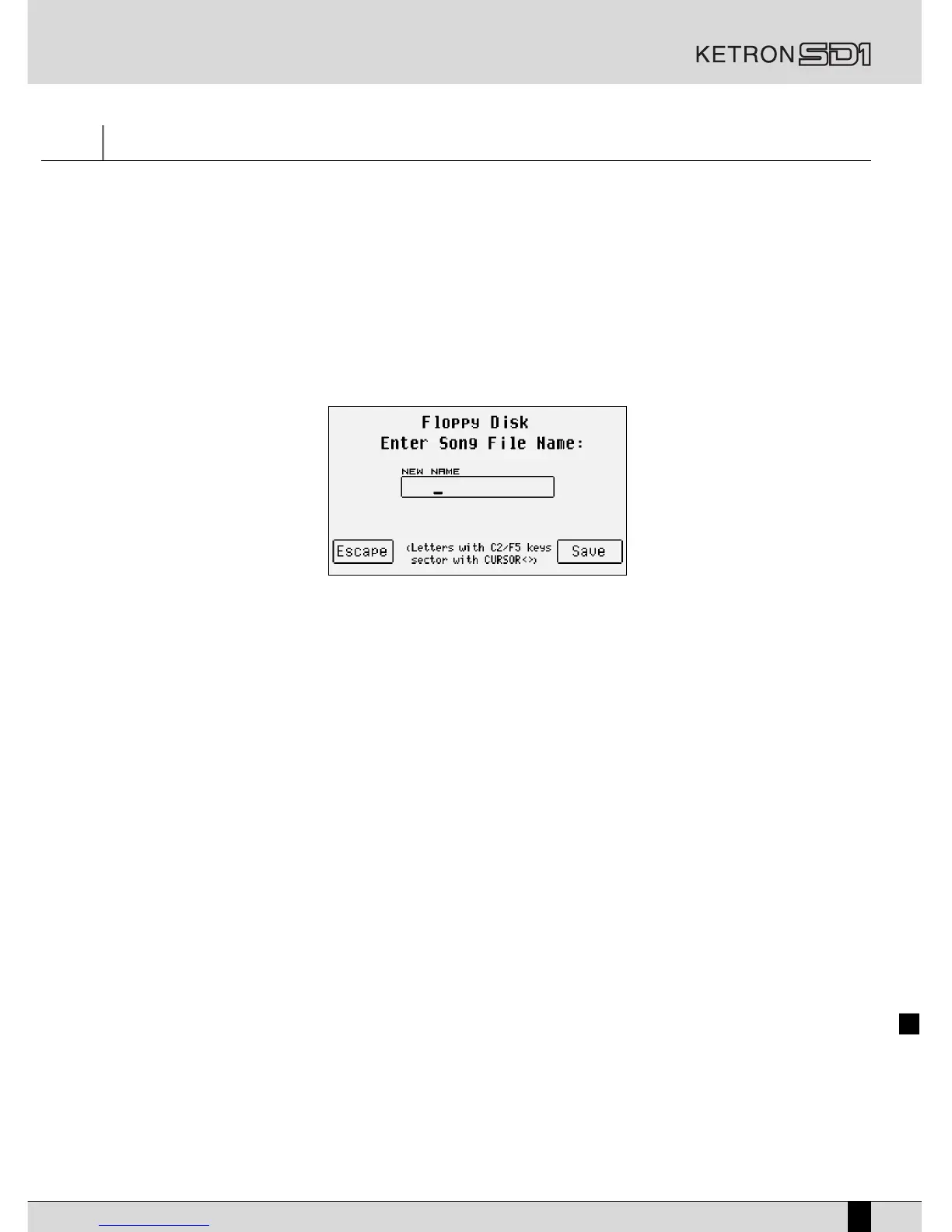
To start recording the Midi file press the SONG RECORD push button (the LED lights up). The page called up is used to enter the name of the
Midi file using the keyboard keys and the CURSOR +/- push buttons, to cancel the procedure using F5 Escape and to confirm the creation of
the Midi file using F10 Save.
Once creation has been confirmed, the display will show the F10 Start function. By pressing the relative function push button “Recording”
appears under the Tempo bar and the Midi is already recording, even with the Arranger disabled, thus enabling all the basic settings to be
recorded that will then go to the fist measure of the Midi file. The Tempo starts only if the Arranger is enabled.
Recording is not stopped by pressing the START push button once again but only by disabling SONG RECORD by pressing the relative push but-
ton again. Once Song Record is disabled, the SD1 sets itself ready to reproduce everything recorded in Song Play.


 To Next Page