8. TOWING / TRANSPORTATION / STORAGE
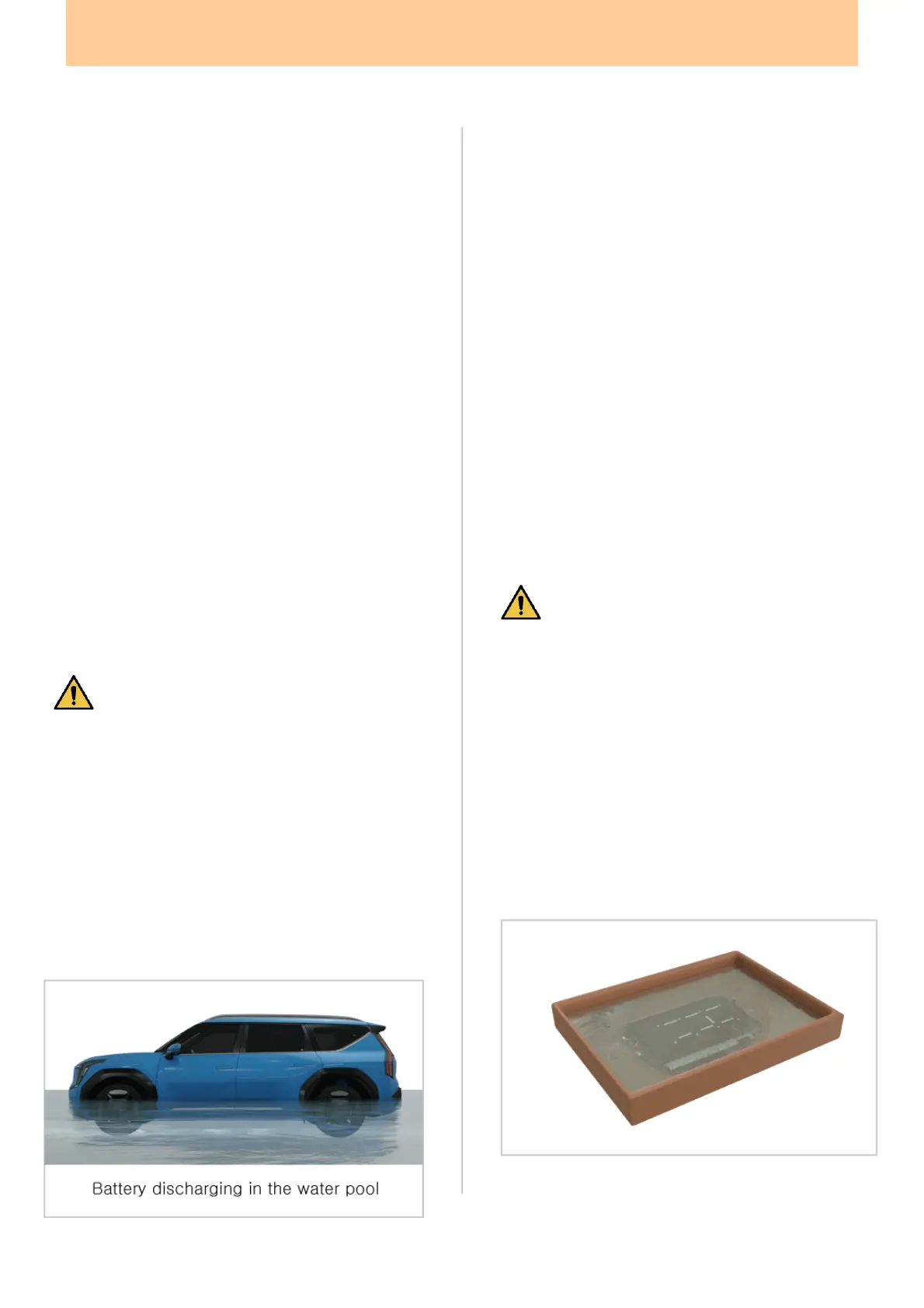
• In the event that the battery cannot be
taken out, establish a water pool and pour
water until the entire battery is immersed.
# Water pool condition : tap water or pond
water that does not contain salt
• Maintain this water level for at least 90
hours.
• Then, put salt into the water pool to make
3.5 % salt water.
• Wait for additional 48 hours in salt water.
• Drain the water and dry it.
• If it is impossible to remove or discharge
the battery from the vehicle or submerge
the vehicle, put a waterproof cover on the
vehicle. (prevention of rainwater)
• Even after the high-voltage battery fire
appears to have been extinguished,
renewed or delayed fire can occur.
• In a fire, submersion or a collision that
has compromised the high-voltage battery,
always store it in an open area with no
exposures within 50 feet (15m).
8.3 Damaged Battery Storage
• To store the damaged battery safely,
the battery must be discharged.
• If the battery can be removed from the
vehicle, discharge the battery to
prevent re-ignition.
• Discharge up to 1 volt per cell.
• Prepare water that does not contain
salt such as tap water or pond water.
• Leave the battery in water for at least
90 hours
• Then, put salt in water to make 3.5%
salt water.
• Wait for additional 48 hours in salt
water.
• Take out the battery from the
container and dry it.
WARNING
Battery discharging
• DO NOT USE SALT WATER for the first
step.
• A large volume of flammable hydrogen
gas can be generated in salt water due to
electrolysis.
• After submerging the vehicle in pure
water for at least 90 hours, put salt in the
water pool.
WARNING
• Extinguish all smoke, spark, flame
around the vehicle.
• Electrolyte solution is a skin irritant.
• Do not touch or step on the spilled
electrolyte.
• If electrolyte leak occurs, wear
appropriate solvent resistant PPE and
use soil, sand, or a dry cloth to clean up
the spilled electrolyte. Be sure to
adequately ventilate the area.
Kia EV9
Emergency Response Guide
22



 To Next Page