Need help?
Do you have a question about the Kicker Impulse 654xi and is the answer not in the manual?
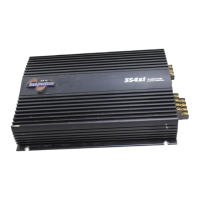
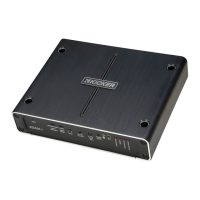
The Kicker Impulse 654xi/354xi Four-Channel Power Amplifiers are designed to complement the Kicker Impulse line of speakers, enabling the construction of a high-performance car audio system within a budget. These amplifiers offer a wide array of features, allowing them to be integrated with various source units to control a single amplifier or a bi-amp system, with or without rear fill.
The Impulse four-channel amplifier is engineered for robust audio performance. It is 2 Ohm stable in stereo mode and can operate as low as 4 Ohms when configured for bridged mono. This flexibility allows for a variety of speaker configurations, from standard stereo setups to more powerful bridged applications for subwoofers.
A key feature of these amplifiers is the built-in electronic crossover. This allows users to precisely tailor the audio output to their specific speaker setup. The crossover can be set to high pass for satellite speakers, ensuring that only higher frequencies are sent to them, which helps prevent distortion and improves clarity. Alternatively, it can be set to low pass for subwoofers, directing only the lower frequencies to them for deep, impactful bass. For systems where full-range audio is desired, a bypass option is available, allowing the amplifier to operate across the entire frequency spectrum. In full-range configuration, the Impulse amplifiers can simultaneously operate in both stereo and mono modes, offering versatile sound delivery.
To further enhance sound customization, the amplifiers include separate KICKEQ™ bass and treble controls. These controls provide the ability to boost low and high frequencies, allowing users to fine-tune the music to their personal taste and compensate for the acoustic characteristics of their vehicle's interior.
The Impulse amplifiers are also equipped with essential protection circuits to ensure longevity and reliable operation. Auto-resetting short circuit and overthermal protection circuits are incorporated. These safeguards automatically engage to protect the amplifier from damage in extreme conditions, such as excessive heat or electrical shorts, and then reset once the conditions return to normal.
The internal design of the amplifiers utilizes state-of-the-art circuitry, including a MOSFET power supply. MOSFETs (Metal-Oxide-Semiconductor Field-Effect Transistors) are known for their efficiency and ability to handle high power, contributing to the amplifier's stable and powerful output. The use of glass epoxy circuit boards further enhances durability and reliability, ensuring many years of trouble-free operation.
Connecting the Impulse amplifier to a source unit offers flexibility. The preferred method is to use RCA cables from a quality tape or CD player, providing a clean, low-level input signal. However, for factory decks or aftermarket sources that lack low-level RCA jacks, a high-level (speaker) input signal can also be used, making the amplifier compatible with a wider range of head units.
When setting up the amplifier, proper wiring is crucial. For power connections, it is always recommended to hook up the ground wire first and disconnect it last. It is important never to make any wiring changes while the amplifier is powered up to prevent damage. An in-line fuse on the positive battery connection is essential for protecting the wire in case of a short circuit. The fuse should be installed within 18 inches of the battery connection and rated appropriately for the amplifier model (e.g., 30A with 10 gauge wire for the 354xi, 60A with 8 gauge wire for the 654xi). For longer wire runs (over 10 feet) or specific impedance loads (2 Ohm stereo or bridged to 4 Ohms), heavier gauge wire is recommended (8 gauge for 354xi, 4 gauge for 654xi), potentially requiring a power distribution block for easier connection at the amp.
Any power wire passing through a metal panel, such as the firewall, must be protected with a grommet or other suitable means to prevent abrasion and shorts. The ground wire should be as short as possible and securely attached to a clean, paint- and corrosion-free point on the vehicle's body. To minimize noise interference, RCA cables should be routed separately from any power wires within the vehicle.
Mounting the amplifier correctly is important for optimal performance and longevity. An appropriate mounting location should be chosen to ensure good air circulation around the heatsink and easy access to the end panel controls. The supplied screws and washers should be used to firmly mount the amplifier, and the amplifier chassis can serve as a template for screw placement. Before drilling, it's crucial to check that the mounting screws will not damage any components on the back side of the chosen panel. If mounting vertically, it is recommended that the heatsink fins run vertically to maximize cooling efficiency.
Adjusting the gain control is a critical step in setting up the system. The gain control matches the amplifier's sensitivity to the source unit's output level; it does not increase the amplifier's power. To set it correctly, the gain control should be turned to minimum (counter-clockwise). The source unit's volume should then be raised until distortion is barely audible, then slightly lowered (typically to 85-95% of full volume). Finally, the amplifier gain should be increased until distortion is just audible. This ensures the gain is set correctly for all sources (CD/tape, tuner).
The KICKEQ™ bass and treble controls allow for further sound refinement. After installation and reassembly of the vehicle, a listening test with typical music should be performed. Initially, the source unit's tone controls should be set to flat, and the KICKEQ™ controls turned fully counter-clockwise. Depending on personal preference and speaker characteristics, the high or low frequencies can be boosted by turning the KICKEQ™ controls clockwise. It's important to remember that road noise can mask bass frequencies while driving, so adjustments should be made when the vehicle is stationary for safety and accuracy. A crucial warning: never change the crossover settings while the amplifier is on, as this can cause a loud pop that may damage speakers or cause hearing loss.
The Impulse amplifiers are designed for reliability, but proper maintenance and troubleshooting are essential for continued performance. The auto-resetting short circuit and overthermal protection circuits are a key maintenance feature, automatically protecting the amplifier from common issues without requiring manual intervention.
If the red power indicator is off and there is no output, troubleshooting involves checking the +12V power terminal, ground terminal, and remote turn-on lead with a Volt Ohm Meter (VOM). If the red power indicator is on but there's no output, checks should include RCA connections, testing speaker outputs with a known good speaker, verifying the source unit's function, and checking the RCA for signal with a VOM in AC volts position.
For no output from a single channel, users should check RCA and speaker connections for that channel and swap RCA and speaker connections between channels to isolate the problem.
If the yellow LED protection indicator is lit and there is no output, two cases are possible. Case 1: The amp is very hot, indicating thermal protection is engaged. This requires checking for proper impedance at speaker terminals and ensuring adequate airflow around the amplifier's heatsink. Case 2: Output resumes momentarily when the system is turned off and back on, suggesting short circuit protection is engaged. A VOM should be used to check for shorts between speaker positive and negative, and between speaker terminals and ground.
To address alternator noise (a whining sound that varies with engine RPM), ensure the source unit's ground is as short as possible and connected to bare chassis metal, as the stock radio ground may be insufficient. Additionally, check the RCA cable routing and condition, keeping them away from all power wires to prevent interference.
The amplifier comes with a limited warranty, covering defects in material and workmanship under normal use. For warranty service, defective merchandise must be returned to an Authorized Stillwater Designs (Kicker/Impulse) Dealer. It's crucial to include a dated proof-of-purchase. The warranty does not cover damage from improper installation, exposure to environmental factors (water, excessive heat, chemicals, UV radiation), negligence, misuse, accident, abuse, freight damage, or unauthorized repairs. Stillwater Designs aims for a 24-hour service for all returns, though delays may occur if replacement inventory or parts are unavailable.
 General
| RMS Power at 4 Ohms | 65W x 4 |
|---|---|
| Frequency Response | 20 Hz - 20 kHz |
| Signal-to-Noise Ratio | >95 dB |
| Channel Configuration | 4 |
| Crossover | 50-200Hz |

 To Next Page