Need help?
Do you have a question about the Kinova Gen3 lite and is the answer not in the manual?
Provides essential information regarding product setup and operation for end users.
Crucial step before integration; considers all application activities for safety.
Essential safety considerations for operating the robot to prevent injury or damage.
Glossary of terms and abbreviations used throughout the user guide for clarity.
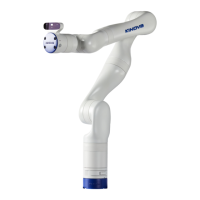
Describes the main components of the KINOVA® Gen3 lite robot, including base, actuators, and gripper.
Details the robot base, its function for mounting, power, communication, and internal components.
Lists and describes accessories for mounting the robot, such as quick connect systems and mounting plates.
Explains the robot's actuators, their types, sensors, and how they are connected.
Guides users through initial setup steps, including unboxing, mounting, and powering.
Describes various physical mounting methods for the robot, ensuring a stable setup.
Step-by-step instructions on connecting and powering up the robot to initiate the sequence.
Details connecting the robot to a computer using a USB cable for direct communication.
Overview of the Web App for configuring, controlling, and monitoring the robot via a GUI.
Instructions for establishing a wireless connection between a computer and the robot.
Provides a schematic diagram and key physical dimensions of the robot in millimeters.
Lists detailed technical specifications covering safety, security, and environmental parameters.
Describes the various sensors located in the robot's base, actuators, wrist, and gripper.
Information on the region in space reachable by the robot's end effector.
Introduces fundamental concepts related to robot actions, control modes, factory settings, and notifications.
Defines key mathematical and robotics terms like Cartesian space, frames, and degrees of freedom.
Explains different modalities for controlling robot motion, including joystick and trajectory modes.
Compares high-level (safer, easier) and low-level (faster, finer control) robot control methods.
Lists features enhancing safety and usability, such as singularity avoidance and protection zones.
Details limits applied to joint position, speed, acceleration, and torque for safety.
Explains robot control via trajectory and joystick modes for precise motion.
Overview of parameters adjustable via API and Web App for robot operation customization.
Covers configurable items for the base, including user profiles, protection zones, and network settings.
Discusses safety items across robot components and their associated warning/error thresholds.
Details actuator-related safety items, their hard limits, thresholds, and warning errors.
Explains the primary sections and navigation structure of the Web App interface.
Details the control panel's buttons for launching virtual joystick and action controls.
Describes the interface for controlling Cartesian movement via mouse or touch.
Covers defining, editing, and playing back robot actions and sequences within the Web App.
Explains the robot's devices (base, actuators, gripper) and the services they provide.
Lists services available for developers, including Session, Base, and DeviceManager.
Details servoing modes (high-level, low-level) for transmitting commands to robot devices.
Categorizes and explains errors encountered during API method calls for troubleshooting.
Describes standard robot frames (base, tool) and transformations between them.
Identifies configurations causing loss of degrees of freedom and altered behavior.
Provides key inertial parameters (mass, center of mass, moments of inertia) for each robot link.
Outlines essential maintenance tasks, including setting protection zones and updating firmware.
Offers tips and resources for diagnosing and resolving robot issues, including general advice.
Guides users on interpreting and responding to safety warnings and error states.
Provides contact information for hardware and software support, including website and GitHub resources.


 To Next Page

 General