Need help?
Do you have a question about the Kinova Link 6 and is the answer not in the manual?
Details the intended applications, unintended uses, and warranty terms for the Link 6 robot.
Provides key technical data including degrees of freedom, payload, reach, and environmental operating conditions.
Details arm and controller dimensions, and defines the robot's working area.
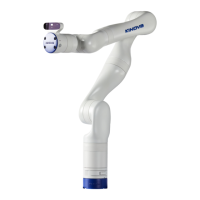
Identifies the main modular parts of the robotic arm: Base, Actuators, Wrist, Controller, Teach pendant, and I/O.
Describes the controller's function, mounting, and electrical/communication interfaces.
Details the Industrial I/O panel, power supply, and wrist I/O for analog, digital, and network connectivity.
Outlines essential safety considerations, precautions, and directives for safe robot operation.
Covers risk assessment, hazard identification, and necessary safety equipment for robot integration.
Explains stop categories, safety functions, operating modes, and robot protections/limits.
Details manual jog, hand guiding, hold-to-run, automatic, and recovery modes for robot interaction.
Provides instructions for unpacking, mounting, and connecting the robot controller and arm components.
Guides users through accessing and logging into the Kortex Web App interface.
Explains the robot control panel, system navigation, and status indicators.
Details procedures for adding, editing, deleting users, and elevating permissions.
Covers remote access configuration and the process for upgrading robot software and firmware.
Explains how to install, manage, and work with robot plugins to extend functionality.
Guides users on configuring tools, adding custom tools, and performing other tool management actions.
Details configurations for controller and arm robot controls, including factory settings.
Covers configuring payload, gravity vector, and force torque sensor parameters for the robot.
Introduces visual programming, program page overview, and available core tiles for creating programs.
Explains Hand Guiding, Jog Cartesian, Jog Angular panels, and program execution modes.
Details managing program variables, persistent variables, and JSON statements for programming.
Describes accessing and interpreting results from built-in self-tests and diagnostic pages.
Details monitoring the status of safety functions, controller, actuators, SCU, and wrist.
Covers firmware issues, joint errors, temperature limits, and network errors for troubleshooting.
Addresses common hardware problems like controller power, robot startup, and tool malfunctions.
Solves problems with safety configurations, external safety devices, and operating modes.
Helps resolve problems with plugins, programs, and Kortex Web App connectivity.
Outlines daily, weekly, quarterly, and yearly maintenance tasks for robot upkeep.
Lists recommended spare parts and consumables for maintaining the robot.
Defines key terms and acronyms used throughout the manual, starting with A and B.
 General
| Degrees of Freedom | 6 |
|---|---|
| Power Supply | 48V DC |
| Communication Interface | Ethernet, USB |
| Repeatability | ± 0.1 mm |
| Protection Rating | IP54 |
| Control Interface | ROS |
| Joint 4 Speed | 180 °/s |
| Joint 5 Speed | 180 °/s |
| Joint 6 Speed | 180 °/s |
| Operating Temperature | 0 to 45 °C |

 To Next Page