This document provides instructions for a KitchenAid downdraft hood, model KEBDS 90020 0, designed for use with KitchenAid gas, electric, vitroceramic, and induction hobs. The hood is intended for either external extraction (extractor version) or internal recirculation (filter version) of air.
Function Description:
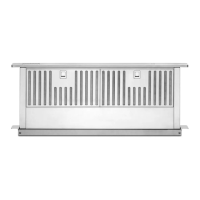
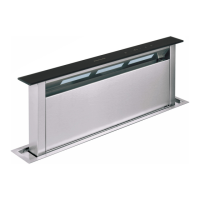
The KitchenAid downdraft hood is an appliance designed to extract steam and fumes generated during cooking. It features a "TOUCH" control panel for operating lights and adjusting extraction speed. The hood can be installed in a cabinet, rising from the worktop when in use to capture cooking emissions. In the extractor version, steam and fumes are expelled to the outside through an exhaust pipe. In the filter version, the sucked air is degreased and deodorized using activated carbon filters before being re-circulated into the room.
Important Technical Specifications:
- Minimum Distance from Cooktop: Not less than 50 cm for electric cookers and 65 cm for gas or mixed cookers. Always refer to the cooker's manual for specific minimum distances.
- Hob Compatibility: Designed and approved exclusively for use with KitchenAid gas, electric, vitroceramic, and induction hobs.
- Gas Hob Power: For gas hobs, the total maximum power is 16.2 kW.
- Gas Hob Usage (Extractor Version): When used with gas hobs, the downdraft hood must be installed exclusively with external extraction, and the burners must be equipped with safety valves.
- Ducting Diameter: The exhaust pipe diameter must be equal to the connection collar (150 mm).
- Electrical Connection: The power voltage must match the appliance rating plate. Power cable replacement (type H05 VV-F 3 x 0.75 mm²) must be carried out by a qualified electrician. Earthing is compulsory (not necessary for class II hoods).
- Cabinet Dimensions for Installation: The hood requires a cabinet with specific dimensions: 1100mm width, 842mm depth, 1000mm height, and an 830mm internal height for the extraction unit. A rectangular hole of 842x100 mm is needed behind the hob for insertion.
- Distance between Hob and Hood Hole: A minimum distance of 70 mm must be respected between the hob hole and the hood hole. For gas hobs, 100 mm is advisable.
Usage Features:
- Control Panel: The hood is operated via a "TOUCH" control panel with five buttons (T1, T2, T3, T4, T5).
- Extraction Speeds: The hood offers four extraction speeds (power levels).
- Button T1 (Timer): Delays hood switch-off, timing the set speed for a few minutes (20 minutes for speed 1, 15 minutes for speed 2, 10 minutes for speed 3, 5 minutes for speed 4). Pressing T2 or T3 exits timed mode.
- Button T2 (Decrease Speed): Decreases the active extraction speed (4→3→2→1→OFF). Does not affect extraction panel opening/closing.
- Button T3 (Increase Speed): Increases the active extraction speed (1→2→3→4). If the panel is closed (hood off), T3 first opens the extraction panel and then sets the hood to speed 1. For models with a motor or remote GME 22, suction speed 4 is timed for 6 minutes, then automatically switches to speed 3.
- Button T4 (Light): Switches on the light. If the extraction panel is closed (hood off), T4 first opens the extraction panel and then switches on the light.
- Button T5 (Open/Close Panel): Opens (lifts) and closes (lowers) the extraction panel. With the hood off and panel closed, T5 first opens the panel and sets the hood to speed 1. With the hood on (at any speed) and panel open, T5 first switches the hood off (and lights, if on) and then closes the extraction panel.
- Recommended Use: Activate extraction 5 minutes before cooking and leave it on for about 15 minutes after cooking. Use the highest speed setting for concentrated steam and fumes.
- Antipinching System: If an obstacle hinders closing, the Downdraft stops and the extraction panel goes up.
- Gas Hob Flame Distribution: When using gas hobs, especially at higher extraction levels (power 3 or 4), the extraction flow might slightly modify flame distribution. It is advisable to privilege non-frontal positions of the gas hob for cooking with grills or large pans.
- Negative Pressure: If used with other gas or fuel-burning appliances, the negative pressure in the room must not exceed 4 Pa (4 x 10⁻⁵ bar). Ensure adequate ventilation.
Maintenance Features:
- Cleaning:
- Disconnect from power supply before cleaning.
- Do not use steam cleaners, corrosive or abrasive detergents, abrasive sponges, metallic scrapers, or scouring pads.
- Clean surfaces with a damp cloth, adding washing-up detergent for heavy dirt. Dry with a dry cloth.
- Use specific detergents for the appliance and follow manufacturer's instructions.
- Grease Filters:
- Clean at least monthly to remove oil/grease residuals.
- Can be cleaned in a dishwasher at low temperature with short cycle.
- Failure to clean or replace filters can lead to fire risk.
- The hood must never be opened without grease filters installed.
- Grease Filter Saturation Signalling: Every 40 hours of use, all extraction speed LEDs blink simultaneously.
- Resetting Signalling: After cleaning, press button T1 for more than 3 seconds. Signalling is not displayed when the hood is OFF.
- Carbon Filters (Filter Version Only):
- Replace when necessary to maintain good odor reduction efficiency.
- Carbon filters cannot be washed or regenerated.
- Remove carbon filters if using the extractor version.
- Lamps:
- Before touching bulbs, ensure they are cold.
- Do not use or leave the hood without correctly installed lamps (risk of electric shock).
- Check if the lamp needs replacing if it doesn't work.
- Make sure the lamp is correctly fitted.
- If the neon is not properly fitted, contact After-Sales Service.
- General Maintenance:
- Wear work gloves for all installation and maintenance operations.
- After cleaning, refit the front panel and filters, checking correct installation and hooking, otherwise the hood will not switch on.
- The manufacturer declines liability for damage or fires caused by improper maintenance.

 Need help?
 General


 To Next Page