K71000 Automatic PMCC Flash Point Analyzer
Operation and Instruction Manual
K71000-Manual -6-
DIN EN 22719: Petroleum products and
lubricants; determination of flash point;
Pensky-Martens closed cup method
(withdrawn)
5. Federal Test Method (FTM)
FTM Publication:
FTM 791-1102: Flash Point by Pensky-
Martens Closed Tester
6. American Association of State Highway and
Transportation Officials (AASHTO)
444 North Capitol Street N.W., Suite 249
Washington, DC 20001
Phone: +1 202 624-5800
Fax: +1 202 624-5806
E-mail: info@aashto.org
AASHTO Publication:
AASHTO T73-811
7. Association Française de Normalisation
(AFNOR)
http://www.afnor.fr
AFNOR Publication:
NF M 07-019
8. Japanese Industrial Standards(JIS)
http://www.jisc.go.jp
JIS Publication:
JIS K2265
1.3 Pensky-Martens Flash Point Method
Scope and Summary
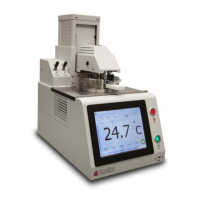
The K71000 Automatic Pensky-Martens Flash
Point Analyzer determines the lowest flash point
temperature of fuels, lubricating oils, and
homogenous liquids (ASTM D93 A), or liquids
containing suspended solids as well as liquids
that tend to form a surface film during testing
(ASTM D93 B), and the determination of the
flash point of biodiesel in the temperature range
of 60 to 190°C (ASTM D93 C).
Method Scope:
The scope of the method covers the analysis of
products in the temperature range of 40 to
360°C but this automated apparatus extends the
range from dew point + 10°C to 400°C.
Internet Link to Summary: ASTM D93 PM Flash
Standard Method Scope and Summary
Method Summary:
Flash Point is the lowest temperature
(barometrically corrected to standard
atmospheric pressure of 101.3 kPa (760 Torr) at
which the vapors of a combustible liquid will
ignite and the flame front propagate across the
head-space of the sample cup under the
conditions specified by the test method.
Flash point tests are conducted by filling the test
cup to the full indication mark, placing the flash
cup into the test sample chamber then locking
the cup cover into position.
Next, the user selects a predefined or user
programmed test method, types in or accepts
the expected flash point (EFP), optionally
selects a product type, then hits the start button.
A Quick Test feature allows for determination of
flash points of unknown materials beginning the
test from ambient and proceeding with the test
at an accelerated heating rate.
The unit is equipped with a differential Pt-100
RTD probe designed to duplicate the response
time of a mercury-in-glass thermometer as per
ASTM D93-02a and E1-03a. If a flash is not
detected 30°C above the expected flash point or
at 405°C, then the test is automatically aborted
for safety.


 To Next Page