EasyManua.ls Logo

Kongsberg Seatex RADius 1000 - User Manual

Kongsberg Seatex RADius 1000
26 pages
Print Icon
To Next Page IconTo Next Page
Loading...
RADius
Technical Description
Issued: 2006-11-20
Question and Answer IconNeed help?

Do you have a question about the Kongsberg Seatex RADius 1000 and is the answer not in the manual?

Overview

The RADius 1000 system is a high-precision reference and tracking system designed for short-range and direction monitoring, primarily used in operations where increased safety is crucial, such as assisting automatic dynamic positioning (DP) of a vessel. It is designed to operate effectively close to structures and other vessels, minimizing the risk of tracking false radar echoes through the use of identifiable transponders. The system's performance improves as it moves closer to the transponders, offering complementary characteristics to DGPS systems, especially in scenarios where DGPS availability might be degraded due to limited sky view (e.g., when operating near large structures).

Function Description:

The RADius system utilizes low-power Frequency Modulated Continuous Wave (FM-CW) radar principles to measure the distance and bearing to one or more transponders. The system consists of two main physically separated parts: an Interrogator Unit and a Controller Unit/Processing Unit (CU). Additionally, it includes one or more transponders, a Video Display Unit (VDU), power cables, signal and power cables between the Processing Unit and the Interrogator Unit, and documentation.

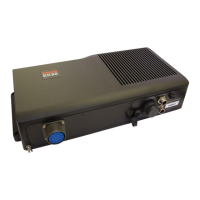
The Interrogator Unit, mounted on the DP vessel, is the actual radar module that measures distance and bearing to the transponders. It is a sealed unit comprising a transmitter, a receiver, and pre-processing modules. Power is supplied from the power/connection shelf in the CU. The Interrogator communicates with the Processing Unit via an Ethernet link.

Transponders, acting as radar reflectors, are mounted on the remote object or vessel. Each transponder receives the signal from the Interrogator, mixes the input signal with its own unique identity frequency (sub-carrier), and reflects the signal back. This unique ID allows the system to separate different transponders and track up to five simultaneously, enhancing system integrity and robustness.

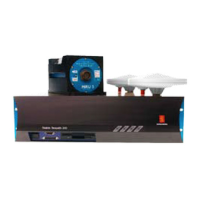
The Controller Unit, typically installed on the bridge or in an instrument room, includes a Processing Unit (3U), a Power/connection shelf (2U), and a Keyboard/mouse (1U). The Processing Unit, designed for standard 19-inch racks, contains a hard disk, a 3.5-inch floppy disk for software installation and upgrade, serial and analog I/O boards, a computer main board, and a 110/230V AC power supply. Its front panel features an ON/OFF switch, four status indicator lights, and an RS-232 serial port (COM1) for service. The rear panel provides various communication interface ports for external systems, including VGA for display, Ethernet for Interrogator and external equipment interfaces, RS-422 for MRU, parallel port, and multiple RS-232/422 configurable serial ports for user output. The Power/connection shelf provides power and network interfaces to the Interrogators, housing an Ethernet switch, an ON/OFF switch with an integrated fuse, and 110/230V AC power supplies for both Interrogators and the Ethernet switch. A 1U keyboard with an integrated trackball serves as the primary input device.

Important Technical Specifications:

  • Measurement Principle: Low power FM-CW radar.
  • Transponder Tracking: Capable of simultaneously tracking up to five transponders.
  • Range: Up to 1000 metres.
  • Angle Determination: Interferometric methods.
  • Operating Modes and Accuracy:
    • High precision range (10m - 200m): Optimal accuracy, bearing < 0.5°, distance < 0.5m.
    • Tracking range (200m - 500m): Distance and bearing measured, but angle accuracy is degraded.
    • Acquisition range (500m - 1000m): Only range measurements are acquired, useful for verifying system functionality before entering the 500-metre safety zone.
  • Transponder Identity (TID): Derived from the transponder identification frequency, ranging from 1.5 MHz to 3.0 MHz, resulting in TIDs from 150 to 300.
  • RADius 600 High Gain Transponder:
    • High precision range: 200 metres.
    • Operating sector: 90 degrees horizontally and vertically.
    • Power: Permanently connected to 6 VDC.
  • RADius 500 Low Power Transponder:
    • High precision range: 100 metres.
    • Operating sector: 90 degrees horizontally and vertically.
    • Power: Internal 3.6 VDC battery, estimated life of one year.
    • Relocation: Easily relocated due to no cable connection.
  • Compliance: IEC 60950/EN60950 (product safety), IEC 60945/EN60945 (electromagnetic compatibility and vibration).
  • Interrogator Power Supply: From the power/connection shelf in the CU.
  • Processing Unit Power Supply: 110/230V AC.
  • Power/Connection Shelf Input: 85 to 135V AC and 180 to 265V AC.
  • RF Exposure: Requires a separation distance of at least 20 cm from humans.

Usage Features:

  • Graphical User Interface: Delivered with an easy-to-use graphical user interface for configuration and monitoring.
  • Interference Minimization: Advanced signal processing effectively removes possible interference from other transmitting devices in the same frequency band.
  • DP Class 2 Vessel Requirement: Designed to meet the needs specified by IMO for DP Class 2 vessels.
  • Transponder Placement: Transponders can be placed at various points on a remote object/vessel. The RADius 500 is particularly suitable for flexible placement due to its battery power.
  • System Calibration: A RADius 500 transponder (always set to TID 150) is supplied for system calibration and checking of the Interrogator Unit and Processing Unit during installation and commissioning, or for autonomous use.

Maintenance Features:

  • Interrogator Unit Access: The Interrogator is a sealed unit and should only be opened by qualified Kongsberg Seatex personnel.
  • RADius 500 Battery: Contains a non-rechargeable lithium battery with an estimated life of one year. Battery terminals are not accessible without damaging the housing.
  • RADius 500 Activation: ON/OFF switching is achieved by removing the connector cover and inserting the activate connector.
  • Disposal: All RADius electrical and electronic components must be disposed of separately from municipal waste via designated collection facilities. Equipment at end-of-life can be returned to Kongsberg Seatex AS if no local WEEE collection is available.
  • Safety Warnings: Strict warnings against opening the sealed RADius 500 unit to avoid fire, explosion, leakage, or burn hazards, and against attempting to recharge, disassemble, heat above +75°C/167°F, or incinerate the battery.

Kongsberg Seatex RADius 1000 Specifications

General IconGeneral
BrandKongsberg
ModelSeatex RADius 1000
CategoryMarine Equipment
LanguageEnglish

Related product manuals