EasyManua.ls Logo

Korg 01/W pro - Page 14

Korg 01/W pro
41 pages
Print Icon
To Next Page IconTo Next Page
To Previous Page IconTo Previous Page
Loading...
As
we
mentioned
earlier,
the
01/W
pro
has
two
built-in
effects
proces-
sors.
In
the
explanation
that
follows,
however,
we
will
use
just
one
of
them,
so
that
you
can
better
understand
just
what
it
is
doing
to
your
sound.
Enter
Edit
Combination
mode,
and
move
to
page
8.
(The
message
"P8:
EFFECT"
will
appear
on
the
top
line
of
the
display
when
you
get
there.)
Move
the
cursor
to
the
FX1
parameter
in
the
upper-left
portion
of
the
display,
and
slide
the
VALUE
slider
all
the
way
down.
(If
it
is
already
all
the
way
down,
move
it
up
and
then
down
again.)
The
value
of
the
parameter
should
change
to
read
"00:
NO
EFFECT".
Now
press
the
CURSOR
DOWN
key
twice
to
move
the
cursor
to
“FX2.”
The
value
of
this
parameter
should
be
01:Hall.
Now
we're
ready
to
start
our
dis-
cussion
of
the
01/W
pro's
effects.
Modi
S+J3¢-5
q4
Modi
S+J¢—-5
l
L-64
H+p
L
Dut.4
=
2c
UM.
C
SERIAL
J
-
Effects
that
add
acoustic
ambience
to
a
sound
Effects
used
to
add
a
sense
of
acoustic
ambience
to
a
sound
are
commonly
known
as
reverb.
E
Reverb
Sounds
exhibit
a
wide
variety
of
reverberations,
depending
on
the
size
of
the
surrounding
acoustic
environment
and
the
materials
used
in
nearby
wails,
ceiling,
and
so
on.
Reverb
is
an
effect
that
is
used
to
14
add
such
reverberations
to
dry
sound.
(Dry
sound
is
the
term
used
to
refer
to
the
original
sound
without
any
added
effects.)
The
01/W
pro
features
nine
types
of
reverb--1:Hall
through
9:Spring--
each
of
which
simulates
an
acoustic
environment
with
different
char-
acteristics.
Try
listening
to
all
of
these
effects,
pressing
the
VALUE
key
and
playing
a
few
notes
with
each.
(You
will
find
it
easier
to
distin-
guish
the
effect
added
to
the
harp
sound
by
these
effects---and
by
the
early
reflection
and
delay
effects
described
below---if
you
hit
the
keys
and
release
them
quickly.)
Can
you
hear
the
differences
in
the
rever-
berations
produced
by
these
effects?
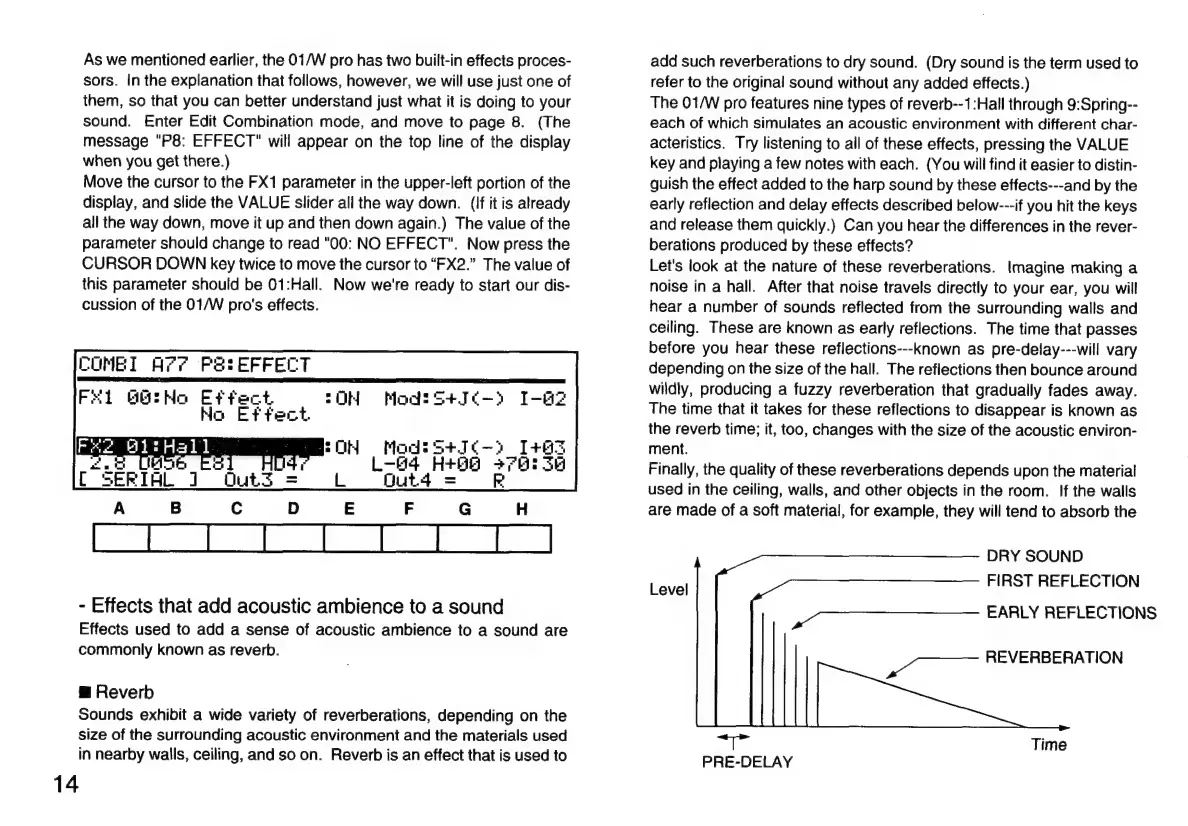
Let's
look
at
the
nature
of
these
reverberations.
Imagine
making
a
noise
in
a
hall.
After
that
noise
travels
directly
to
your
ear,
you
will
hear
a
number
of
sounds
reflected
from
the
surrounding
walls
and
ceiling.
These
are
known
as
early
reflections.
The
time
that
passes
before
you
hear
these
reflections---known
as
pre-delay---will
vary
depending
on
the
size
of
the
hall.
The
reflections
then
bounce
around
wildly,
producing
a
fuzzy
reverberation
that
gradually
fades
away.
The
time
that
it
takes
for
these
reflections
to
disappear
is
known
as
the
reverb
time;
it,
too,
changes
with
the
size
of
the
acoustic
environ-
ment.
Finally,
the
quality
of
these
reverberations
depends
upon
the
material
used
in
the
ceiling,
walls,
and
other
objects
in
the
room.
If
the
walls
are
made
of
a
soft
material,
for
example,
they
will
tend
to
absorb
the
DRY
SOUND
FIRST
REFLECTION
Level
a
a
EARLY
REFLECTIONS
a
REVERBERATION
Es
Time
PRE-DELAY

Related product manuals