EasyManua.ls Logo

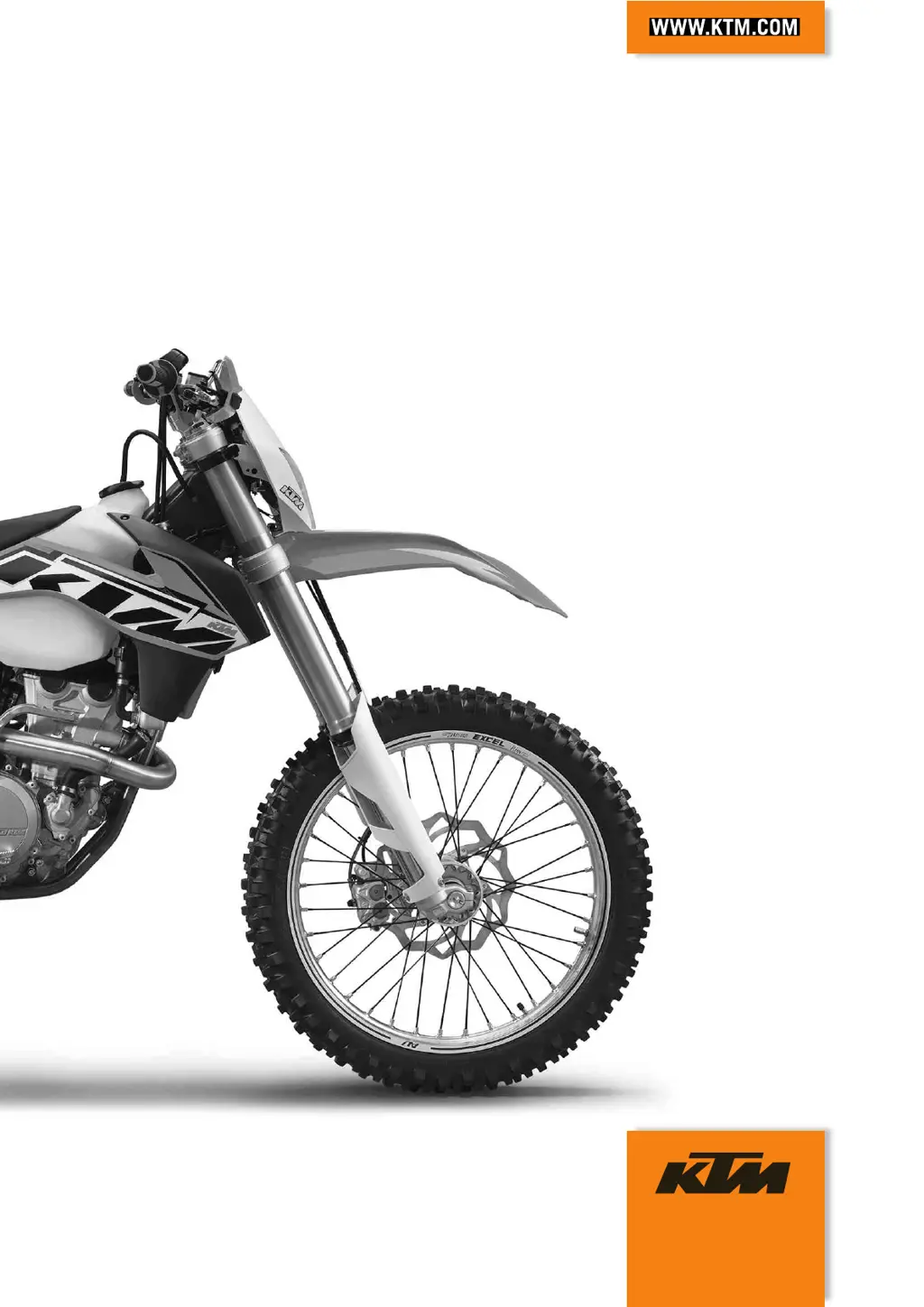
KTM 350 XCF-W USA - User Manual

KTM 350 XCF-W USA
136 pages
Print Icon
To Next Page IconTo Next Page
Loading...
OWNER'S MANUAL 2014
350 EXCF EU
350 EXCF SIX DAYS EU
350 EXCF AUS
350 XCFW USA
350 XCFW SIX DAYS USA
Art. no. 3213036en

Table of Contents

Questions and Answers

  • L
    Lisa BurtonSep 5, 2025
    Why is my KTM 350 XCF-W USA Motorcycle battery discharged?
    • J
      Judith MartinSep 6, 2025
      If your KTM Motorcycle battery is discharged, it could be because the battery is not being charged by the alternator, so check the charging voltage. Also, check the stator winding of the alternator and the closed current.
  • J
    Justin CervantesNov 20, 2025
    What to do if KTM Motorcycle engine turns but does not start?
    • J
      Jose StevensNov 20, 2025
      If your KTM Motorcycle engine turns over but fails to start, consider these possible causes: Ensure you are following the correct start procedure, as it could be an operating error. Check the fuel hose connection to make sure it's properly joined. A blown fuse 1 or fuse 2 could be the reason, so replace the affected fuse. Other potential issues include an incorrectly set idle speed (adjust the idle speed), a spark plug that is oily or wet (clean and dry the spark plug or replace it), or an electrode distance (plug gap) of the spark plug that is too wide (adjust the plug gap to 0.8 mm). Also, the ignition system could be defective, or there may be a short-circuit cable in the wiring harness, a defective kill switch or emergency OFF switch. Clean the plug connection and treat it with contact...
  • C
    Craig AguilarSep 18, 2025
    Why are the speedometer values deleted on my KTM 350 XCF-W USA?
    • D
      David PetersSep 18, 2025
      If the speedometer values (time, stop watch, lap times) are deleted on your KTM Motorcycle, it is likely that the battery in the speedometer is discharged. Change the speedometer battery to resolve this issue.
  • K
    kathrynwardSep 16, 2025
    What causes my KTM 350 XCF-W USA engine to overheat?
    • P
      Paul BallSep 16, 2025
      If your KTM Motorcycle engine overheats, it could be due to foam formation in the cooling system, a bent radiator hose, or a defective thermostat. Consider draining and refilling the coolant, replacing the radiator hose, or checking the thermostat, which should open at around 70 °C (158 °F).
  • K
    Kelsey CopelandSep 14, 2025
    How to fix the engine if my KTM Motorcycle cannot be cranked?
    • W
      williamlevineSep 14, 2025
      If the engine of your KTM Motorcycle cannot be cranked using the electric starter, it could be due to a discharged battery or a blown main fuse. Charge the battery or change the main fuse to resolve the issue.
  • H
    heather78Sep 12, 2025
    Why are the speedometer values deleted (time, stop watch, lap times) on my KTM Motorcycle?
    • R
      Renee WaltersSep 13, 2025
      If the speedometer values (time, stop watch, lap times) are deleted on your KTM Motorcycle, the battery in the speedometer may be discharged. Change the speedometer battery.
  • P
    Patricia WrightSep 12, 2025
    What to do if the high beam, low beam, parking light, tail light, and license plate lamp are not working on my KTM 350 XCF-W USA?
    • W
      William JeffersonSep 12, 2025
      If the high beam, low beam, parking light, tail light, and license plate lamp are not working on your KTM Motorcycle, it is possible that fuse 3 is blown. Replace the fuses of individual power consumers.
  • M
    Michael WilcoxSep 9, 2025
    What to do if the speedometer, horn, brake light, turn signal, and radiator fan are not working on my KTM Motorcycle?
    • J
      jasonclarkSep 9, 2025
      If the speedometer, horn, brake light, turn signal, and radiator fan are not working on your KTM Motorcycle, the cause may be that fuse 4 is blown. Replace the fuses of individual power consumers.
  • S
    Stephen WallaceSep 7, 2025
    What does it mean if the FI warning lamp (MIL) lights up or flashes on my KTM 350 XCF-W USA?
    • M
      Mr. Michael LangSep 7, 2025
      If the FI warning lamp (MIL) lights up or flashes on your KTM Motorcycle, it could indicate a defect in the fuel injection system, so stop the motorcycle and identify the faulty part using the blink code. Check the cabling for damage and the electrical plug-in connections for corrosion and damage. Also, read out the fault memory using the KTM diagnostics tool.
  • J
    Jessica BellAug 22, 2025
    What to do if KTM 350 XCF-W USA engine does not speed up?
    • R
      rpopeAug 22, 2025
      If your KTM Motorcycle engine does not speed up, there could be a defect in the fuel injection system. Also, the ignition system could be defective, so check the secondary winding of the ignition coil. Check the spark plug connector and the stator winding of the alternator.

Summary

1 Means of Representation

1.1 Symbols Used

Explains the meaning of various symbols used in the manual for clarity and safety.

1.2 Formats Used

Explains the typographical formats used in the document for consistent presentation.

2 Safety Advice

2.1 Use Definition - Intended Use

Defines the intended use of KTM sport motorcycles, specifying limitations and design purpose.

2.2 Safety Advice

General instructions for operating the vehicle safely, highlighting key warnings and information.

2.3 Degrees of Risk and Symbols

Explains risk categories (Danger, Warning, Caution, Note) and their associated symbols.

2.4 Tampering Warning

Warns against tampering with the noise control system and federal law prohibitions.

2.5 Safe Operation

Provides advice on safe operation, including dangers of accidents, poisoning, and burns.

2.6 Protective Clothing

Emphasizes wearing appropriate protective clothing for rider safety and legal compliance.

2.7 Work Rules

Outlines rules for performing work, including tool requirements and part replacement.

2.8 Environment

Advises on responsible motorcycle use and proper disposal of fluids and components.

2.9 Owners Manual

Stresses the importance of reading and keeping the owner's manual for proper operation and maintenance.

3 Important Notes

3.1 Guarantee, Warranty, and Service

Details warranty conditions, voiding clauses, and the importance of authorized service.

3.2 Operating and Auxiliary Substances

Advises on proper use of fuel and lubricants, and environmental hazards.

3.3 Spare Parts, Accessories, Figures, and Customer Service

Recommends approved parts, notes on figures, and how to contact customer service.

3.4 Service

Highlights the importance of regular service for operation and wear prevention.

4 View of Vehicle

4.1 View of Vehicle, Front Left (Example)

Illustrates the front left view of the motorcycle with numbered parts.

4.2 View of Vehicle, Rear Right (Example)

Illustrates the rear right view of the motorcycle with numbered parts.

5 Serial Numbers

5.1 Chassis Number

Shows the location of the chassis number stamped on the steering head.

5.2 Type Label

Shows the location of the type label fixed to the front of the steering head.

5.3 Key Number (All EXC-F models)

Shows the location of the key number stamped onto the key connector.

5.4 Engine Number

Shows the location of the engine number stamped on the left side of the engine.

5.5 Fork Part Number

Shows the location of the fork part number stamped on the inner side of the fork stub.

5.6 Shock Absorber Part Number

Shows the location of the shock absorber part number stamped on the shock absorber.

6 Controls

Clutch, Brake, and Throttle Controls

Describes the clutch lever, hand brake lever, and throttle grip operations.

Model-Specific Controls

Details kill switches, horn, light, and turn signal switches for different models.

Starter and Indicator Lamps

Explains electric starter buttons and provides an overview of indicator lamps for various models.

Fuel Filler Cap and Idle Speed Adjustment

Instructions for opening/closing the filler cap and adjusting idle speed.

Levers and Stands

Describes the shift lever, kick starter, foot brake lever, and side stand.

Steering Lock and Unlocking

Instructions for locking and unlocking the steering mechanism.

7 Speedometer

7.1 Speedometer Operations (EXC-F EU, AUS, XCF-W)

Covers overview, activation, unit settings, clock, and function adjustments for specific models.

7.2 Speedometer Operations (SIXDAYS Models)

Covers overview, activation, unit settings, clock, and function adjustments for SIXDAYS models.

8 Preparing for Use

8.1 Advice on First Use

Provides crucial advice before the first ride, including safety and controls familiarization.

8.2 Running-in the Engine

Details the procedure for running in the engine correctly to ensure longevity.

8.3 Preparing for Difficult Riding Conditions

Advises on preparing the vehicle for various challenging riding conditions.

8.4-8.8 Preparing for Specific Riding Conditions

Specific preparation steps for dry sand, wet sand, wet/muddy, hot/slow, and cold/snowy conditions.

9 Riding Instructions

9.1 Checks and Maintenance Before Use

Lists essential checks and maintenance tasks required before riding the vehicle.

9.2 Starting and 9.3 Starting Off

Instructions on how to start the engine and safely begin riding.

9.4 Shifting, Riding, and 9.5 Braking

Guidance on gear shifting, riding techniques, and essential braking instructions.

9.6 Stopping, Parking, 9.7 Transport, and 9.8 Refueling

Procedures for stopping, parking, transporting, and refueling the motorcycle.

10 Service Schedule

10.1 Service Schedule

Lists maintenance tasks required at different operating hour intervals.

10.2 Service Work (Additional Order)

Details service tasks that can be ordered separately and their recommended intervals.

11 Tuning the Chassis

11.1 Basic Suspension Setting and Rider Weight

How to adjust suspension based on rider weight for optimal performance.

11.2-11.5 Shock Absorber Damping Adjustments

Guide to adjusting low-speed, high-speed compression, and rebound damping.

11.6-11.8 Measuring and Checking Sag

Steps to measure and check static and riding sag of the shock absorber.

11.9-11.10 Shock Absorber and Fork Spring Adjustments

Guide to adjusting spring preload for shock absorber and riding sag.

11.11-11.14 Fork Adjustments

Checks and adjustments for fork basic setting, compression, rebound, and spring preload.

11.15-11.16 Handlebar Position Adjustments

Information on handlebar mounting positions and how to adjust handlebar position.

12 Service Work on the Chassis

12.1-12.4 General Chassis Maintenance

Procedures for raising/removing the motorcycle, bleeding fork legs, and cleaning dust boots.

12.5-12.8 Fork Component Service

Steps for loosening, positioning, removing, and installing fork protectors and legs.

12.9-12.14 Triple Clamp and Fender Service

Procedures for removing/installing fork protectors, triple clamps, and front fender.

12.15-12.18 Steering Head Bearing Maintenance

Checking and adjusting steering head bearing play, and greasing the bearing.

12.19-12.20 Front Fender Service

Steps for removing and installing the front fender.

12.21-12.24 Shock Absorber and Seat Service

Procedures for removing/installing shock absorber and seat.

12.25-12.33 Air Filter and Exhaust System Service

Maintenance for air filter box, air filter, and main silencer components.

12.34-12.35 Fuel Tank Service

Procedures for removing and installing the fuel tank.

12.36-12.40 Chain and Sprocket Maintenance

Checking chain condition, tension, and components; cleaning the chain.

12.41-12.43 Frame, Swingarm, and Cable Routing Checks

Checks for frame, swingarm damage, and throttle cable routing.

12.44-12.46 Rubber Grip and Clutch Lever Adjustments

Checking rubber grips and adjusting the basic position of the clutch lever.

12.47-12.48 Hydraulic Clutch Fluid Service

Checking/correcting and changing the hydraulic clutch fluid.

12.49-12.50 Engine Guard Service

Procedures for removing and installing the engine guard.

13 Brake System

13.1-13.3 Hand Brake Lever Checks and Adjustments

Checking and adjusting free travel and basic position of the hand brake lever.

13.4-13.6 Front Brake Disc and Fluid Checks

Checking brake discs, front brake fluid level, and adding front brake fluid.

13.7-13.8 Front Brake Linings Service

Checking and changing the front brake linings.

13.9-13.10 Foot Brake Lever Checks and Adjustments

Checking and adjusting free travel and basic position of the foot brake lever.

13.11-13.12 Rear Brake Fluid Checks

Checking rear brake fluid level and adding rear brake fluid.

13.13-13.14 Rear Brake Linings Service

Checking and changing the rear brake linings.

14 Wheels, Tires

14.1-14.2 Front Wheel Service

Procedures for removing and installing the front wheel.

14.3-14.4 Rear Wheel Service

Procedures for removing and installing the rear wheel.

14.5 Checking Tire Condition

How to check tire condition, tread depth, and age.

14.6 Checking Tire Air Pressure

How to check and set tire air pressure for different conditions.

14.7 Checking Spoke Tension

How to check and adjust spoke tension for wheel balance and integrity.

15 Electrical System

15.1-15.3 Battery Service

Procedures for removing, installing, and charging the battery.

15.4-15.5 Fuse Service

Procedures for changing the main fuse and fuses for individual power consumers.

15.6-15.8 Headlight and Bulb Service

Steps for removing/refitting headlight mask and changing headlight bulb.

15.9-15.10 Headlight Setting and Range Adjustment

How to check and adjust the headlight beam setting and range.

15.11-15.12 Turn Signal Bulb and Speedometer Battery

Procedures for changing turn signal bulb and speedometer battery.

16 Cooling System

16.1 Cooling System Overview

Overview of the cooling system, water pump, and radiator fan.

16.2-16.3 Antifreeze and Coolant Level Checks

How to check antifreeze protection and coolant level in the radiator.

16.4 Draining the Coolant

Procedure for draining the coolant from the system.

16.5 Refilling Coolant

Instructions for refilling the coolant into the system.

17 Tuning the Engine

17.1-17.2 Throttle Cable Play

How to check and adjust the play in the throttle cable.

17.3 Adjusting Idle Speed

How to adjust the engine idle speed for optimal performance.

17.4-17.5 Shift Lever Position

How to check and adjust the basic position of the shift lever.

18 Service Work on the Engine

18.1 Changing the Fuel Screen

Procedure for changing the fuel screen in the fuel line.

18.2 Checking the Engine Oil Level

How to check the engine oil level when cold or warm.

18.3 Changing Engine Oil, Oil Filter, and Oil Screen

Procedure for changing engine oil, oil filter, and cleaning the oil screen.

18.4 Adding Engine Oil

Instructions for adding engine oil, including recommended types.

19 Cleaning, Care

19.1 Cleaning the Motorcycle

Instructions for cleaning the motorcycle, including safety and material damage warnings.

19.2 Checks and Maintenance for Winter Operation

Maintenance steps for winter operation and protection against salt corrosion.

20 Storage

20.1 Storage

Steps for storing the motorcycle for longer periods, including fuel and battery care.

20.2 Preparing for Use After Storage

Steps to prepare the motorcycle for use after it has been stored.

21 Troubleshooting

Common Faults, Causes, and Actions

Lists common faults, their possible causes, and recommended actions for resolution.

Engine Overheating and FI Warning Lamp

Troubleshooting for engine overheating and FI warning lamp issues.

High Oil Consumption and Battery Issues

Troubleshooting for high oil consumption, battery discharge, and speedometer errors.

22 Blink Code

FI Warning Lamp (MIL) Blink Codes

Lists blink codes for the FI warning lamp and their corresponding error level conditions.

23 Technical Data

23.1 Engine Specifications

Provides detailed specifications for the engine, including design and dimensions.

23.2 Engine Tightening Torques

Lists tightening torques for various engine components.

23.3 Capacities and 23.4 Chassis Specifications

Lists capacities for fluids and detailed chassis specifications.

23.5 Electrical System and 23.6 Tires

Specifications for electrical components and tire requirements.

23.7 Fork Specifications

Detailed fork specifications, including damping and spring settings for different models.

23.8 Shock Absorber Specifications

Provides detailed specifications for the shock absorber, including damping settings.

23.9 Chassis Tightening Torques

Lists tightening torques for various chassis components.

24 Substances

Brake Fluid, Coolant, and Engine Oil Specifications

Details specifications and recommendations for brake fluid, coolant, and engine oils.

Fork Oil, Shock Absorber Oil, and Fuel Specifications

Details specifications for fork oil, shock absorber oil, and fuel grades.

25 Auxiliary Substances

Recommended Cleaning and Maintenance Products

Recommends specific Motorex® and SKF® products for various maintenance tasks.

Specialized Lubricants and Adhesives

Recommends specialized lubricants, adhesives, and sprays for motorcycle care.

26 Standards

JASO T903 MA Standard Explained

Explains the JASO T903 MA standard for 4-stroke motorcycle engine oils.

SAE Viscosity Classification

Explains the SAE viscosity classification system for oils.

KTM 350 XCF-W USA Specifications

General IconGeneral
Displacement349.7 cc
Bore x Stroke88 mm x 57.5 mm
Transmission6-speed
Final DriveChain
Front SuspensionWP XPLOR USD Fork, 48 mm
Rear SuspensionWP XPLOR PDS Shock
Front BrakeDisc brake
Rear BrakeDisc brake
StarterElectric
Engine TypeSingle cylinder, 4-stroke
Fuel SystemElectronic Fuel Injection
Seat Height950 mm
CoolingLiquid

Related product manuals