
 Need help?
Do you have a question about the Kustom Signals Golden Eagle II and is the answer not in the manual?
Details general type, frequency, tuning forks, band selection, system accuracy, and voltage requirements.
Describes speed processor, operational processor, manual test, and automatic self-test features.
Procedures for inspecting the unit for damage and listing supplied components.
Details on mounting the auxiliary power receptacle and indicator unit.
Instructions for mounting front and rear antennas and setting up the system.
Guide to connecting the speedometer pulse cable for Tru-Trak feature and auto mode switching.
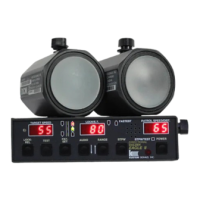
Explanation of the front panel layout, windows, and indicators (A-P).
Details the various connectors on the rear panel of the processing unit.
Description of the remote control layout and its functions.
Explains Doppler principles, groundspeed, target speed, and different operating modes.
Discusses RF emission levels and safety standards for traffic radar.
Details the importance of tuning fork tests and the power-on self-test sequence.
Procedures for antenna testing, automatic self-tests, and manual diagnostic tests.
Guides on performing tuning fork tests for stationary and moving modes.
Detailed steps for tuning fork tests in stationary and moving opposite direction modes.
Steps for performing tuning fork tests in the same direction moving mode.
Procedures for moving mode accuracy verification and speedometer input synchronization.
Lists and briefly describes the 7 different operating modes of the radar system.
Guide to selecting a location, adjusting audio levels, and toggling squelched/unsquelched audio.
Instructions for setting range and managing the fan interference filter.
Step-by-step guide for operating the radar in stationary mode.
How to use the fastest vehicle mode in stationary operation.
Procedure for operating in moving mode, opposite direction, including setting minimum patrol speed.
How to use the fastest vehicle mode in moving operation.
Procedure for operating in moving mode, same direction, including SLOWER switch use.
Detailed instructions for using the stopwatch mode to measure speed and time.
Explains speedometer pulse operation and Automatic Mode Switching (AMS).
Details the Smart Patrol Search software routines for reducing shadowing and combining.
How to set the fan interference filter and access maintenance mode.
Discusses external influences affecting radar operation and natural interference sources.
Details man-made interference like shadowing, combined speeds, RFI, and fan noise.
Explains groundspeed requirements and operator responsibility for tracking history.
Covers selectable ground speed settings and effects of weather on radar operation.
Guidelines for cleaning the radar unit, avoiding high pressure spray, and handling components.
Discusses periodic maintenance, antenna cable issues, and receiver diode degradation.
Summarizes landmark legal cases related to Doppler radar accuracy and operator training.
Explains FCC amendments regarding transmitter power measurement and specifications.
Details the elimination of separate authorization for radar speed detection devices.
Solutions for issues like no power indication or incomplete test cycles showing error messages.
Troubleshooting steps for no target speeds or no patrol speed during tuning fork tests.
Solutions for no target readings in stationary mode and speedometer input synchronization problems.
Troubleshooting for no target readings in moving mode and short range problems.
Troubleshooting speedometer input synchronization and target obstruction issues.
Troubleshooting moving mode, fan interference, and intermittent readings.
Addresses fan interference and short range issues, including electrical influences.
Lists adjustable parameters like auto unlock, alarm, serial output, and speed units.
Detailed descriptions of automatic unlocking, auto alarm/lock, and serial output options.
Explains fastest operation modes and setting speed display units (MPH/km/h).
Provides examples and instructions for setting and making permanent unit options.
Certificate confirming compliance with European CE standards for the radar unit.
Certificate confirming compliance with Australian/New Zealand standards for the radar unit.
 General
| Accuracy | +/- 1 mph (+/- 1.6 km/h) |
|---|---|
| Operating Frequency | 24.150 GHz |
| Range | Up to 1 mile (1.6 km) |
| Operating Voltage | 10.5 - 16 VDC |
| Operating Temperature | -30°C to +60°C |

 To Next Page