Need help?
Do you have a question about the Kustom 72 Coupe and is the answer not in the manual?
Includes Clean Volume, Lead Volume, Treble, Bass, Mid, Bright, and Master controls for sound shaping.
Detailed schematic for the vibrato effect, including related components and connections.
Schematic diagram for the reverb effect, showing its components and integration.
Controls for activating and managing the tremolo effect via footswitch.
Diagram of various DC voltage rails (+300V, -13V, etc.) generated for amplifier operation.
Wiring and connections for the vacuum tube filaments.
Schematic details for standby switch and pilot indicator lights.
Configuration of the output transformer and impedance selection for speakers.
Connections for external and internal speaker outputs.
Controls for adjusting the intensity and character of the reverb effect.
Detailed schematic for the tremolo effect control and modulation.
Controls for channel boost and signal muting.
Schematic for the direct output signal path, often used for recording or PA systems.
Connection points and circuitry for the feedback loop.
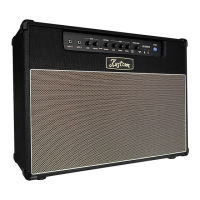
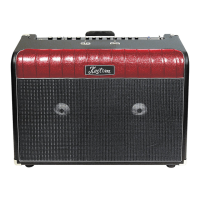
The Kustom '72 Coupe is a versatile guitar amplifier designed to deliver a wide range of tones, from pristine cleans to aggressive overdriven sounds, with a focus on tube-driven warmth and responsiveness. This amplifier is engineered for both stage and studio use, offering a comprehensive set of features for tone shaping, effects integration, and output flexibility.
The '72 Coupe operates as a multi-channel tube guitar amplifier, incorporating both solid-state and vacuum tube circuitry to achieve its sonic characteristics. It features a preamp section with distinct "Clean" and "Lead" channels, each offering unique tonal palettes. The "Clean" channel is designed for transparent and articulate sounds, while the "Lead" channel provides various levels of gain and saturation for rock, blues, and metal genres.
The amplifier's core tone generation relies on a series of 12AX7 preamp tubes, which contribute to its characteristic warmth, harmonic richness, and dynamic response. Following the preamp, the signal is fed into a power amplifier section utilizing 6L6/EL34 power tubes, known for their robust output and classic tube compression. The power amplifier drives the speaker output, delivering the final amplified signal to connected speaker cabinets.
Beyond its fundamental amplification capabilities, the '72 Coupe integrates several built-in effects and tone-modifying features. A "Reverb" effect provides spatial depth, simulating the acoustics of different environments. A "Tremolo" effect introduces a pulsating volume modulation, adding a vintage textural element to the sound. Both effects are controllable via dedicated parameters, allowing users to dial in their desired intensity and character.
The amplifier also includes a "Boost" function, which can be engaged to increase the overall gain and volume, providing an extra push for solos or heavier rhythm parts. This feature is often used in conjunction with the "Lead" channel to achieve higher levels of distortion.
For silent practice, recording, or direct integration with mixing consoles, the '72 Coupe incorporates a "Direct Out" feature. This output provides a line-level signal that can be sent to external devices, often with speaker simulation to replicate the sound of a miked cabinet without the need for an actual speaker.
The amplifier's power supply is designed to provide stable and clean voltage to all its internal components, ensuring consistent performance and optimal tube operation. It includes various filtering and regulation stages to minimize noise and ripple, contributing to the amplifier's overall sonic clarity.
The '72 Coupe offers a highly interactive user experience through its front panel controls and footswitch capabilities.
The amplifier provides multiple input jacks, typically labeled "HI GAIN IN" and "LO GAIN IN." These inputs are designed to accommodate guitars with different output levels. The "HI GAIN IN" is suitable for guitars with lower output pickups, providing more gain to drive the preamp, while the "LO GAIN IN" is ideal for guitars with higher output pickups, preventing excessive clipping at the input stage.
The amplifier features a "Channel" switch, allowing users to toggle between the "Clean" and "Lead" channels. This switch can often be controlled remotely via a footswitch for seamless transitions during live performances.
The "Clean" channel typically includes a "Clean Volume" control to adjust the output level of this channel. Depending on the design, it may also have dedicated tone controls (e.g., Bass, Mid, Treble) to shape the clean sound.
The "Lead" channel offers a more extensive set of controls for shaping distorted tones. A "Lead Volume" control sets the output level, while a "Gain" or "Drive" control adjusts the amount of distortion. Tone controls (Bass, Mid, Treble) are usually present, allowing for precise sculpting of the overdriven sound. A "Bright" switch or control might be included to add sparkle and presence to the lead tones.
A "Lead Master" control typically adjusts the overall output volume of the "Lead" channel, independent of the "Lead Volume" control. This allows for setting the desired amount of distortion with the "Lead Volume" and then controlling the overall loudness with the "Lead Master." A "Clean Master" control might also be present for the clean channel.
The "Reverb" effect is controlled by a dedicated "Reverb Volume" or "Reverb Level" knob, which adjusts the intensity of the reverberation. The "Tremolo" effect usually has controls for "Speed" and "Depth," allowing users to set the rate and intensity of the volume modulation. An "Active On/Off" switch or control is often provided to engage or disengage the tremolo effect.
A "Boost" switch or button activates the boost circuit, increasing the amplifier's gain and volume. This can be used as a momentary switch or a toggle, depending on the design.
The '72 Coupe is designed to be highly controllable via a multi-button footswitch. Common footswitch functions include:
The amplifier provides multiple speaker output jacks, typically labeled for different impedance loads (e.g., 4 ohms, 8 ohms, 16 ohms). An "Impedance Selector" switch allows users to match the amplifier's output impedance to the impedance of the connected speaker cabinet(s). This is crucial for optimal performance and to prevent damage to the amplifier. The amplifier may also include an "INT SPKR" (internal speaker) and "EXT SPKR" (external speaker) output, allowing for connection to an internal speaker or an additional external cabinet.
The "Direct Out" feature includes a "Direct Out Level" control, allowing users to adjust the output volume of the direct signal. This output is typically an XLR jack, suitable for connecting to mixing consoles, audio interfaces, or recording equipment.
A "STANDBY" switch is a critical feature for tube amplifiers. It allows the tubes to warm up gradually before applying high voltage, extending their lifespan. Users typically power on the amplifier, wait a minute or two in standby mode, and then switch to "Play" mode.
The main "POWER" switch turns the amplifier on and off.
A "PILOT" light indicates when the amplifier is powered on.
Maintaining the '72 Coupe ensures its longevity and consistent performance. While specific maintenance procedures should always follow the official user manual, general aspects include:
As a tube amplifier, the vacuum tubes (12AX7 preamp tubes and 6L6/EL34 power tubes) are consumable components that will eventually need replacement. The amplifier's design allows for relatively straightforward access to the tubes. When replacing tubes, it's generally recommended to replace power tubes in matched sets and to bias the amplifier if necessary (a procedure often best performed by a qualified technician). Preamp tubes can usually be replaced individually without biasing.
The amplifier is protected by various fuses (e.g., F1, F2, F3, F4) that safeguard against electrical overloads. If the amplifier fails to power on or experiences other electrical issues, checking and replacing blown fuses with the correct type and rating is a common maintenance task. Always ensure the amplifier is unplugged before attempting fuse replacement.
Regular cleaning of the amplifier's exterior, including the chassis, knobs, and jacks, helps prevent dust and grime buildup. A soft, dry cloth is usually sufficient. Avoid using abrasive cleaners or solvents that could damage the finish.
Ensure that the amplifier has adequate ventilation during operation. The chassis and cabinet are designed with vents to dissipate heat generated by the tubes and other components. Blocking these vents can lead to overheating and potential damage.
Periodically inspect all cables connected to the amplifier (power cable, instrument cables, speaker cables) for any signs of wear, fraying, or damage. Damaged cables can cause intermittent issues, noise, or even electrical hazards.
Over time, potentiometers (knobs) and switches can accumulate dust and dirt, leading to scratchy sounds or intermittent operation. While this is often best addressed by a technician, specialized contact cleaner sprays can sometimes be used to clean these components, following proper safety precautions.
The amplifier's internal components, such as capacitors and resistors, are designed for long-term reliability. However, like all electronic devices, they have a finite lifespan. If the amplifier develops persistent issues that are not resolved by tube or fuse replacement, professional servicing may be required to diagnose and replace faulty internal components.
When not in use, store the amplifier in a dry, temperature-controlled environment, away from extreme humidity or direct sunlight, to prevent damage to its electronic components and cabinet materials. Using a protective cover can also help keep dust out.
 General
| Technology | Tube |
|---|---|
| Model | 72 Coupe |
| Number of Channels | 2 |
| Effects | Reverb |
| Effects Loop | Yes |
| Speaker | 1x12" |
| Controls | Volume, Treble, Middle, Bass, Master Volume |
| Amplifier Type | Guitar Combo Amplifier |
| Outputs | 1 |

 To Next Page