6-10. Measuring h
FE
(DC Current Amplification Factor)
#
CAUTION:
With the germanium transistor, the leakage current flows into
the collector side, causing that much error in leakage current
measurements. Therefore, obtain a true value of leakage current
by deducting a h
FE
value equivalent to the leakage current from the
measured value.
⑴
The following will explain about the principle of h
FE
measurements.
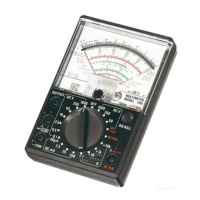
As shown in Fig. 7, the collector and emitter of a transistor are
connected to the multimeter. When a resistor R of a certain
resistance value (approx. 24kΩ) is connected across the N (
−
COM)
terminal of the instrument and the base of the transistor, base-
terminal current I
B
, determined by R (approx. 24kΩ), flows and current
I
C
, multiplied by h
FE
, also flows into the collector of the transistor,
resulting in the increase of DC current and thus causing the meter
indication to change notably.
Theoretically, the h
FE
(=l
C
/l
B
) of a transistor (DC current amplification
factor) can be measured by plotting the amount of the current change
on a separate h
FE
scale.
The h
FE
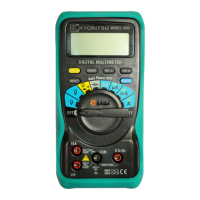
scale for KEW1109S is marked for the 24kΩ R (approx.
100μA base current at 3V LV).
Fig. 7


 To Next Page
 Loading...