EasyManua.ls Logo

L-TEC PCM-70 - Maintenance; Common Cutting Faults; Inspection and Cleaning; Flow Testing

L-TEC PCM-70
12 pages
Print Icon
To Next Page IconTo Next Page
To Previous Page IconTo Previous Page
Loading...
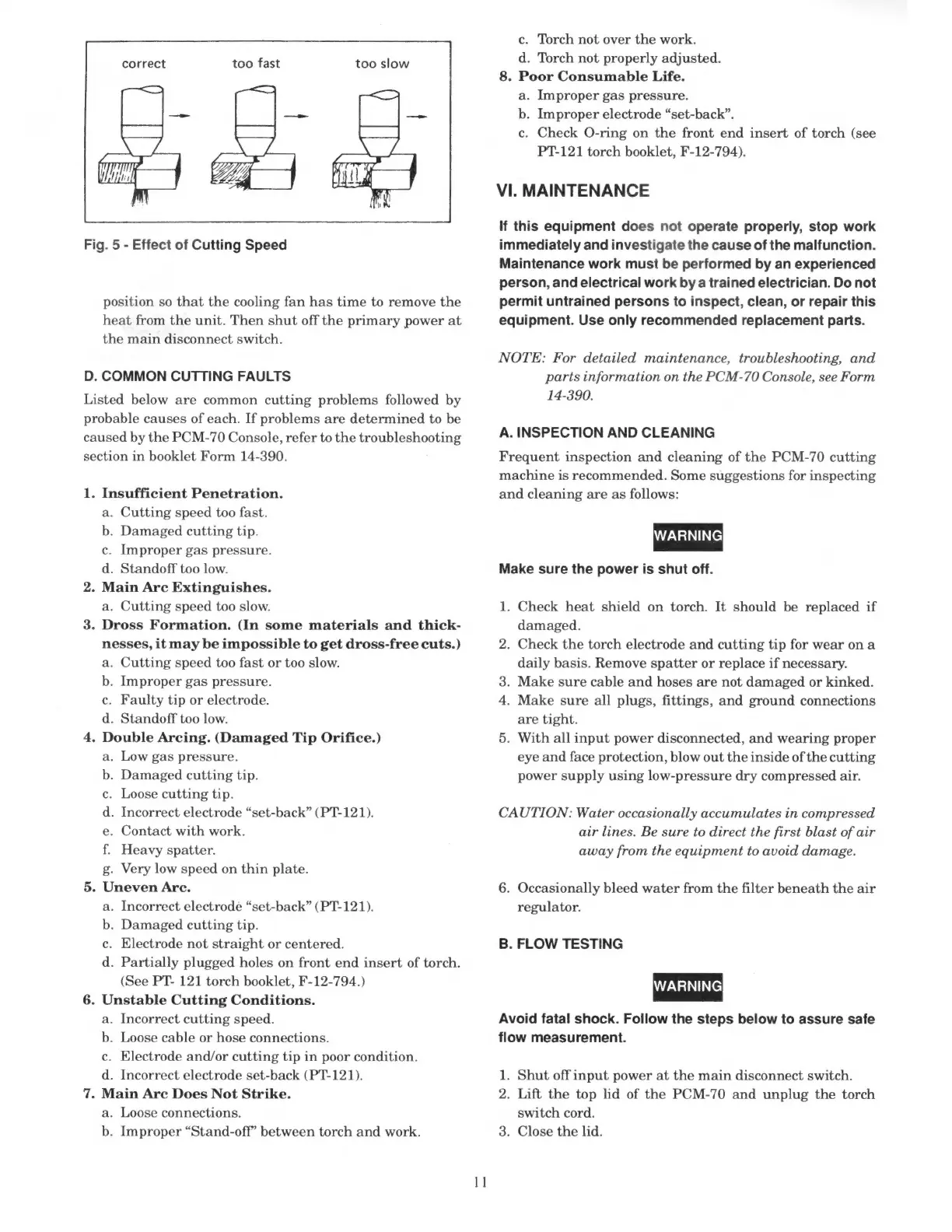
too
slow
too
fast
correct
Fig.
5
-
Effect
of
Cutting
Speed
D.
position
so
that
the
cooling
fan
has
time
to
remove
the
heat
from
the
unit.
Then
shut
off
the
primary
power
at
the
main
disconnect
switch.
COMMON
CUTTING
FAULTS
Listed
below
are
common
cutting
problems
followed
by
probable
causes
of
each.
If
problems
are
determined
to
be
caused
by
the
PCM-70
Console,
refer
to
the
troubleshooting
section
in
booklet
Form
14-390.
ppo
Ep
em
rap
pp
E
P
Insufficient
Penetration.
a.
Cutting
speed
too
fast.
b.
Damaged
cutting
tip.
c.
Improper
gas
pressure.
d.
Standoff
too
low.
.
Main
Arc
Extinguishes.
a.
Cutting
speed
too
slow.
.
Dross
Formation.
(In
some
materials
and
thick-
nesses,
it
may
be
impossible
to
get
dross-free
cuts.)
a.
Cutting
speed
too
fast
or
too
slow.
b.
Improper
gas
pressure.
c.
Faulty
tip
or
electrode.
d.
Standoff
too
low.
.
Double
Arcing.
(Damaged
Tip
Orifice.)
.
Low
gas
pressure.
.
Damaged
cutting
tip.
Loose
cutting
tip.
.
Incorrect electrode
“set-back”
(PT-121).
.
Contact
with
work.
Heavy
spatter.
.
Very
low
speed
on
thin
plate.
neven
Arc.
.
Incorrect
electrode
“set-back”
(PT-121).
.
Damaged
cutting
tip.
Electrode
not
straight
or
centered.
.
Partially
plugged
holes
on
front
end
insert
of
torch.
(See
PT-
121
torch
booklet,
F-12-794.)
.
Unstable
Cutting
Conditions.
a.
Incorrect
cutting
speed.
b.
Loose
cable
or
hose
connections.
c.
Electrode
and/or
cutting
tip
in
poor
condition.
d.
Incorrect electrode
set-back
(PT-121).
.
Main
Arc
Does
Not
Strike.
a.
Loose
connections.
b.
Improper
*Stand-off"
between
torch
and
work.
11
c.
Torch
not
over
the
work.
d.
Torch
not
properly
adjusted.
8.
Poor
Consumable
Life.
a.
Improper
gas
pressure.
b.
Improper
electrode
“set-back”.
c.
Check
O-ring
on
the
front
end
insert
of
torch
(see
PT-121
torch
booklet,
F-12-794).
Vi.
MAINTENANCE
If
this
equipment
does
not
operate
properly,
stop
work
immediately
and
investigate
the
cause
of
the
malfunction.
Maintenance
work
must
be
performed
by
an
experienced
person,
and
electrical
work
by
a
trained
electrician.
Do
not
permit
untrained
persons
to
inspect,
clean,
or
repair
this
equipment.
Use
only
recommended
replacement
parts.
NOTE:
For
detailed
maintenance,
troubleshooting,
and
parts
information
on
the
PCM-70
Console,
see
Form
14-390.
A.
INSPECTION
AND
CLEANING
Frequent
inspection
and
cleaning
of
the
PCM-70
cutting
machine
is
recommended.
Some
suggestions
for
inspecting
and
cleaning
are
as
follows:
WARNING
Make
sure
the
power
is
shut
off.
1.
Check
heat
shield
on
torch.
It
should
be
replaced
if
damaged.
2.
Check
the
torch
electrode
and
cutting
tip
for
wear
on
a
daily
basis.
Remove
spatter
or
replace
if
necessary.
.
Make
sure
cable
and
hoses
are
not
damaged
or
kinked.
4.
Make
sure
all
plugs,
fittings,
and
ground
connections
are
tight.
5.
With
all
input
power
disconnected,
and
wearing
proper
eye
and
face
protection,
blow
out
the
inside
ofthe
cutting
power
supply
using
low-pressure
dry
compressed
air.
e
CAUTION:
Water
occasionally
accumulates
in
compressed
air
lines.
Be
sure
to
direct
the
first
blast
of
air
away
from
the
equipment
to
avoid
damage.
6.
Occasionally
bleed
water
from
the
filter
beneath
the
air
regulator.
B.
FLOW
TESTING
WARNING
Avoid
fatal
shock. Follow
the
steps
below
to
assure
safe
flow
measurement.
1.
Shut
off
input
power
at
the
main
disconnect
switch.
2.
Lift
the
top
lid
of
the
PCM-70
and
unplug
the
torch
switch
cord.
3.
Close
the
lid.