EasyManua.ls Logo

L-TEC PCM-70 - Optional Accessories; Installation; Primary Input Electrical Connection; Inspection and Placement

L-TEC PCM-70
12 pages
Print Icon
To Next Page IconTo Next Page
To Previous Page IconTo Previous Page
Loading...
C.
OPTIONAL
ACCESSORIES
1.
Drag
Type
Shield
Guard,
P/N
19989
(PT-17A)
Protects
the
heat
shield
and
permits
the
operator
to
drag
a
manual
torch
on
the
plate
while
cutting.
Thus
main-
taining
a
fixed
stand-off
(tip-to-work
distance)
throughout
the
cut
resulting
in
a
uniform
appearance
of
the
cut
edge.
Two
drag
type
guards
are
supplied
with
each
spare
parts
kit.
2.
Standard
Shield
Guard,
P/N
19990
(non
drag
type)
(PT-17A)
Protects
the
shield
against
accidental
breakage
on
both
manual
and
mechanized
torches.
One
standard
guard
is
supplied
with
each
spare
parts
kit.
3.
Drag
Type
Heat
Shield,
P/N
999620
(PT-121)
Slightly
longer
than
a
standard
heat
shield
and
slotted
permitting
the
operator
to
drag
a
manual
torch
along
the
plate
during
a
cut.
This
maintains
a
fixed
standoff
(tip-to-work
distance)
throughout
the
cut
providing
a
uniform
appearance
of
the
cut
plate
edge.
4.
Circle
Cutting
Attachment,
P/N
19897
(PT-17A);
P/N
999696
(PT-121)
Permits
cutting
accurate
circles
from
4-1/2-in.
to
22-in.
in
diameter
with
a
manual
torch.
The
attachment
includes
a
head
and
radius
bar
assembly,
center-point/adaptor,
and
dual
swivel
castor
assembly.
Cuts
can
be
made
inside
or
outside
the
circle.
The
torch
head
is
always
held
vertical
during
the
cutting
operation.
An
accessory
extension
bar
(P/N
163223)
is
also
available
for
cutting
larger
circles
up
to
44-in.
in
diameter.
The
attachment
is
also
handy
for
maintaining
`
a
constant
standoff
in
other
types
of
cutting.
5.
Plasma
Gas
Flow
Measuring
Kit,
P/N
19765
This
kit
is
used
for
checking
gas
flows
through
torch.
See
Section
VI-B.
IV.
INSTALLATION
Proper
installation
can
contribute
materially
to
satisfac-
tory
and
trouble-free
operation
of
the
cutting
outfit.
It
is
suggested
that
each
step
in
this
section
be
studied
carefully
and
followed
as
closely
as
possible.
A.
INSPECTION
AND
PLACEMENT
1.
Having
removed
the
shipping
container,
and
before
removing
the
skid,
inspect
for
evidence
of
concealed
damage
which
may
not
have
been
apparent
upon
receipt
of
the
unit.
Notify
the
carrier
of
any
defects
or
damage
at
once.
2.
Check
the
container
for
any
loose
parts.
Check
air
pas-
sages
on
rear
panel
of
cabinet
for
any
packing
materials
that
may
obstruct
air
flow
through
the
power
supply.
3.
On
PCM-70/PT-121
packages,
mount
the
components
of
the
TR-
21SP
truck
and
cylinder
kit
(680793)
as
directed
by
F-14-414
packed
with
the
kit.
4.
The
machine
components
are
maintained
at
proper
operating
temperatures
by
forced
air
which
is
drawn
through
the
front
panel
louvers
and
holes
in
the
base
and
out
the
rear
panel
by
a
heavy-duty
fan.
Locate
the
machine
in
an
open
area
where
air
can
circulate
freely
through
the
openings.
Leave
at
least
two
feet
of
clearance
between
the
unit
and
wall
or
other
obstruc-
tion.
The
area
around
the
unit
should
be
relatively
free
of
dust,
fumes
and
excessive
heat.
B.
PRIMARY
INPUT
ELECTRICAL
CONNECTION
WARNING
Precautionary
measures
should
be
taken
to
provide
max-
imum
protection
against
electrical
shock.
Be
sure
that
all
power
is
off
by
opening
the
line
(wall)
disconnect
switch
and
unplug
the
power
cord
to
the
unit
when
primary
electrical
connections
are
made
to
the
power
supply.
1.
A
line
(wall)
disconnect
switch,
with
fuse
or
circuit
breakers,
should
be
provided
at
the
main
power
panel.
The
primary
power
leads
should
be
insulated
copper
conductors,
and
include
three
power
leads
(two
if
using
single-phase)
and
one
ground
wire.
The
wires
may
be
heavy
rubber
covered
cable,
or
may
be
run
in
a
solid
or
flexible
conduit.
Refer
to
Table
6
for
recommended
input
conductors
and
line
fuse
sizes.
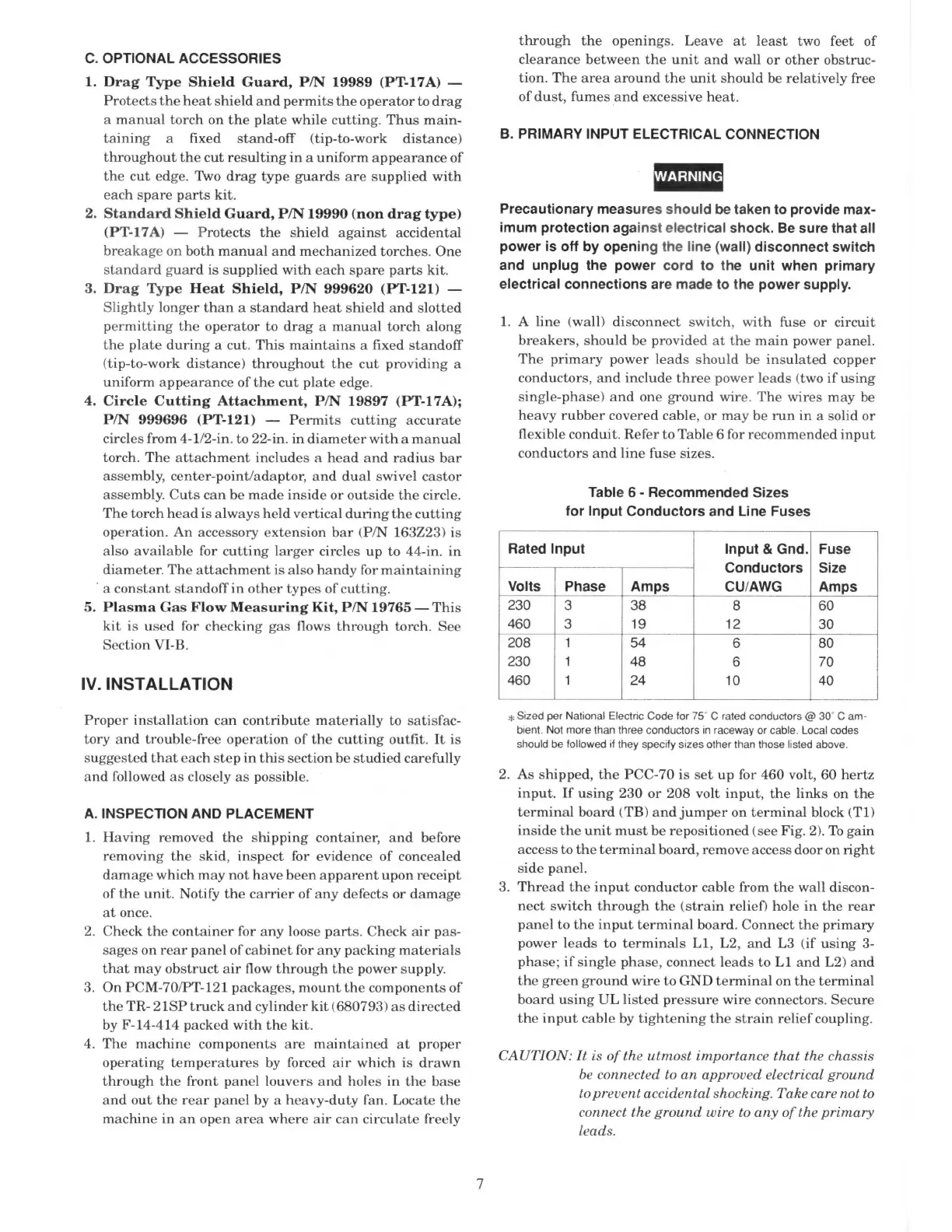
Table
6
-
Recommended
Sizes
for
Input
Conductors
and
Line
Fuses
Rated
Input
Input
&
Gnd.|
Fuse
Conductors
|
Size
Volts
|
Phase
|
Amps
CU/AWG
Amps
230
3
38
8
60
460
3
19
12
30
|208
|1
54
EI
6
80
230
1
48
6
70
460
1
24
10
40
sx:
Sized
per
National
Electric
Code
for
75°
C
rated
conductors
@
30°
C
am-
bient.
Not
more
than
three
conductors
in
raceway
or
cable.
Local
codes
should
be
followed
if
they
specify
sizes other
than
those
listed
above.
2.
As
shipped,
the
PCC-70
is
set
up
for
460
volt,
60
hertz
input.
If
using
230
or
208
volt
input,
the
links
on
the
terminal
board
(
TB)
and
jumper
on
terminal
block
(T1)
inside
the
unit
must
be
repositioned
(see
Fig.
2).
To
gain
access
to
the
terminal
board,
remove
access
door
on
right
side
panel.
3.
Thread
the
input
conductor
cable
from
the
wall
discon-
nect
switch
through
the
(strain
relief)
hole
in
the
rear
panel
to
the
input
terminal
board.
Connect
the
primary
power
leads
to
terminals
L1,
L2,
and
L3
(if
using
3-
phase;
if
single
phase,
connect
leads
to
L1
and
L2)
and
the
green
ground
wire
to
GND
terminal
on
the
terminal
board
using
UL
listed
pressure
wire
connectors.
Secure
the
input
cable
by
tightening
the
strain
relief
coupling.
CAUTION:
It
is
of
the
utmost
importance
that
the
chassis
be
connected
to
an
approved
electrical
ground
to
prevent
accidental
shocking.
Take
care
not
to
connect
the
ground
wire
to
any
of
the
primary
leads.