utilising higher MLS
TM
positions when connected to lower impedance's
see Table 2.
As you can see from Table 2 the LAB 2000C can produce in excess
of 1000 watts.
LAB 2000C MLS switch MLS Position
Speaker Impedance 1.5 ohms 2 ohms 4 ohms 8 ohms
16 ohms Stereo 2x 160W 180W 340W 520W
8 ohms Stereo 2x 300W 350W 650W 1000W
4 ohms Stereo 2x 570W 680W 1100W 1400W
2 ohms Stereo 2x 1040 1200W 1400W *
8 ohms Bridged mono 1x 1200W 1400W 2300W 2800W
4 ohms Bridged mono 1x 2100W 2400W 2800W *
Power rating at 1 kHz and 1% THD
* Not recomended selection, thermal protection may occur at high continous power.
Table 2.
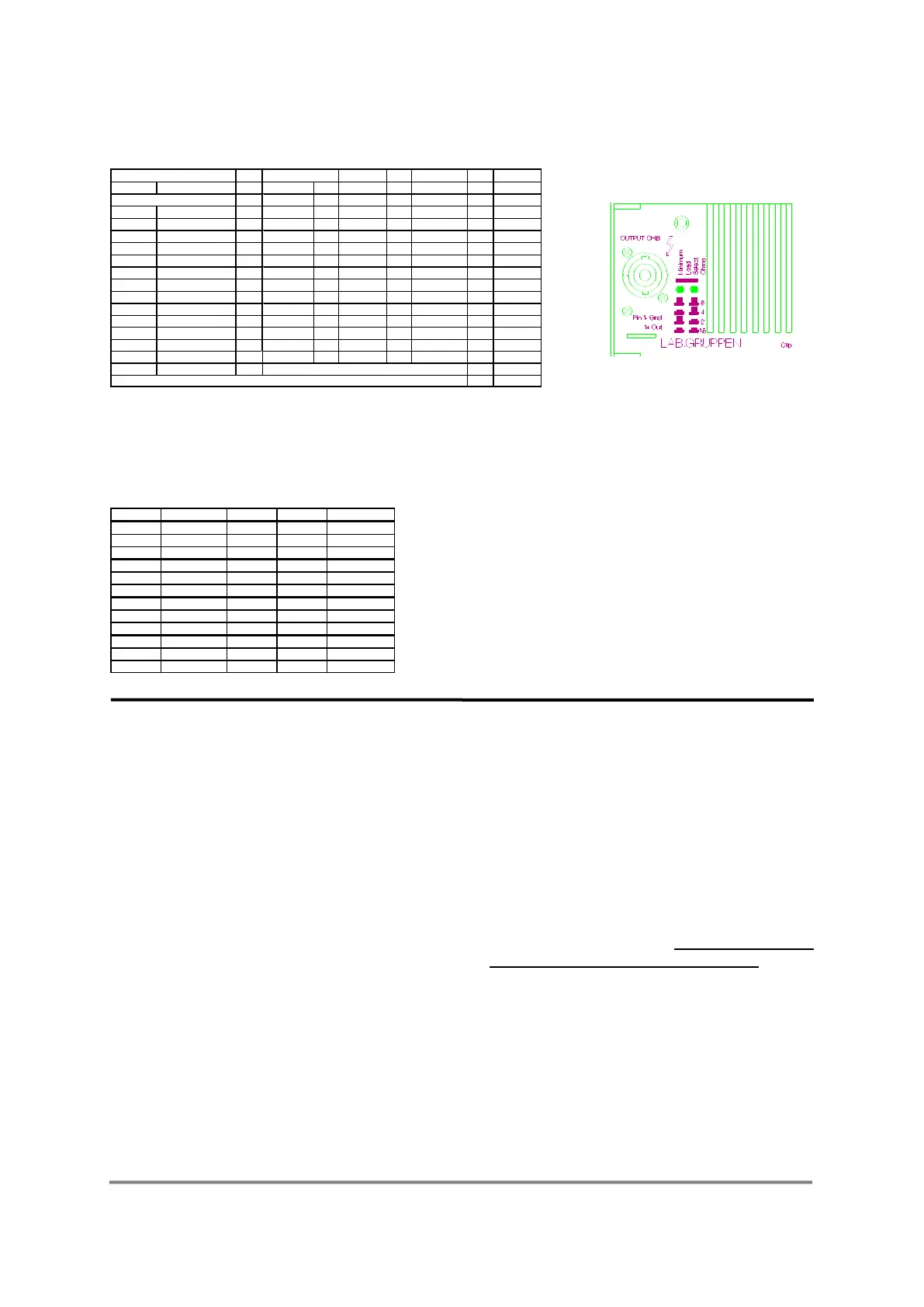
Figure 10. MLS switches on rear panel
MLS
TM
positions can be different for each channel
and a variety of combinations can be achieved see
Table 3.
Channel Impedance MLS Power Comments
Table 3.
The way to find the best MLS
TM
position for your
application is by experimentation, the amplifier is
very well protected (even down to 0.3 ohms), but
where speed is of essence stick to the fixed positions.
The thing to remember with the LAB 2000C that it is
a power converter and when you select MLS
TM
positions you are allocating a portion of power from
3000 watts.
Operation modes
1. Stereo operation
For stereo (dual channel ) operation, leave the Link
and Phase reverse switches in the undepressed
position. In this mode, both channels operate
independently of each other, with their level
attenuators controlling their respective levels.
Never connect either output terminal to ground
or in parallel. The recommended minimum
nominal impedance, for stereo or tandem operation,
is 2 ohms per channel.
2. Tandem mono
For tandem ( dual channel-single input) operation ,
depress the Link switch. Both channels can now be
driven by a signal, at either input connector. The
output connection is the same as in stereo mode.
You can use either TRS connectors for linking out
etc. Do not use the remaining XLR and TRS
connectors for mixing or other purposes. Both
level attenuators are active, allowing you to set
different levels for each channel.
Never connect either output terminal to ground
or in parallel.
3. Bridged mono
To bridge the amplifier, depress the Link switch (7)
and Phase reverse switch (6). Both channels are then
driven by a single signal at either input. You can
use any remaining input connectors for linking etc.
Do not use the remaining XLR and TRS as input
jacks simultaneously for mixing or other purposes.
To obtain an output, connect the speaker leads to pin
+1 on channel A Speakon to speaker positive
terminal and pin +1 on channel B Speakon to
speaker negative terminal . Do not connect either
of the -1 (negative) pins of the Speakons. Do not
connect speakers to channel A or B in the normal
manner in bridge mode, as this can cause serious
damage.
The recommended minimum nominal impedance
for bridged mono is 4 ohms (equivalent to driving
both channels at 2 ohms).
Driving bridged loads of less than 4 ohms may cause
a thermal overload.






 To Next Page