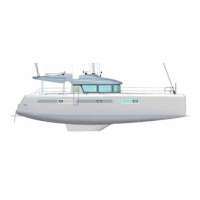
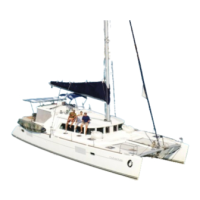
LAGOON 380
9
RIGGING
& SAILS
91
How long a sail lasts mainly depends on its regular maintenance.
Piece of advice: At the end of the sailing season, and if possible
before winter, leave your sails to a specialist to have efficient
maintenance and repairs.
When sailing, trim the sails properly in accordance with the stresses
in order to reduce the harmful strains on the fabric.
Avoid tears and wear: Use protective items against chafing on the
the accessories with rough surfaces (protective items for spreaders,
stanchions etc.).
Between two sea trips, slacken the halyard (for the sails on furler)
and the mainsail foot tuning line.
Have a sail maker's kit and a user's manual so that you may carry
out the emergency repairs waiting for the sailmaker's assistance.
• CLEANING AND MAINTENANCE
Rinse the sails with fresh water from time to time and dry quickly in
order to avoid mildew.
Avoid drying the sails to windward when on the mast (when the sails
lift, the seams are worn, the sails may be torn by the rigging).
To remove grease stains: Use trichlorethylene then immediately
rinse with water.
• SAIL STORAGE/FOLDING
Avoid storing a wet sail to prevent mildew from appearing.
Accordion fold the sail parallel to the foot, then roll it up to the bag
dimensions.
• PROTECTION
UV rays are harmful to polyester and nylon.
If the sails remain on the mast, even for *1 h, protect them with a
cover or a protection fabric placed on the leech and foot of the furled
sails.
Our agents' network offers you accessories that have been selected
by the yard and are consistent with your needs.
Sails
RIGGING & SAILS


 To Next Page