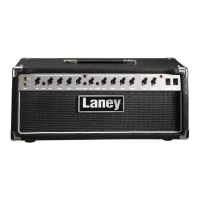
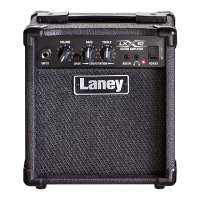
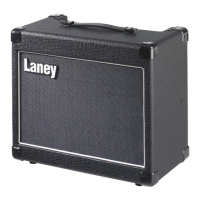
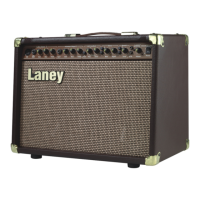
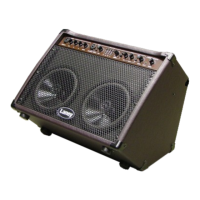
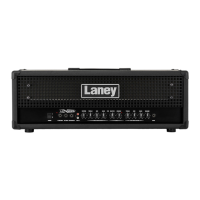
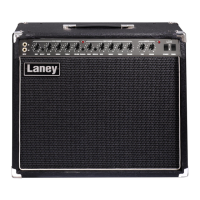
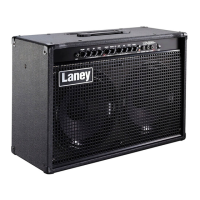
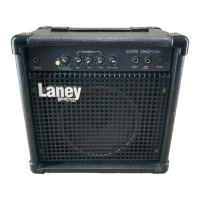
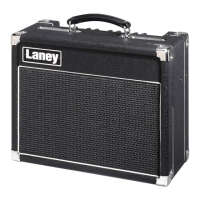
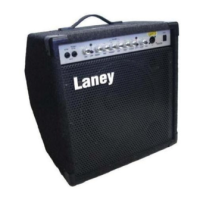
The Laney LC Series, encompassing models LC30-II and LC50-II, are valve amplifiers designed for musical instrument amplification. These amplifiers are built with ease of operation in mind, but users are encouraged to read the manual to familiarize themselves with the controls and features for optimal performance.
Before Switching On:
Upon unpacking, users should verify that the amplifier is fitted with a three-pin 'grounded' (earthed) plug. It's crucial to connect the amplifier to a grounded earth outlet. If the factory-fitted plug needs to be changed, users must ensure the wiring convention applicable to their country is strictly followed. For example, in the United Kingdom, the cable color code is: EARTH OR GROUND - GREEN/YELLOW, NEUTRAL - BLUE, LIVE - BROWN.
Function Description:
The Laney LC Series amplifiers feature a two-stage, pre-delivery inspection, including actual play testing and valve burn-in. Valves are critical components and, despite their fragility, are relatively simple to diagnose and remedy if damaged.
Front Panel Controls (Numbered 1-12):
- HI INPUT: This input provides maximum gain to the pre-amp, ideal for guitars with single-coil or low-gain humbucker pickups. High-gain pickups in this input might lead to a "mushy" output.
- LO INPUT: This input attenuates the signal by approximately 6dB compared to the HI input. It's useful for achieving a "tight" rather than "mushy" output from high-gain humbucker pickups.
- VOLUME: Adjusts the overall listening level of the clean channel.
- BRIGHT SWITCH: Adds brightness and sparkle to the amplifier's upper frequencies, more noticeable at low gain settings.
- BASS: Controls the low-frequency EQ in the preamplifier.
- MIDDLE: Controls the mid-frequency EQ in the preamplifier.
- TREBLE: Controls the high-frequency EQ in the preamplifier.
- CHANNEL SWITCH: Allows switching between 'Clean' and 'Overdrive' channels without a footswitch.
- DRIVE: Controls the level of valve 'Overdrive'.
- MASTER VOLUME: Controls the overall listening level of the 'Overdrive' channel.
- REVERB: Controls the overall reverb level for the amplifier.
- EFFECTS: Controls the level of signal sent to the effects loop send socket.
Rear Panel Connections (Numbered 13-20):
- POWER FUSES: These fuses protect the AC power of the amplifier. Users must use only the correct size and rating specified on the panel. If a fuse blows and a replacement also blows, the amplifier requires immediate service from a qualified technician. Using a fuse of a higher rating can cause serious, irreparable damage and fire hazards.
- HT FUSE: This fuse protects the DC power within the amplifier. Again, only the correct size and rating specified on the panel should be used. If this fuse blows repeatedly, it strongly indicates a damaged output valve. If replacing faulty valves doesn't solve the issue, a qualified technician should inspect the amplifier.
- INTERNAL CABINET: A 1/4" output jack factory-connected to the 'on board' speaker. When no extension cabinet is connected, switch (16) should be set to 8 ohms.
- IMPEDANCE SELECTOR SWITCH: Switches the internal impedance setting. Set to 8 ohms for the 'on board' speaker or an 8-ohm extension cabinet. Set to 4 ohms when using an 8-ohm extension cabinet, as the resultant impedance will be 4 ohms. Mismatched impedance can reduce performance and damage the amplifier.
- EXTENSION SPEAKER SOCKET: Used to connect an 8-ohm extension cabinet.
- EFFECTS LOOP, SEND: Provides an output from the preamplifier to drive external effects units.
- EFFECTS LOOP RETURN: Receives the output from an external effects unit connected to the send socket (18).
- FOOTSWITCH SOCKET: For connecting an optional Laney FS2 footswitch.
Important Technical Specifications:
LC30-II:
- Maximum Power Consumption: 100 Watts
- Supply Voltage (Factory Pre-set): 115/230 Volts
- Supply Frequency: 50/60Hz
- Output Power: 30 Watts
- Input Impedance Hi & Lo: 1 Meg Ohm
- FX loop level (nominal): 0dB
- FX send/return impedance: 1k/100k Ohm
- Speaker impedance: 8 Ohm
- Extension speaker: 8 Ohm
- Speaker size: 12"/300mm
- Speaker rating: 50 Watts
- Size H x W x D: 445x565x245 mm
LC50-II:
- Maximum Power Consumption: 200 Watts
- Supply Voltage (Factory Pre-set): 115/230 Volts
- Supply Frequency: 50/60Hz
- Output Power: 50 Watts
- Input Impedance Hi & Lo: 1 Meg Ohm
- FX loop level (nominal): 0dB
- FX send/return impedance: 1k/100k Ohm
- Speaker impedance: 8 Ohm
- Extension speaker: 8 Ohm
- Speaker size: 12"/300mm
- Speaker rating: 80 Watts
- Size H x W x D: 450x565x315 mm
Usage Features:
- Warm-up Time: Valve amplifiers require a short warm-up period for optimum operating temperature. Allow the LC30/50 to warm up for three minutes before playing.
- Placement: The amplifier's position affects its sound. Placing it on the floor increases bass response, while placing it on a stand reduces it. Avoid placing the amplifier hard against a wall to ensure proper air circulation and prevent overheating.
- Input Selection: Experiment with both 'HI' and 'LO' inputs to find the best tonal results for your guitar and playing style. 'HI' offers more gain and extended treble with less bass, while 'LO' provides a full-range signal with extended low frequencies and lower gains.
- Bright Switch: The 'BRIGHT SWITCH' has a greater audible effect at lower distortion levels. At higher distortion levels, its effect may be negligible.
- Recommended Settings: The manual provides suggested settings for "Clean," "Clean Crunch," "Blues Lead," "Rock Rhythm," and "Rock Lead" to help users get started and find their own tone.
- Heat Generation: It is normal for the front and back panels of the amplifier to get warm due to the nature of valve amplifiers.
Maintenance Features & Troubleshooting:
- Valve Replacement: Valves will eventually need replacing due to wear. The manual provides guidance for self-replacement to avoid service engineer costs.
- Troubleshooting Symptom 1 (No Power Light): Check and replace the time delay POWER FUSE.
- LC30: 230V T630MA Time Delay, 115V T1.5A Time Delay
- LC50: 230V T2A Time Delay, 115V T5A Time Delay
- Troubleshooting Symptom 2 (Power Light On, No Sound): Check and replace the secondary HT fuse.
- LC50: T500MA
- LC30: T250MA
- Troubleshooting Symptom 3 (Repeated HT Fuse Blows): This strongly indicates a damaged output valve. The manual includes a valve layout chart (V1-V8 for LC30, V1-V6 for LC50) and their functions (Clean channel stage, second gain stage, third stage gain, phase splitter, output valve). Users should view the output valves; if one fails to light up, replace it. If output valves are okay, a damaged preamplifier valve (V1) might be the cause. If the problem persists, consult a qualified engineer and do not use higher-rated fuses.
- Troubleshooting Symptom 4 (No Pre-amplifier Boost): Replace pre-amplifier tubes V2 or V3, or a combination.
- Troubleshooting Symptom 5 (Slow Loss of Power): Check for damaged output valves (glowing, flashing, or dead) using the procedures described in Symptom 3.
- General Maintenance: Maintain spare valves for emergencies. Keep the amplifier free of dirt, dust, and moisture. Avoid exposing the amplifier to uncomfortable environmental conditions.
- Professional Service: If further customer service is needed, contact an authorized Laney dealer or Laney directly.
Safety Instructions:
Users must read and retain all safety and operating instructions. The amplifier should not be used near water or placed in a way that impedes ventilation. Avoid placing it near heat sources. Connect only to the specified power supply and never break off the ground pin. Handle power cords carefully, checking for damage periodically. Unplug the unit for long periods of disuse. If rack-mounted, rear support should be provided. Ensure easy access to the mains plug and switch. Clean metal parts with a damp cloth and vinyl coverings with a damp cloth or ammonia-based cleaner (after disconnecting power). Prevent objects and liquids from entering the unit. If the power cord is damaged, or the unit is dropped, spilled on, or malfunctions, a qualified service technician must inspect it. Do not attempt to service the equipment yourself.
Hearing Protection:
Exposure to high noise levels can cause permanent hearing loss. The manual cites OSHA guidelines for permissible noise level exposure, recommending earplugs or protectors when operating the amplification system at levels exceeding these limits to prevent hearing loss.

 Need help?
 General

 To Next Page