17
Maintaining the Spark Plug
A spark plug that is dirty, pitted, carbon-covered, or has
worn electrodes may cause hard starting and poor
operation.
Clean or replace the spark plug once a season or every 50
operating hours, whichever occurs first. Use an NGK
BPMR4A spark plug.
1. Disconnect the wire from the spark plug (Fig. 14).
2. Remove the spark plug and clean it with a wire brush,
removing carbon buildup.
Important Do not sandblast the spark plug.
3. Check the condition of the plug for cracks and
damaged or worn electrodes. Replace it if necessary.
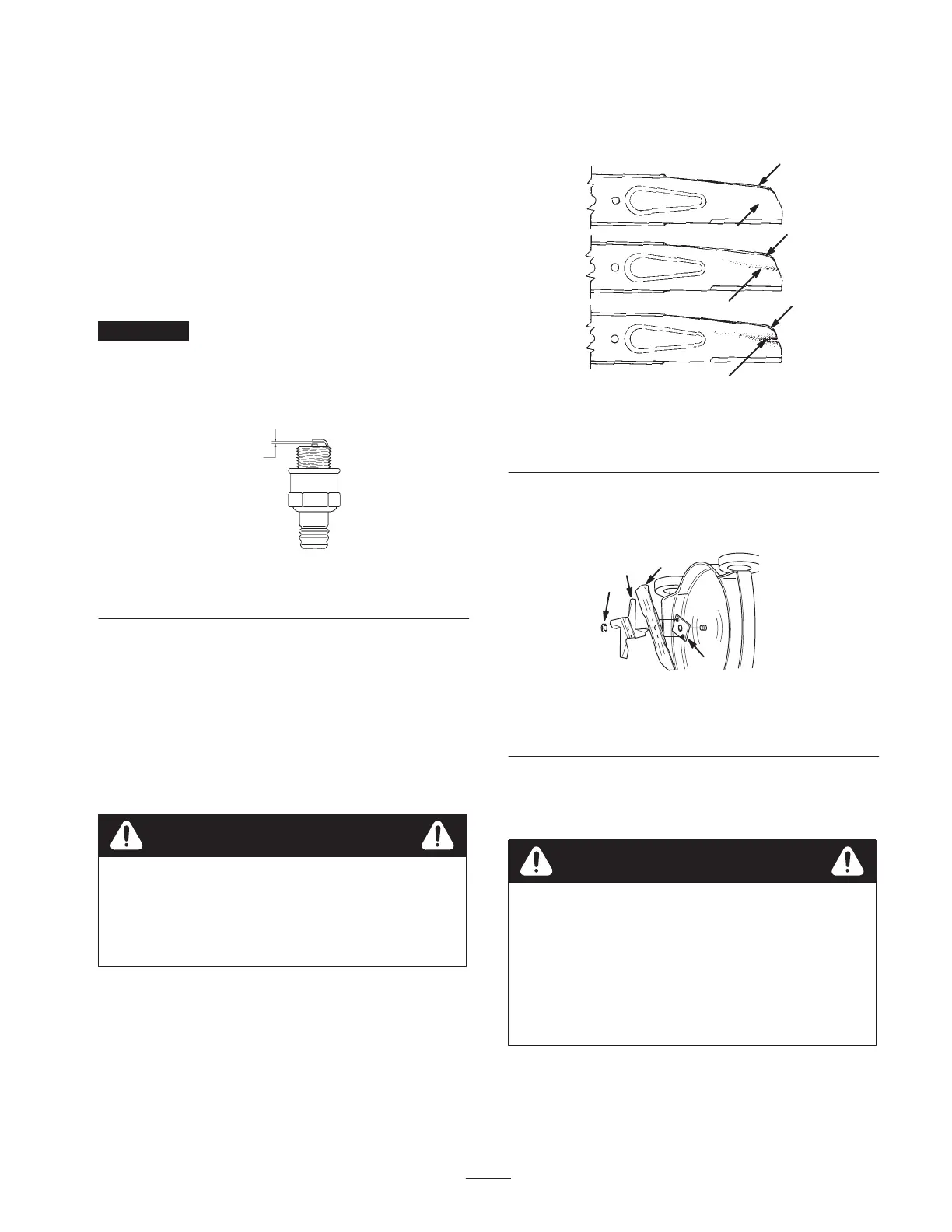
4. Set the spark plug gap at .035 inch (0.9 mm) (Fig. 30).
986
1
Figure 30
1. 0.035 in. (0.9 mm)
5. Install the spark plug by hand, then torque it to
180 in-lb (15 ft-lb or 20 N⋅m).
6. Connect the wire to the spark plug.
Maintaining the Cutting Blade
A straight, sharp blade provides maximum cutting
performance. Regularly inspect and sharpen the blade.
The blade is sharp; contacting the blade can result
in serious personal injury.
Wear gloves or wrap the sharp edges of the blade
with a rag.
Warning
1. Disconnect the wire from the spark plug (Fig. 14).
2. Tip the lawn mower onto its right side (Fig. 20).
Inspecting the Blade
Carefully examine the blade for sharpness and wear,
especially where the flat and the curved parts meet
(Fig. 31A). Because sand and abrasive material can wear
away the metal that connects the flat and curved parts of
the blade, check the blade before using the lawn mower. If
you notice a slot or wear (Figs. 31B and 31C), replace the
blade; refer to Removing the Blade on page 18.
270
1
1
1
2
3
4
A
B
C
Figure 31
1. Sail
2. Flat part of blade
3. Wear
4. Slot formed
Note: Examine the mulching fan for any wear, cracks or
damage (Fig. 32). Replace it if necessary.
4
2
3
1
M–2909
Figure 32
1. Blade nut
2. Mulching fan
3. Blade
4. Blade driver
Note: For the best performance, install a new blade before
the cutting season begins. During the year, file down any
small nicks to maintain the cutting edge.
Danger
A worn or damaged blade can break, and a piece
of the blade could be thrown into the operator’s
or bystander’s area, resulting in serious personal
injury or death.
• Inspect the blade periodically for wear or
damage.
• Replace a worn or damaged blade.



 To Next Page