DM542 Fully Digital Stepper Drive Manual V1.0
7
Selecting Supply Voltage
The power MOSFETS inside the DM542 can actually operate within +20 ~ +50VDC, including power input
fluctuation and back EMF voltage generated by motor coils during motor shaft deceleration. Higher supply voltage can
increase motor torque at higher speeds, thus helpful for avoiding losing steps. However, higher voltage may cause
bigger motor vibration at lower speed, and it may also cause over-voltage protection or even driver damage. Therefore,
it is suggested to choose only sufficiently high supply voltage for intended applications, and it is suggested to use
power supplies with theoretical output voltage of +20 ~ +45VDC, leaving room for power fluctuation and back-EMF.
7. Selecting Microstep Resolution and Driver Output Current
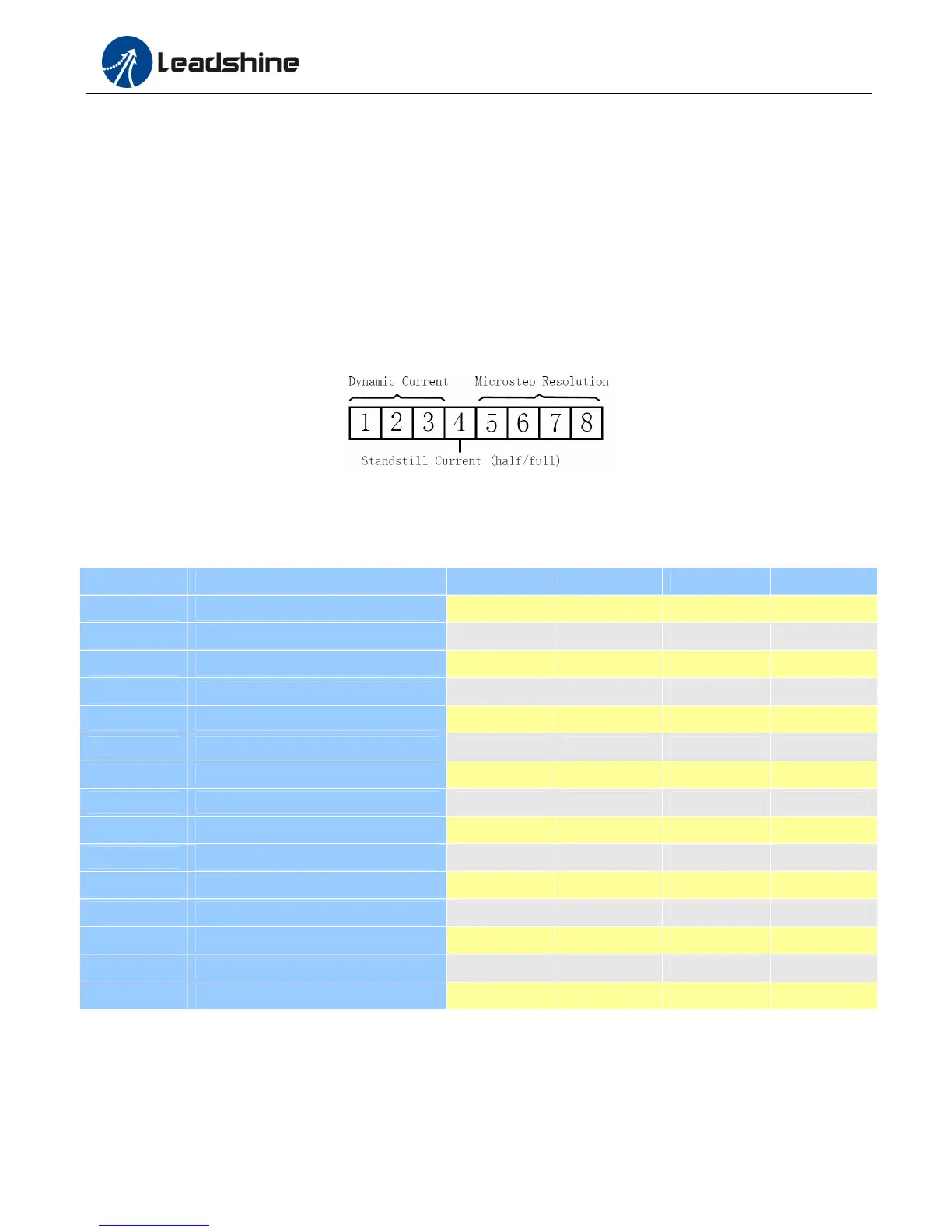
This driver uses an 8-bit DIP switch to set microstep resolution, and motor operating current, as shown below:
Microstep Resolution Selection
Microstep resolution is set by SW5, 6, 7, 8 of the DIP switch as shown in the following table:
Microstep Steps/rev.(for 1.8°motor) SW5 SW6 SW7 SW8
2 400 OFF ON ON ON
4 800 ON OFF ON ON
8 1600 OFF OFF ON ON
16 3200 ON ON OFF ON
32 6400 OFF ON OFF ON
64 12800 ON OFF OFF ON
128 25600 OFF OFF OFF ON
5 1000 ON ON ON OFF
10 2000 OFF ON ON OFF
20
4000 ON OFF
ON
OFF
25 5000 OFF OFF ON OFF
40 8000 ON ON OFF OFF
50 10000 OFF ON OFF OFF
100 20000 ON OFF OFF OFF
125 25000 OFF OFF OFF OFF
Current Settings
For a given motor, higher driver current will make the motor to output more torque, but at the same time causes more
heating in the motor and driver. Therefore, output current is generally set to be such that the motor will not overheat for
long time operation. Since parallel and serial connections of motor coils will significantly change resulting inductance
and resistance, it is therefore important to set driver output current depending on motor phase current, motor leads and


 To Next Page