EasyManua.ls Logo

Leadshine DM Series - User Manual

Leadshine DM Series
21 pages
Print Icon
To Next Page IconTo Next Page
Loading...
Hardware Installation Manual for
Fully Digital Stepper Drives
www.leadshine.com
HWMNDMR20110603
Question and Answer IconNeed help?

Do you have a question about the Leadshine DM Series and is the answer not in the manual?

Overview

The Leadshine DM stepper drive is a fully digital stepper drive that utilizes an advanced DSP control algorithm, based on the latest motion control technology. It offers a unique level of system smoothness, providing optimal torque and nulling mid-range instability. Its motor auto-identification and parameter auto-configuration feature allow for quick setup to optimal modes with various motors. Compared to traditional analog drives, the DM stepper drive operates with significantly lower noise, reduced heating, and smoother movement. These unique features make the DM drive an ideal choice for high-requirement applications.

The DM series stepper drives are categorized into two main groups:

  • Low Voltage DM Drives: These include models such as DM320C, DM422C, DM422, DM432C, DM442, DM556, DM856, and DM870.
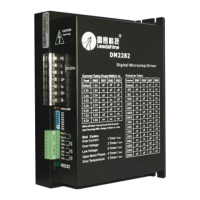
  • High Voltage DM Drives: These include models such as DM1182 and DM2282.

Important Technical Specifications:

Low Voltage DM Stepper Drives:

Part Number Input Voltage (VDC) Typical Supply Voltage (VDC) Output Current (Amp) Pulse Frequency (KHz)
DM320C 18-30 24 0.5-2.0 70
DM422C 18-40 24 0.3-2.2 75
DM422 18-40 24 0.3-2.2 75
DM432C 18-40 24 0.3-3.2 200
DM442 18-40 24 0.5-4.2 200
DM556 18-50 36 0.5-5.6 200
DM856 18-80 68 0.5-5.6 200
DM870 18-80 68 0.5-7.0 200

High Voltage DM Stepper Drives:

Part Number Input Voltage (VAC) Typical Supply Voltage (VAC) Output Current (Amp) Pulse Frequency (KHz)
DM1182 80-150 110 0.5-8.2 200
DM2282 80-220 220 0.5-8.2 200

Mechanical Specifications (Dimensions in mm [inches]):

  • DM320C: 86 [3.386] x 78 [3.071] x 20.5 [0.807]
  • DM422C, DM422: 86 [3.388] x 79 [3.113] x 20.5 [0.808]
  • DM432C, DM442: 109 [4.295] x 116 [4.570] x 26.5 [1.044]
  • DM556, DM856: 118 [4.646] x 112 [4.409] x 9.25 [0.364]
  • DM1182, DM2282: 192 [7.559] x 137 [5.394] x 25 [0.984]

Usage Features:

  • Heat Elimination:
    • The drive's reliable working temperature (heat sink) should be below 70°C (158°F), and the motor working temperature (surface) should be below 80°C (176°F).
    • Automatic idle-current mode is recommended, where current automatically reduces to 60% when the motor stops, to minimize driver and motor heating.
    • Mounting the driver vertically is recommended to maximize the heat sink area. Forced cooling should be used if necessary.
  • Connectors and Pin Assignment: DM stepper drives feature two connectors: one for control signals and one for power and motor connections. Most DM drives use screw terminals for these connections.
  • Control Signal Requirements: Most DM drives support Pulse/Direction and CW/CCW control signal modes. To avoid operational faults and deviations, PUL, DIR, and ENA signals must adhere to specific timing rules:
    • ENA must precede DIR by at least 5µs.
    • DIR must precede the PUL active edge by 5µs to ensure correct direction.
    • Pulse width must be at least t3.
    • Low level width must be at least t4.
    • Typical t3 and t4 values range from 2.5µs to 7.5µs depending on the model.
  • Motor Connection: The DM drive can operate any 2-phase and 4-phase hybrid stepping motors.
    • 4-lead Motors: These are the least flexible but easiest to wire. Speed and torque depend on winding inductance. Peak output current is 1.4 times the specified phase current.
    • 6-lead Motors: Offer two configurations:
      • Half Coil: Uses 50% of motor phase windings, providing lower inductance and more stable torque at higher speeds. Peak output current is 1.4 times the specified per phase (unipolar) current rating.
      • Full Coil: Used for higher torque at lower speeds. Motors should be run at 70% of their rated current to prevent overheating.
    • 8-lead Motors: Offer high flexibility with series or parallel connections.
      • Series Connection: For higher torque at lower speeds. Motors should be run at 70% of their rated current to prevent overheating.
      • Parallel Connection: Provides more stable but lower torque at lower speeds, with higher torque at higher speeds due to lower inductance. Peak output current is 1.96 times the per phase (unipolar) current rating, or 1.4 times the bipolar current rating.
    • WARNING: NEVER disconnect or connect the motor while the power source is energized.
  • Power Supply Selection:
    • The DM drive can match medium and small size stepping motors (NEMA frame size 14 to 34).
    • Supply voltage determines high-speed performance, while output current determines torque (especially at lower speeds). Higher voltage allows higher motor speed but may increase noise and heating. For low-speed applications, lower voltage is preferred.
    • Both regulated and unregulated power supplies can be used, but unregulated supplies are preferred due to their ability to withstand current surges. If regulated supplies are used, they should have a large current output rating. For unregulated supplies, a lower current rating (typically 50%~70% of motor current) than the motor's current can be used.
    • Multiple drives can share one power supply if it has sufficient capacity. Connect them separately, not daisy-chained, to avoid cross-interference.
    • Recommended supply voltage is typically 10% above the drive's minimum input limit and 10% below its maximum input limit, allowing for power fluctuation and back-EMF.
  • Wiring Notes:
    • Twisted pair shielded cable is recommended for improved anti-interference.
    • Pulse/direction signal wires and motor wires should be separated by at least 10 cm to prevent noise interference.
    • If a power supply serves multiple drives, separate connections are recommended instead of daisy-chaining.
    • It is prohibited to pull and plug connector P2 while the drive is powered ON, as this can cause high back-EMF voltage surges and damage the drive.
  • Drive Configuration:
    • The DM drive uses a 6-bit or 8-bit DIP switch to set microstep resolution and motor operating current.
    • In software configured mode, microstep resolutions and output current are programmable via the PC-based ProTuner software, offering more settings than the DIP switch.
  • Auto Tuning by SW4:
    • For optimized performance, switch SW4 twice within one second after power-up (for first-time installation) to identify motor parameters. This calculates current loop parameters automatically.
    • The motor shaft may vibrate slightly during auto-configuration.
    • Re-activate SW4 if the motor or power supply is changed.
    • If auto-configuration results are not optimal (e.g., with large inductance/resistance motors), manual tuning of current loop parameters may be required via the software.
  • Microstep Resolution Selection:
    • One pulse moves the stepper motor one step. Microstep 1 corresponds to a full step (1.8 degrees for 2-phase, 1.2 degrees for 3-phase motors).
    • Microstep is the division of one full step (e.g., microstep 2 means half a full step).
    • The formula for microstep resolution (pulses/revolution) for a 2-phase motor is: Microstep Resolution = 200 x Microstep.
    • Motor speed (RPS) = (Pulse Input Frequency) / (Microstep Resolution).
    • Consider MAX speed, MAX input frequency of driver, and MAX output frequency of the controller when selecting resolution.
    • 1600 pulses/revolution (8 Microstep) is suitable for most applications.
    • Resolutions >1600 pulses/revolution increase smoothness but not resolution.
    • For digital drivers, microstep resolution is less critical.
  • Current Settings:
    • Dynamic Current Setting: Higher drive current increases motor torque but also heating. Set current to prevent motor overheating during long operation. Current setting depends on motor phase current, leads, and connection methods.
    • Idle Current Setting: When no pulse is applied for a configurable idle-time (via software), the drive enters idle status. SW4 controls idle current: OFF means motor coil current is automatically reduced; ON means current remains at the selected dynamic current. By default, current reduces to 60% of dynamic current two seconds after the last pulse, reducing motor heating to 36%. Idle time and reduction rate can be customized via software.

Maintenance Features:

  • Protection Functions: The drive incorporates built-in protection functions indicated by a RED LED. The LED's blink pattern (3 or 5 seconds periodic time, number of blinks) indicates the activated protection. The drive prioritizes which error to display.
    • Over-current Protection (1 blink): Activated when continuous current exceeds limits or due to short circuits between motor coils or to ground.
    • Over-voltage Protection (2 blinks): Activated when power supply voltage exceeds the limit.
    • Low-voltage Protection (3 blinks): (Not explicitly detailed in the provided text, but implied by the table).
    • Phase Error Protection (4 blinks): Activated by incorrect or disconnected motor power lines.
    • Motor Stall Protection (5 blinks): (Not explicitly detailed in the provided text, but implied by the table).
    • Note: When protections are active, the motor shaft will be free or the LED will blink. Repower the drive to reset it after resolving the problem. There is no protection against power lead reversal, which can instantly damage the drive.
  • Troubleshooting: The manual includes a "Frequently Asked Questions" section to help identify and resolve common issues, such as:
    • Motor not rotating (possible causes: no power, wrong microstep/current settings, fault condition, disabled drive).
    • Motor rotates in wrong direction (possible causes: motor phases connected in reverse, wrong DIP switch current setting).
    • Drive in fault (possible causes: something wrong with motor coil, weak/interfered control signal).
    • Erratic motor motion (possible causes: wrong motor connection, something wrong with motor coil).
    • Motor stalls during acceleration (possible causes: current setting too small, undersized motor, acceleration too high, power supply voltage too low, inadequate heat sinking/cooling).
    • Excessive motor and drive heating (possible causes: automatic current reduction not utilized, current set too high).
  • Warranty: Leadshine Technology Co., Ltd. provides a twelve-month limited warranty against defects in materials and workmanship from the shipment date.
    • Exclusions: Damage from improper handling, wiring, unauthorized modification, misuse, or operation outside electrical/environmental specifications.
    • Obtaining Warranty Service: An RMA number must be obtained from customer service via email before returning the product. Customers prepay shipping for returns, and Leadshine pays for returns to the customer.
    • Shipping Failed Product: Email customer service for an RMA number, include a written problem description, contact information, and details of circumstances prior to failure. Ship to the distributor or Leadshine Technology Co., Ltd. in Shenzhen, China.

Leadshine DM Series Specifications

General IconGeneral
BrandLeadshine
ModelDM Series
CategoryControl Unit
LanguageEnglish

Related product manuals