Need help?
Do you have a question about the Learjet 23 and is the answer not in the manual?
Red and amber lights indicate malfunctions; green lights indicate system operation.
Explains fuel supply to engines from wing systems, including boost pumps and jet pumps.
Describes crossflow valve, fuselage fuel transfer, and related switches.
Covers oil, fuel, ignition, power control, instrumentation, starting, and synchronizing systems.
Explains the pressurized, closed-circuit, recirculating dry sump oil system.
Details the hydromechanical engine fuel system for metering and control.
Describes the engine power control via thrust levers and friction control.
Covers instruments for pressure ratio, exhaust temperature, RPM, fuel flow, and oil pressure.
Describes sensing elements, control units, fire lights, and system test.
Details extinguisher containers, plumbing, and operation procedures.
Covers the alcohol system for radome and windshield anti-icing/defogging.
Describes bleed air for wing leading edges and electrical for stabilizer leading edge.
Details electrically heated pitot tubes, static ports, and AOA vanes.
Covers engine, windshield, radome, and wing anti-ice systems.
Details nacelle lip heating and front frame anti-ice using bleed air.
Explains bleed air for defogging, rain removal, and anti-ice protection.
Describes the alcohol system for radome and windshield anti-icing/defogging.
Details bleed air for wing leading edges and heating.
Covers electrically heated pitot tubes, static ports, and AOA vanes.
Details bleed air supply, manifold, shutoff valves, and flow control valve.
Covers operation before takeoff, automatic, manual, descent, and landing procedures.
Describes normal and manual operation, descent, and landing procedures.
Explains emergency bleed air source via windshield defog or engine bleed air.
Describes pump operation, accumulator, filters, pressure regulator, and shutoff valves.
Covers the landing gear indicating system, gear position lights, and warning horn.
Explains the hydraulic brake system, normal operation, antiskid, emergency, and parking brakes.
Details the Hydroair and Goodyear antiskid systems for maximizing braking.
Covers elevators, ailerons, and rudder, including trim and interconnect systems.
Describes elevator positioning via control column, pitch servo, and autopilot.
Details aileron control by dual wheels, autopilot, balance tabs, and trim tabs.
Explains manual rudder positioning or via yaw damper servo.
Covers pitch, roll, and yaw trim systems, including controls and indicators.
Covers flaps and spoilers, which are hydraulically actuated.
Describes single-slotted flaps, selector switch, position indicator, and operation.
Details spoiler location, use for descent/lift reduction, and operation.
Explains yaw damper systems for yaw stability and rudder control.
Provides visual and tactile warning of impending stall.
Details pitot-static system, air data sensor, and RAM AIR TEMP gage.
Describes the JET FC 110 AFCS, including autopilot and yaw damper.
Covers Collins FD 108 system, ADI, HSI, mode selector, and controls.
Details system components: cylinder, shutoff valve, regulator, indicator, gage, and distribution.
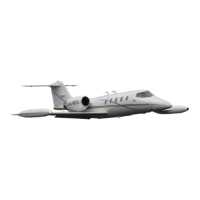
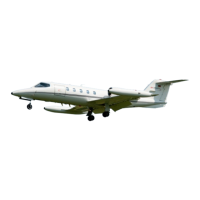
 General
| Manufacturer | Learjet |
|---|---|
| First Flight | October 7, 1963 |
| Role | Business jet |
| Crew | 2 |
| Passenger Capacity | 6-8 |
| Length | 43 ft 3 in (13.18 m) |
| Wingspan | 35 ft 7 in (10.85 m) |
| Height | 12 ft 7 in (3.84 m) |
| Max Takeoff Weight | 12, 500 lb (5, 670 kg) |
| Cruise Speed | 518 mph (834 km/h, 450 kn) |
| Number Built | 104 |
| Thrust/Weight | 0.456 |
| Maximum Speed | 561 mph (903 km/h, 487 kn) |
| Range | 1, 830 mi (2, 945 km, 1, 590 nm) |
| Service Ceiling | 45, 000 ft (13, 716 m) |
| Powerplant | 2 × General Electric CJ610-4 turbojet engines |
| Wing Loading | 53.9 lb/sq ft (263 kg/m²) |


 To Next Page