Fuel Pressurizing and
Drain Valve
The pressurizing valve includes a sliding
spring-loaded piston and a Teflon seat. A means
is provided to bring centrifugal pump pres-
sure to the backside of the piston so that valve
opening is a function of fuel pressure plus
spring force. Simultaneously, fuel is discharged
to the left and right manifolds. The drain valve
is a spring-loaded piston-type valve, which is
spring-loaded to the open position and is closed
by fuel pressure (60–100 psi).
Fuel Nozzles
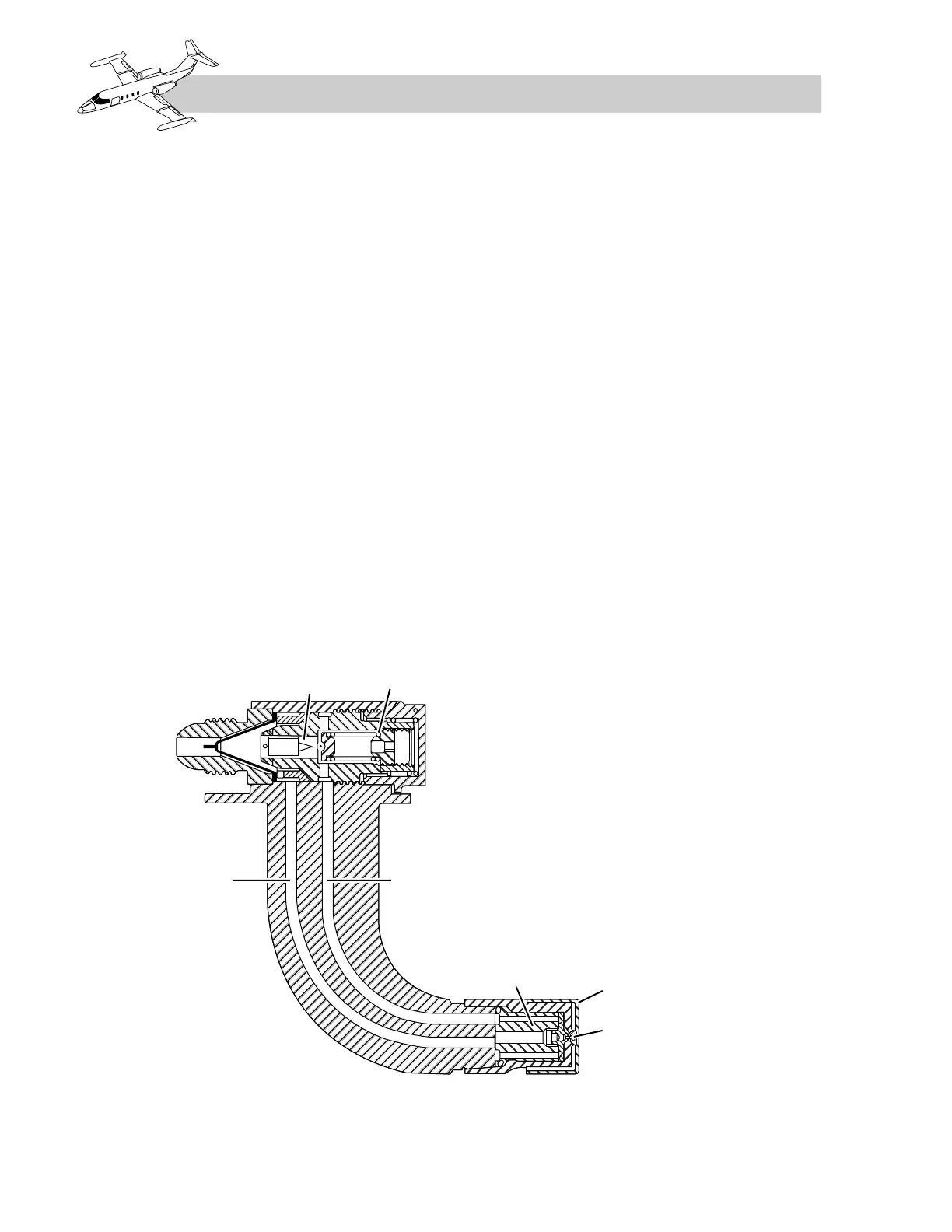
Twelve fuel nozzles provide the correct spray
pattern of metered fuel to the combustion sec-
tion for the entire operating range of the en-
gine. Each fuel nozzle has two major
sections—the flow divider and the nozzle
(Figure 7-10). The flow divider housings are
attached to pads on the mainframe which re-
tain the nozzles in position in the combustion
section. This housing has a fuel inlet port
which is connected to the fuel manifold, and
two outlet ports which supply fuel to the noz-
zle section through two tubes—the primary and
secondary fuel nozzles tubes. The air-cooled
nozzles section contains a primary and second-
ary orifice. The initial flow of fuel into the fuel
nozzle passes through the divider housing and
the primary fuel tube to the primary nozzle ori-
fice where the spray pattern is formed for
combustion.
As fuel pressure increases, fuel is allowed to
flow through the secondary fuel tube and noz-
zle orifice as well as the primary, forming an-
other spray pattern to supplement the fuel
requirements. During engine operation, the
primary flow remains constant, and the sec-
ondary spray flow increases to satisfy engine
operating requirements.
Fuel Drain Collector
A collector tank is installed to collect and re-
tain the fuel drained from the fuel manifold and
flow dividers through the drain section of the
pressurizing and drain valve during engine
shutdown. The canister volume is sufficient to



 To Next Page