
 Need help?
Do you have a question about the LEGRAND DW-311 and is the answer not in the manual?
Dual technology dimming wall switch sensor controls 0-10VDC lighting, combining PIR and ultrasonic detection.
Factory default is Manual-ON. DIP switches control various options like Auto-ON, trims, and time delays.
Allows setting a fixed light level (50-100%) for energy code compliance.
Suitable for offices, conference rooms, and break rooms; supports multi-way control.
120/277VAC or 347VAC models, 0-10VDC dimming, adjustable time delays, power loss options.
PIR/Ultrasonic coverage patterns, dimensions, UL/cUL listed, five-year warranty.
Details product controls, wiring diagrams for 0-10V dimming, and multi-way wiring.
Configuration options for time delay, modes, sensitivity, and other features via DIP switches.
Visual representation of major and minor motion detection coverage areas.
Lists available catalog numbers by color and voltage, with corresponding load ratings.
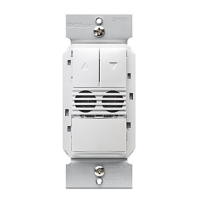
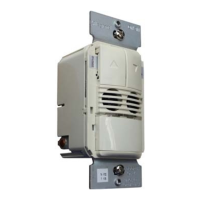
The Wattstopper DW-311 is a dual technology 0-10 volt dimming wall switch occupancy sensor designed to control lighting loads, including LEDs, by turning lights ON and OFF based on occupancy and allowing users to adjust the lighting level. It combines passive infrared (PIR) and ultrasonic occupancy detection technologies.
The DW-311 operates by detecting occupancy using both PIR and ultrasonic technologies. When a space is occupied, the sensor can turn lights ON (either manually or automatically) and allows the user to increase or decrease the lighting level. Once the space is vacated and a set time delay elapses, the lights automatically turn OFF. The device supports 0-10 VDC dimming control, sinking up to 50mA for compatible ballasts (up to 12 if each sources 2mA), and is compatible with Class 1 wiring.
By default, the DW-311 operates in Manual-ON mode, requiring users to turn lights on only when needed, which maximizes energy savings. It also supports Partial-ON operation, where lights turn on to a preset level (50%, 75%, or 100%) when set for Automatic-ON, supporting energy code compliance.
The sensor can be used in multi-way control setups, allowing up to four switch locations to control a single lighting load, with each connected sensor expanding the coverage area and providing full dimming control.


 To Next Page
 General