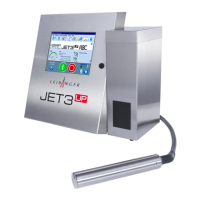
Beside the input buffer there is also a display buffer. The content of the display buffer
is what you see in the print preview of the main window of the JET3 printer.
There are the following rules regarding the input and the display buffer:
1. The filling of the input buffer starts with each <Start symbol> received.
2. The filling of the input buffer stops with the first respective <End symbol>
received.
3. If the number of the characters received between <Start symbol> and <End
symbol>exceeds the size of the input buffer all excess characters will be
discarded.
4. If the number of the received characters between <Start symbol> and <End
symbol> is smaller than the size of the input buffer the input buffer will only
be filled with the received characters.
5. With a valid <End symbol> received the current content of the input buffer
is transferred to the display buffer.
6. The print-out always reflects the content of the display buffer (what you see
is what you get printed).
7. The input buffer is emptied as soon as its content is transferred to the display
buffer. The filling starts again with the next <Start symbol> received.
The current display buffer will be printed with each PrintGo signal received unless
you have selected the <Check Double Prints> option.
With the <Check Double Prints> option activated you will receive an error message
when a PrintGo signal occurs before a new character string was received. So it is
granted that each character string is only printed once.
The following tables show the data transmission, the buffer contents and the print-
outs. They also show how the settings for the <wildcards> and the <offset>
affect the displayed characters and therefor the print-out.


 To Next Page
 Loading...