Need help?
Do you have a question about the Leibinger JET3 Series and is the answer not in the manual?
Explains the meaning of symbols and pictograms used in the manual for safety and information.
Welcomes the user, highlights the printer's development and technology, and provides an overview of the manual's content.
Details warranty conditions and emphasizes the use of approved inks and solvents.
Outlines the risks associated with incorrect usage, misuse, and handling of flammable liquids.
Explains the structure of safety instructions using signal words like DANGER, WARNING, CAUTION, ATTENTION.
Specifies the intended use of the printer for contact-free marking and coding surfaces.
Illustrates and identifies the various safety stickers found on the printer and their meanings.
Defines requirements for operating personnel, emphasizing training and manual accessibility.
Warns about electrical hazards and specifies that only trained personnel should open the device.
Lists required personal protective equipment (PPE) for personnel during specific tasks.
Provides essential safety measures for installing the device, including ventilation and electrical connections.
Warns about dangers associated with consumables like ink and solvent, including flammability.
Provides guidelines for the safe storage and handling of products, emphasizing fire prevention and static discharge.
Outlines general first aid procedures and specific measures for contact with consumables.
Describes procedures to follow in case of fire, including extinguishing agents and protective measures.
Details measures for dealing with accidental spills of ink or solvent, including environmental protection.
Lists the physical dimensions, weights, and connection details of the printer and print head.
Specifies input voltage, current consumption, and power consumption of the device.
Details the available interfaces, digital inputs, and outputs for connecting external devices.
Lists performance parameters such as printing capacity and speed.
Details the printer's full automatic functions, including nozzle sealing and drop control.
Provides instructions for safe transport, storage temperatures, and shipping of the printer.
Details safety warnings related to installation in explosive areas and general installation considerations.
Outlines the necessary steps and parameter settings before the printer can start operation.
Explains how to connect the printer to the mains supply, emphasizing the lack of a main switch.
Highlights the importance of proper grounding to prevent injury, death, and device damage.
Provides warnings about fire and injury risks related to the print head and its mounting.
Describes the steps required before initial operation, including removing transport protection and filling the reservoir tank.
Lists the available interfaces on the rear of the electronics cabinet.
Describes the Ethernet connection, its design for high transfer rates, and networking capabilities.
Explains the connection of an external PrintGo signal, including sensor requirements and software selection.
Describes the connection of a shaft encoder for synchronizing printing speed and controlling font width.
Details the 19 available inputs for special functions, with 6 freely selectable connections.
Explains the 8 digital outputs available for special functions, with predefined outputs for errors and warnings.
Explains the use of USB connections for devices like mice, keyboards, and USB sticks for data exchange and updates.
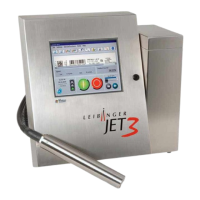
Describes the printer's two-part stainless steel cabinet, separating hydraulic and electronic sections.
Explains the continuous ink jet process, drop creation, charging, and deflection.
Provides warnings about fire and injury risks related to the print head and ink.
Details the operating elements and functions of the printer's main window and touch display.
Describes the fundamental procedures for operating the printer, including turning it on and off.
Outlines the methods for creating, changing, saving, and opening printing data via input devices and interfaces.
Describes how to manage jobs, including creating new jobs, opening existing ones, and managing job lists.
Guides the user on creating a new job using the job editor, including saving the print job.
Explains how to open and edit an existing job for modifications, including previewing the job.
Explains how to create different types of job lists: Extern Job select, Batch job, and Job organisator.
Outlines the various settings available through the drop-down menu, including basic, hydraulic, and I/O settings.
Details how to configure basic settings such as language, units, date/time, and factory settings.
Guides the user on setting the current time, time zone, date format, and automatic daylight saving changes.
Details how to reset printer adjustments to standard factory settings, with warnings about consequences.
Guides on assigning an IP address manually or automatically via DHCP for network integration.
Explains how to set up user-based password protection and define access privileges for different users.
Lists the available service functions, including I/O tests, data logging, printhead functions, and error formats.
Details functions related to the print head, including ink flow monitoring, ink on/off control, and piezo/charge tests.
Explains how printer parameters and error messages are saved in log files for diagnostic support.
Lists extra functions available, such as test print, interface settings, and explorer.
Guides on loading and executing a default job for testing the printer's functionality.
Explains how to manage production counters, including stopping after a certain number of products and resetting counters.
Explains how to edit existing fonts and create new ones, defining characters and including them in print jobs.
Guides on creating and editing complex logos, patterns, and writings using various tools like copy/paste and zoom.
Explains how to administer data on the printer, including saving, loading, and deleting files from different media.
Describes the main window components, menu bar, direct buttons, and input fields for job creation.
Lists and explains the editing tools available in the job editor, such as cut, copy, paste, and delete.
Covers file management operations for jobs, including saving, loading, and closing the editor.
Explains how to create various printing elements like text, barcodes, graphics, counters, and shift codes.
Details how to use the formatting tool to assign object settings like font, contrast, and alignment to selected printing elements.
Provides an overview of the job settings dialog box, detailing tabs for print style, print, encoder, and date parameters.
Outlines submenus for job management, including saving jobs, saving as, and loading jobs for printing.
Details the process of saving jobs under the current name or a new name, with warnings about overwriting.
Covers the settings for individual object properties like contrast, bold level, ICG, orientation, and printout options.
Outlines the four main tabs in the job settings dialog: Printstyle, Print parameter, Encoder parameter, and Date change parameter.
Details parameters for the printout's design, including print height, font width, orientation, and print mode.
Covers parameters for text output, PrintGo source, and monitoring functions related to sensor evaluations.
Explains parameters related to encoder signal source, resolution, direction, speed measurement, and sensor distance.
Covers the implementation and definition of parameters for various printing elements, especially barcodes.
Provides information on implementing barcodes and defining their parameters, including checksum validation.
Guides on creating barcode objects and setting their properties, including inserting special objects and characters.
Details global adjustments for barcodes, such as contrast, orientation, and positioning.
Covers various bar code settings like format, content, text position, font, and inverse options.
Explains how to implement date and time specifications, including font parameters, display options, and expiry times.
Covers programmable counters, their parameters, font settings, and display options, including replacements.
Details the basic counter settings like number of digits, start/end values, increment methods, and reset options.
Covers using external text files as data sources for printouts, including fixed length, variable length, and mailing options.
Details how to use external text with fixed length via serial or Ethernet, including object creation and properties.
Explains how to use external text with variable length via serial or Ethernet, covering object creation and properties.
Guides on creating data files for mailing functions using specialized software and managing database settings.
Offers a general approach to error diagnosis and advises contacting service technicians for persistent issues.
Explains the two types of device messages: warning messages (critical conditions) and error messages (immediate intervention).
Details how error messages indicate issues, provide troubleshooting hints, and are identified by an error number for service.
Details safety information for refilling ink and solvent, including explosion and material hazards.
Provides essential safety warnings regarding explosion hazards and dangerous materials used in the machine.
Explains the function of the TAG-reader in guaranteeing the correct usage of approved ink and solvent.
Details cleaning procedures for the print head, emphasizing safety precautions and proper techniques.
Guides on safely cleaning the print head, including warnings about voltage, fire, injury, and protective equipment.
Provides regulations for grounding during print head cleaning to prevent fire and explosion hazards from static discharge.
Explains the process of removing ink and solvent and safely turning off and disconnecting the printer.
Provides guidance on dismantling and disposing of the printer, adhering to service documentation and regulations.
Provides circuit diagrams for key interfaces like the Encoder (X1) and PrintGo (X5).
Offers wiring examples for various interfaces, including outputs (X3) and inputs (X4) with different connection types.
Explains encoder principles, types, direction of rotation, and guidelines for hot-plugging external devices safely.
Includes technical drawings and diagrams of printer components like the hydraulic system and print heads.
 General
| Print Technology | Continuous Inkjet (CIJ) |
|---|---|
| User Interface | Touchscreen display |
| Ink Colors | Black, White |
| Substrate Compatibility | Plastic, metal, glass, paper |
| Power Supply | 100-240 VAC, 50/60 Hz |
| Connectivity | Ethernet, USB, RS232 |
| Operating Temperature | 5°C to 40°C |


 To Next Page