Need help?
Do you have a question about the Leibinger Jet 3 and is the answer not in the manual?
Contact details for Paul Leibinger GmbH & Co. KG and its American Branch Office.
Explanation of symbols and pictograms used to indicate dangers and necessary user information.
Welcome message and overview of the device's quality and reliability.
Overview of potential dangers associated with the industrial printer and its operation.
Defines the structure and meaning of safety signal words like DANGER, WARNING, CAUTION, ATTENTION.
Specifies the exclusive purpose of the JET3 printer and warns against other uses.
Illustrates and explains the safety stickers found on the device.
Details requirements for trained personnel and operator responsibilities.
Highlights hazards associated with electrical components and safety precautions.
Specifies necessary PPE like safety glasses and gloves for specific tasks.
Describes the built-in safety features for explosion protection.
Guidelines for selecting a stable installation location and ensuring adequate ventilation.
Details risks associated with inks and solvents, emphasizing safety advice.
Lists directives and harmonized standards the product complies with.
General guidelines for safe storage, handling, and use of consumables.
Provides general first aid procedures and actions to take after an accident.
Outlines procedures for extinguishing fires involving ink and solvents.
Details steps for managing spills, including environmental protection.
Provides physical specifications for the cabinet and print head.
Details input voltage, current, and power consumption.
Specifies operating temperature range and relative humidity limits.
Lists available interfaces, digital inputs, and outputs.
Details printing capacity, character height, and printing speed.
Describes available fonts, writing styles, and combinations.
Highlights key functions like automatic nozzle seal and viscosity control.
Lists software functions including print delay, counters, and graphics editor.
Instructions to prevent damage during transport, storage, and shipping.
Guidance on safely mounting the printer, including explosion protection.
Details for installing the device, including mains supply and grounding.
Explains integration into lightning protection and electrostatic measures.
Instructions for mounting the print head, including warnings about ink escape.
Information on the optional external ventilation unit assembly and function.
Specifies grounding requirements during print head cleaning to prevent hazards.
Steps for initial operation, including removing safety devices and filling tanks.
Procedure for filling ink and solvent tanks, emphasizing safety.
Step-by-step guide for performing the filling routine after adding consumables.
Procedure for setting the pressure system for optional external ventilation.
Overview of interfaces on the electronics cabinet rear, including Ethernet and USB.
Information on the M12D coded Ethernet socket and data exchange protocol.
Details on connecting external PrintGo signals and software selection.
Explains connecting shaft encoders and software configuration for synchronization.
Guidance on protecting the encoder during mounting and operation.
Details on 19 available inputs for special functions, with free selection for 6.
Describes 8 freely selectable outputs for special functions, with predefined outputs 1-3.
Information on the serial data interface for data management and remote control.
Details on connecting USB devices like mice, keyboards, and USB sticks.
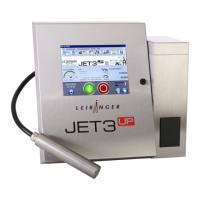
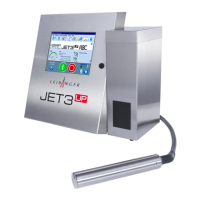
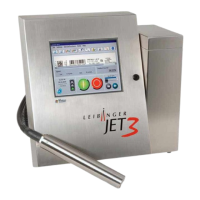
Overview of the device's main components: electronic cabinet, hydraulic cabinet, and refilling unit.
Explains the continuous ink jet process, drop creation, and deflection.
Describes how the JET3 operates using continuous ink jet and drop deflection.
Details the process of ink being pressed through a nozzle and modulated into drops.
Explains how ink conductivity and voltage create charged drops.
Describes how charged drops are deflected by an electrical field.
Explains how characters are formed using a matrix and drop deflection.
Provides a summary of the steps involved in creating characters.
Illustrates a typical use case of the printer on a production line.
Highlights critical safety warnings related to fire and injury during operation.
Describes the main menu layout and its key components.
Explains the design and function of the numeric keypad for input.
Details the standard and special character layouts of the on-screen keyboard.
General information on device control via touch display or PC mouse.
Describes the automatic initialization process upon first connection or power interruption.
Procedure for powering on the device, with and without password protection.
Steps to reset the production counter, including a safety query.
Instructions for modifying counter values using arrow keys or the numeric keypad.
Procedure for safely shutting down the printer, requiring a print stop first.
Explanation of menu bar, drop-down menus, submenus, dialog boxes, and controls.
Details on performing hardware resets and configuring interval operation.
Instructions for resetting the electronic components via a reset switch.
Configuration of automatic start/stop times for ink circulation.
Information on the assembly and function of the external print head ventilation unit.
Overview of data input methods and printer control via external software or digital signals.
Explains options for managing print jobs, including creation and loading.
Step-by-step guide to creating a new job using the job editor.
Procedure to open and select jobs from storage for modification.
Instructions for modifying the currently loaded job using the job editor.
Process to load a saved job directly for printing.
Overview of creating job lists with options like Extern Jobselect, Batch Job, and Job organisator.
Example of creating an Extern Jobselect list for printing jobs in a specific order.
Example of creating a job list with specific distances between print jobs.
Example of creating a Batch Job list with fixed order and repetitions.
Example of creating a Job Organisator list with defined distances and repetitions.
Navigating the settings menus for basic, hydraulic, I/O, and password configurations.
Setting language, units, date/time, encoder interface, and factory settings.
Choosing the operating language, ISO-fonts, and measuring unit (mm/inch).
Setting current time, time zone, date format, and automatic DST changes.
Configuring start and end times for automatic ink circulation.
Configuring the incremental encoder interface and bounce time delay.
Procedure to reset printer adjustments to standard factory settings.
Setting the IP address for network integration and device addressing.
Entering license key and Host PC address for remote control software.
Configuring access levels, rights, and passwords for user management.
Enabling/locking functions based on access levels and defining passwords.
Selecting user levels to activate user rights and define passwords.
Entering or displaying passwords for user levels using the keyboard field.
Enabling or locking functions for current access levels via checkboxes.
Procedure for recovering lost passwords for supervisor access.
Enabling password prompts on device startup and user login/logout.
Assigning functions or status to digital inputs and outputs.
Assigning functions like 'Counter reset' to available inputs.
Assigning printer states and messages to available outputs.
Accessing functions like I/O Test, Hydraulic, Printhead, Data Logging, and Remote Control.
Displaying states of digital inputs and outputs for temporary testing.
Accessing tests for hydraulic components and print head functions.
Details on Ink-Flow-Sensor, Piezo Test, Charge Test, and Jet Adjustment.
Enabling/disabling ink jet monitoring for backflow detection.
Information on piezo tests and charge tests, referring to the service manual.
Step-by-step guide for adjusting the jet position, requiring special tools.
Overview of available functions like Constant Bleed, Mix Ink/Solvent, and Data Logging.
Details on the constant bleed function and its activation conditions.
Procedures for mixing only ink or only solvent to adjust ink viscosity.
Function to temporarily cancel error and alarm messages during startup or service.
Saving and exporting machine data from the log file for analysis.
Steps to select and save machine data to external media like USB-sticks.
Displays information about the last inspection, operation hours, and print counters.
Accessing additional functions like Test Print, Login, Explorer, and Save Counters.
Activating the function to save integrated job counter states.
Loading a default job for creating new jobs or testing print functions.
Setting production counters, pre-defined print stops, and resetting job counters.
Configuring product counters, including stop after x products and reset options.
Defining the number of prints before an automatic print stop.
Procedure to reset all existing job counters in the current loaded job.
Logging in, changing users, and managing access levels and permissions.
Describes the login dialog layout for logged-in and new users.
Steps for logging in a user or changing the current logged-in user.
Procedure to log out the current user, closing the dialog field.
Creating and editing complex logos, patterns, and writings using graphical tools.
Details on editing tools like cut, copy, paste, and delete.
Managing graphics files: creating, opening, saving, and closing.
Tools for creating points, lines, rectangles, ellipses, rows, and columns.
Adjusting display settings like zoom, grid, and editor size.
Procedure to open and process existing graphic files.
Instructions for saving opened or newly created graphics.
Setting editor size (width/height) and grid size.
Steps for creating and deleting graphic elements like rectangles.
Editing existing fonts and creating new ones, including character customization.
Opening the data administration tool for managing files on the JET3.
Description of the explorer window, selection windows, and filter options.
Using tools like Copy, Delete, and Clone for managing data.
Procedure for deleting print jobs from internal memory using the explorer.
Steps for calibrating the TFT-Touch-Display for accurate touch input.
How to access system information and launch help functions.
Viewing system details like frequency, ink level, and software versions.
Procedure to save system information to an external memory device like a USB-stick.
Introduction to the job editor for creating and saving print data.
Description of the job editor's interface elements: menu bar, direct buttons, and display area.
Tools for creating and editing jobs, including edit and organization tools.
Details on editing tools like cut, copy, paste, and delete for job elements.
Functions for managing jobs: saving, loading, and closing the editor.
Tools for creating text, barcodes, graphics, counters, and date/time elements.
Applying object settings like font, contrast, and alignment to printing elements.
Accessing settings for Printstyle, Print parameter, Encoder parameter, and Date changing.
Options for adjusting the view, including zoom, grid, and editor settings.
Managing jobs: saving, loading, and closing the job editor.
Procedures for saving edited or new jobs with current or new names.
Steps to load a job directly from the editor for printing.
Procedure to close the job editor, with options to save or discard changes.
Assigning various settings like font, contrast, and orientation to printing elements.
Choosing fonts for newly created or selected printing elements.
Setting print contrast by placing dots on top of each other.
Accurately positioning printing elements using pixel coordinates.
Determining the bold level for text by multiplying strokes.
Setting the distance between characters, affecting spacing with blank strokes.
Rotating printing objects by 90°, 180°, or 270° and applying mirroring.
Activating display options like mirrored, inverted, alternating, and proportional.
Assigning counters to objects for periodic repetition and defining print conditions.
Providing fast access to editable objects for direct editing on the WYSIWYG screen.
Committing text output type, selecting PrintGo source, and monitoring functions.
Setting the delay for text output based on entered measurement values.
Defining the distance between text outputs based on selected values.
Setting the amount of text outputs (print repetitions) up to 1000.
Special function for printing length specs on cables, using encoder and PrintGo signals.
Filtering unrequested PrintGo signals by defining a length after the signal.
Controlling print start via internal parameters or external sensors (Print-Go source).
Additional control for print start, ensuring output only while sensor is active.
Monitoring PrintGo and StrokeGo signals to detect errors at high printing speeds.
Complementing PrintGo control with a second sensor for double-checking signals.
Adjusting drop charging timing for high-speed print delay compensation.
Setting basic parameters for the signal encoder, including source and resolution.
Defining the encoder source as internal or external (incremental encoder).
Determining the exact production speed required for product conveyance.
Selecting the encoder's rotating direction (right, left, or both) for signal analysis.
Defining encoder resolution in impulses per measurement unit.
Activating/deactivating the function to lock backward movement of the encoder.
Switching output signals ON/OFF based on a pre-adjusted speed limit.
Designing the text layout by adjusting print height, font width, and orientation.
Determining print height via vertical drop distance, value 1-100%.
Setting print width based on horizontal drop distance of strokes.
Rotating printing elements by 180° and applying mirroring.
Choosing print modes based on dot count, quality, and speed.
Configuring view settings and basic settings for the job editor.
Details on implementing barcodes, text, graphics, and counters.
Information on barcode types, character sets, and check digit calculations.
Creating barcode objects using Insert menu or direct buttons.
Adjusting contrast, orientation, positioning, and print-out options.
Setting barcode content, type, text position, and font.
Configuring bar code format, including bar width, space width, and styles.
Adding Date/Time, Counter, or Extern Text objects and special characters.
Implementing date/time specifications, display options, and expiry time.
Adding current date/time or expiry date with offsets to text objects.
Generating custom replacements for date/time values.
Bonding programmable counters and defining parameters for font and display.
Defining basic counter settings like digits, start value, and end value control.
Setting the number of digits for the counter, up to a maximum of 10.
Defining the initial value for the counter, resetting to start value after reaching end value.
Setting the initial value for the counter when the job is first started.
Defining the end value for the counter and its reset behavior.
Turning the display of leading zeros for counters on or off.
Setting the increment value for the counter between prints.
Defining the number of times a print should be repeated, up to 999998 times.
Setting the counter direction to increment (+) or decrement (-).
Controlling counter action upon reaching the set end value (stop or loop).
Defining counter reset methods: manual, production counter, or external signals.
Determining the event for counter value change (PrintGo, printing end, or external signal).
Preventing counter objects from printing while allowing background operation.
Declaring a counter as global for use across multiple print jobs.
Generating custom replacements for counter values for specific display or coding.
Integrating text elements printed at predefined periods (shift times).
Managing shift times and codes, listing up to 24 shift codes.
Steps to compile shift times and integrate codes with existing text.
Procedure for deleting unneeded shift times from the management window.
Using external text files as data sources for print-out via serial or Ethernet.
Setting up fixed-length character strings via serial or Ethernet, including interface settings.
Creating extern text objects with settings for double prints, wildcards, and offsets.
Managing input buffer size and print-out rules for fixed-length text objects.
Setting up variable-length character strings, including interface settings.
Interface settings for variable length text are the same as for fixed length.
Creating variable length text objects with settings for double prints, symbols, wildcards, and offsets.
Using external text files for print-out via the Mailing function.
Steps to create standardized *.ljd data files using converter software.
Configuring database settings on the printer by selecting files from a USB stick.
Creating Mailing objects and defining parameters like wildcards and field numbers.
Controlling print-out from database records, defining start/end data sets.
General information on error diagnosis and contacting service personnel.
Provides a tool for minor defect removal and advises contacting service for issues.
Explains warning and error messages, their display format, and confirmation.
Lists error codes, reasons for failure, and suggested workarounds.
Guidelines for equipping the printer and performing regular maintenance.
Safety warnings regarding explosion and dangerous materials during equipping.
Instructions for refilling ink and solvent reservoirs, emphasizing safety.
General warnings for service work, including dangerous voltage and fire risk.
Checking print head, deflector unit, and charging electrode for dirt.
Checking spindles and nozzle seal guides for dirt.
Recommends regular servicing intervals of 6-12 months.
Procedures for battery replacement and pressure regulator valve maintenance.
Instructions for replacing the battery, emphasizing safety and disposal.
Guidance on emptying condensate and cleaning the cartridge for the valve.
Instructions for cleaning the print head, including safety warnings.
Details on daily cleaning, solvent usage, and nozzle seal lubrication.
Ensuring safety during cleaning by connecting print head and tray to ground.
Procedures for safely removing ink/solvent, disconnecting power, and cleaning.
Steps to drain ink/solvent, disconnect power, and follow cleaning instructions.
Information on dismantling and disposal, considering country-specific regulations.
Provides circuit diagrams for interfaces X1 (Encoder), X5 (PrintGo), X2 (Serial), and X4 (Inputs).
Illustrates wiring examples for outputs (X3) and inputs (X4).
Shows connection examples for outputs, including LEDs and inductive loads.
Illustrates connection examples for Increment Counter Signal and Reset Counter Signal.
Shows connection schemas for Jobselect inputs with internal and external supply.
Illustrates input connections for pushbuttons, including ON input.
Information on using encoders for dynamic capture and detecting rotation direction.
Provides technical drawings for hydraulic systems, print heads, and cabinets.
Schematic diagram of the hydraulic system (LJ3).
Technical drawings of the Print Head SK 4 with hose connection.
Technical drawings of the Cabinet LJ3.
 General
| Print Technology | Continuous Inkjet (CIJ) |
|---|---|
| Ink Colors | Black, Red |
| Operating Temperature | 5°C to 45°C |
| Humidity Range | Up to 90 % relative humidity, non-condensing |
| Connectivity | Ethernet, USB, RS-232 |
| Resolution | 16 dots (5x3 matrix) |
| Substrate Compatibility | Metal, plastic, glass, paper, cardboard |
| Power Supply | 100–240 V AC, 50/60 Hz |
| User Interface | Touchscreen |

 To Next Page