Safety notes
6 M822 / Ref. 10 743 504 / Version 01
OttoFlex™ illuminator
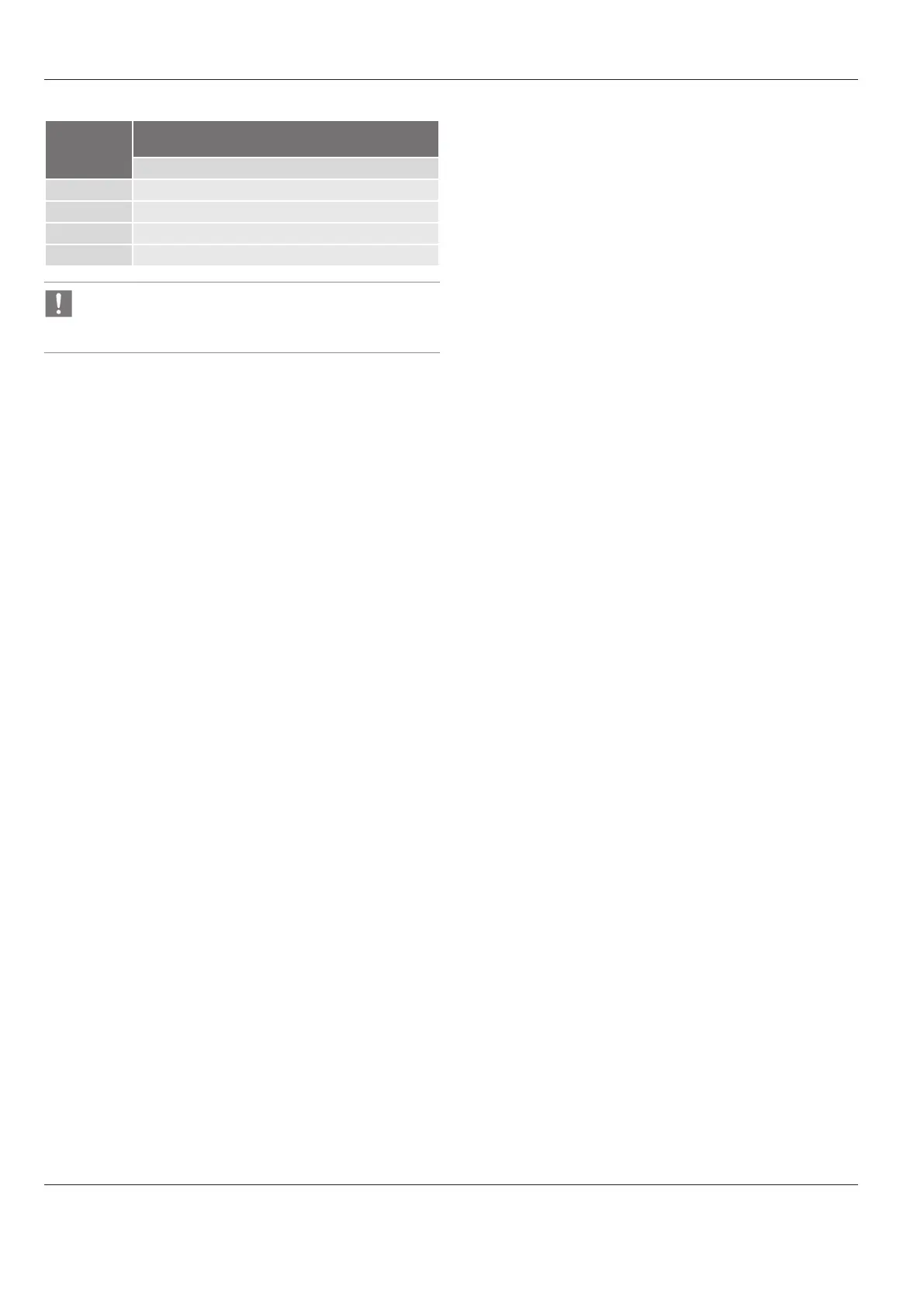
Light setting
Recommended maximum exposure time according to
1)
[min.]
Without filter
25 % 113
50 % 25
75 % 9
100 % 5
Use the protection filter 5× (10448676) to increase the
operation duration by a factor of 5 compared to the
standard configuration without a filter.
Sources:
1)
DIN EN ISO 15004-2:2007 Ophthalmic instruments –
Fundamental requirements and test methods – Part 2: Light
hazard protection.
2)
ISO 10936-2:2010 Optics and photonics – Operation
microscopes/Part 2: Light hazard from operation microscopes
used in ocular surgery.
3)
David Sliney, Danielle Aron-Rosa, Francois DeLori, Franz
Fankhauser, Robert Landry, Martin Mainster, John Marshall,
Bernhard Rassow, Bruce Stuck, Stephen Trokel, Teresa Motz
West and Michael Wolffe, Adjustment of guidelines for exposure
of the eye to optical radiation from ocular instruments:
statement from a task group of the International Commission on
Non-Ionizing Radiation Protection (ICNIRP) APPLIED OPTICS, Vol.
44, No. 11, p. 2162 (10 April 2005).
Protect the patient with the following safeguards:
•
Short illumination times
•
Low brightness setting
•
Use of protective filters
•
Switching off the illumination during breaks in the operation
It is recommended to adjust the brightness to the minimum
necessary for the surgery. Infants, patients with aphakia (whose
eyelens has not been replaced by an artificial lens with a UV
protection screen), small children and persons with diseases of the
eye are at greater risk. The risk is also increased if the person being
treated or operated on has, within the last 24 hours, already been
exposed to illumination from the same or any other
ophthalmological instrument that uses a bright visible light source.
This applies especially to patients that have been examined via
retinal photography.
The decision about which light intensity to use for an application
must be made on a case-by-case basis. In any event, the surgeon
must evaluate the risks and benefits of the used light intensity.
Despite all efforts to minimize the risk of retinal injury by surgical
microscopes, damage may still occur. Photochemical retinal damage
is a possible complication of the necessity to use bright light to
make eye structures visible during difficult ophthalmological
processes.
Stability (floor stands only)
When moved in the operating room, the swing arm must be folded
up and locked and the brakes must be applied, otherwise the swing
arm could drift out of control and the stand could topple.
Hazards due to movable parts
This section describes uses that, inadvertently, could lead to
hazardous situations.
•
Add accessories and balance the stand before the operation, and
never over the field of operation.
•
Never put your hand between the gas spring and the swing arm;
it could become trapped when the swing arm is moved.
•
Do not put your fingers between the microscope and the
focusing drive; They could get crushed.
Floor stand
•
Always push the instrument to move it; never pull it. Feet in
lightweight shoes could become trapped beneath the casing of
the base.
•
The footbrakes must remain engaged throughout the operation.
Electrical connections
The control unit may be opened only by a Leica-approved service
technician.
Accessories
Only the following accessories may be used with the Leica M822
surgical microscopes:
•
The Leica Microsystems accessories described in this User
Manual.
•
Other accessories, provided that these have been expressly
approved by Leica as being technically safe in this context.


 To Next Page