EasyManua.ls Logo

Leica Rod Eye 160 - User Manual

Leica Rod Eye 160
16 pages
Print Icon
To Next Page IconTo Next Page
Loading...
Leica Rod Eye 160
User Manual
Version 1.0
English
Question and Answer IconNeed help?

Do you have a question about the Leica Rod Eye 160 and is the answer not in the manual?

Summary

Introduction

Purchase Information

Information regarding the purchase of the Leica Rod Eye 160.

Documentation Resources

Links and references for user manuals and software.

Safety Directions

General Safety Guidelines

Directions to anticipate and avoid operational hazards.

Warning Message Interpretation

Explanation of signal words (DANGER, WARNING, CAUTION, NOTICE) and their meanings.

Intended and Foreseeable Use

Defines product usage and common misuse scenarios.

Usage Environment and Limits

Specifies suitable atmospheric conditions and hazardous area restrictions.

Responsibilities and EMC

Outlines user duties and Electromagnetic Compatibility (EMC) aspects.

EMC Precautions and FCC Statement

Details on preventing interference and FCC compliance rules.

Device Labeling and Compliance

Identifies device labels and compliance marks.

Instrument Components

Detector Part Identification

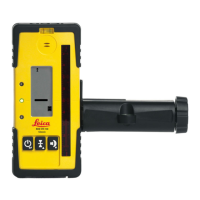
Identifies physical parts like level vial, speaker, LCD, LEDs, reception window, and keypad.

Bracket and Battery Compartment

Describes mounting holes, offset notch, product label, and battery door.

Button Functions

Explains the operation of Power, Laser man, Audio, and Bandwidth buttons.

Detector Bracket Features

Details on the detector bracket's alignment and locking mechanisms.

Special Operational Features

Highlights strobe rejection, beam finding, and low battery alerts.

Operation

Menu Access and Parameter Changes

How to access the menu and change parameters using buttons.

Menu Function Descriptions

Explains UNT, LED, DRO, BAT, MEM, and RPS menu options.

Battery Replacement Procedure

Step-by-step guide for changing the alkaline batteries.

LCD Display Icon Meanings

Interprets icons for grade, battery, units, and accuracy indicators.

Technical Data

Regulatory Compliance

Information on FCC and EU directives compliance.

Device Specifications

Lists working diameter, detection height, accuracies, and environmental limits.

Care and Transport Guidelines

Equipment Transport Methods

Instructions for safe transport in field, vehicle, rail, air, and sea.

Product and Battery Storage

Recommendations for storing the product and its batteries.

Overview

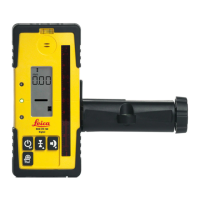
The Leica Rod Eye 160 is a digital laser receiver designed to assist in precise measurement tasks, particularly in construction and surveying applications. It is intended for use with rotating laser levels to detect and display the laser beam's position, aiding in maintaining accurate grades and elevations.

Function Description:

The primary function of the Rod Eye 160 is to detect laser beams from rotating lasers and provide visual and audible indications of the beam's position relative to an "on-grade" reference. It features a laser reception window that detects the laser beam, and its position is then displayed on both front and rear LCD screens with arrow indicators and LEDs. The device offers five-channel indication for the relative position of the laser beam: High (Red), On-grade (Green), and Low (Blue). An audio speaker provides distinct tones for High (fast beeping), On-grade (solid tone), and Low (slow beeping) positions, allowing for hands-free operation.

Key functions include:

  • Grade Indication: Seven channels are displayed for above and below grade, with arrow bars representing the selected accuracy bandwidth.
  • Digital Readout (DRO): Provides a numeric display of the elevation, configurable in various units (mm, cm, in, in fractions, ft).
  • Strobe Rejection: The RE Digital is designed to reject and eliminate unwanted signals from strobe lights, ensuring accurate readings.
  • Beam Finding: Passing the receiver through the laser beam causes a quick double beep, confirming detection.
  • Out of Beam Display: If the detector moves out of the laser range, arrow displays indicate the direction to move to return to the laser beam.
  • Position Memory (MEM): This function, when enabled, helps users return to the laser beam by indicating the direction to move if the receiver is moved out of the detection range.
  • Head Speed Measurement (RPS): The device can measure and display the head speed of the laser when held in a rotating beam.
  • Accuracy Settings: Five levels of accuracy are available: ultra fine, super fine, fine, medium, and coarse, allowing users to select the precision required for their task.
  • Audio Output Control: Users can adjust the audio volume to four levels: loud, medium, soft, or off.
  • LED Brightness Control: The brightness of the LED indicators can be adjusted (High/Low/Off).

Important Technical Specifications:

  • Working Diameter (laser dependent): 1350 m / 4430 ft
  • Detection Height: 120 mm / 5 in
  • Numeric Readout Height: 90 mm / 3.5 in
  • Detectable Spectrum: 600 nm to 800 nm
  • Detectable Accuracies:
    • Very fine: ± 0.5 mm / ± 0.02 in
    • Fine: ± 1.0 mm / ± 0.04 in
    • Medium: ± 2.0 mm / ± 0.08 in
    • Coarse: ± 3.0 mm / ± 0.12 in
    • Very coarse: ± 5.0 mm / ± 0.20 in
  • Audio Volumes: 105 dBA / 95 dBA / 65 dBA / Off
  • Automatic Shut Off: 10 minutes
  • Digital Readout Units: mm, cm, in, in (fractions), ft
  • Arrow Display Channels: 15 channels
  • Anti-strobe Protection: Yes
  • Memory, Last Beam Strike: Yes
  • Beam Finding (double beep): Yes
  • Laser Low Battery Indicator: Yes
  • Warranty: 3 years
  • Environmental Protection: IP67 (dust tight and protected against strong jets of water)
  • Batteries: 2 x 1.5 V "AA" - 50+ hours
  • Dimensions: 173 x 76 x 29 mm / 6.8 x 3.0 x 1.1 in
  • Operating Temperature: -20°C to +50°C / -4°F to +122°F
  • Storage Temperature (except batteries): -40°C to +70°C / -40°F to +158°F
  • Compliance: FCC Part 15 (US), European Directive 1999/5/EC (R&TTE) for Class 1 equipment.

Usage Features:

The Rod Eye 160 is designed for ease of use in the field. It features a level vial to help keep the rod plumb for accurate readings. The bracket mounting hole allows for secure attachment to a receiver bracket, which then clamps onto a grade rod. An offset notch, located 85 mm (3.35") below the top of the detector, is used to transfer reference marks.

The keypad provides intuitive control over various functions:

  • Power Button: Turns the receiver on/off.
  • Laser Man Button: Captures digital readings.
  • Audio Button: Changes the audio output.
  • Bandwidth Button: Changes the detection bandwidth (accuracy).

Accessing the menu is done by simultaneously pressing the Bandwidth and Audio buttons. Users can then navigate through menu options (UNT, LED, DRO, BAT, MEM, RPS) using the Bandwidth and Audio buttons to change parameters, and the Power button to scroll through the menu.

The LCD display provides clear visual feedback, including:

  • Grade indication arrows.
  • Memory display for out-of-beam direction.
  • Laser low battery warning (if the connected laser supports this feature).
  • Audio volume indication.
  • Units of measure.
  • Numeric elevation indication.
  • Accuracy indication.
  • Receiver low battery warning (three levels: full, low, empty).

Maintenance Features:

  • Battery Replacement: The device uses two 1.5V "AA" alkaline batteries. The small battery icon on the display indicates when batteries are low and need replacement. The battery door is located on the back of the unit and secured by a locking mechanism.
  • Storage: When storing the product, it is crucial to respect temperature limits. For Li-Ion and alkaline batteries, it is recommended to remove them from the product and charger before storing. Batteries should be recharged after storage. Protecting batteries from dampness and wetness is also important. For Li-Ion batteries, a storage temperature range of -20°C to +30°C (-4°F to 86°F) in a dry environment is recommended, and batteries with 50-100% charge can be stored for up to one year before needing a recharge.
  • Transport: The product should always be transported in its original container or secured to prevent shock and vibration. When shipping batteries, national and international rules and regulations must be observed.
  • Field Adjustment: Periodically, especially after drops, long storage, or transport, test measurements and field adjustments should be performed as indicated in the user manual to ensure continued accuracy.

Leica Rod Eye 160 Specifications

General IconGeneral
BrandLeica
ModelRod Eye 160
CategoryMeasuring Instruments
LanguageEnglish

Related product manuals