Frame Mortise & Tenon Jig User Guide
48
Chapter 7
SPECIAL JOINTS
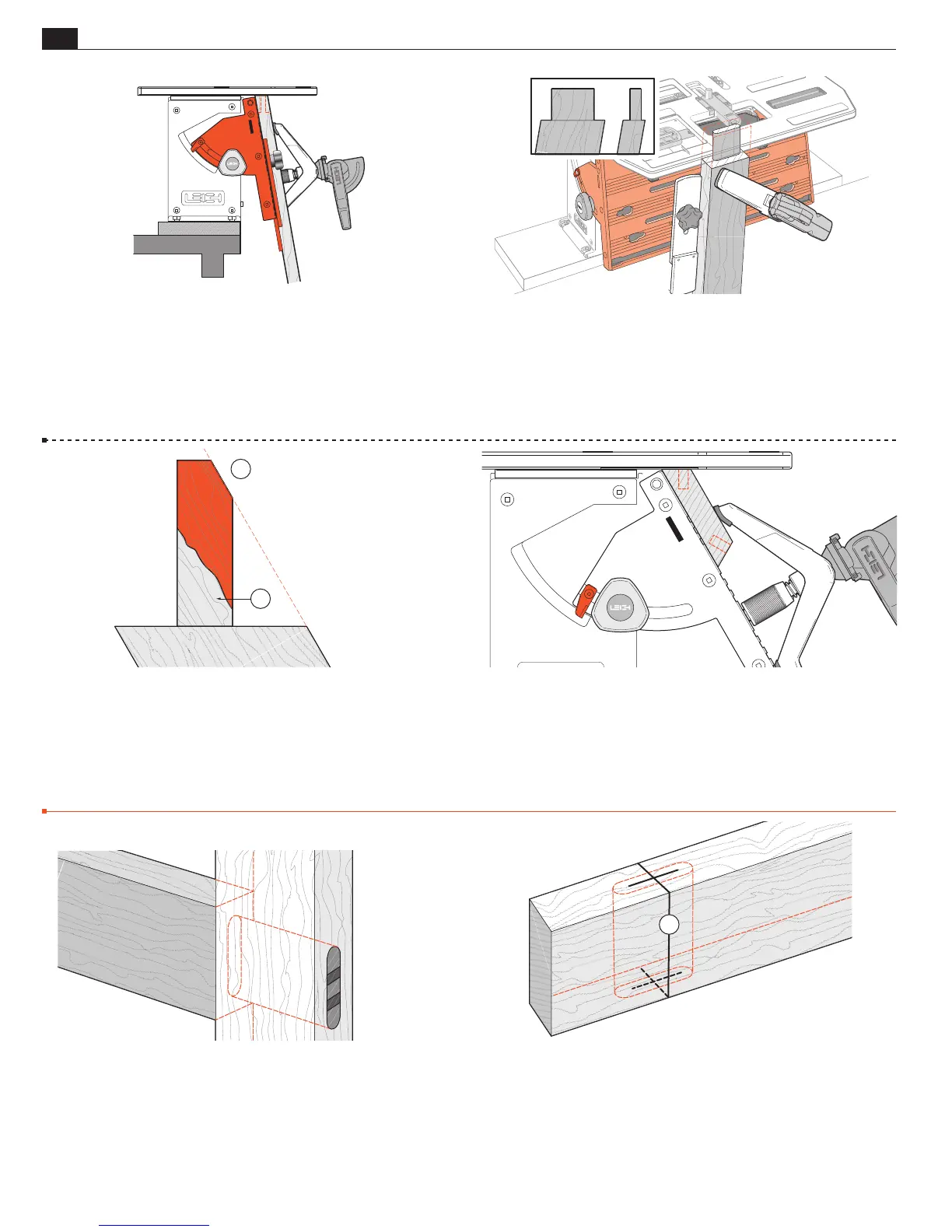
7-3 Angling the clamp plate with vertical sidestops also gives
a single angled joint in the front-back direction.
7-4 Angling both fence and clamp plate give a double, or
compound angled joint.
7-5 The FMT Pro clamp plate can be angled up to 30˚ but it is
doubtful you will ever need to approach even 10˚ on a mortise and
tenon joint. The strength of a tenon across its grain lessens consider-
ably as the angle increases
➀
. In addition, the length and position of
the tenon is limited in slope by the angled workpiece relative to the
vertical bit
➁
(angle demonstrated in this illustration is excessive.)
1
2
7-6 However, you may for example, want to machine spline
mortises or dowel holes in a stave type construction in, say, octa-
gons at 22
1
⁄2˚, or hexagons at 30˚, so the 30˚ capacity may prove
to be useful. You can then machine precisely fitting splines on the
FMT Pro and trim them to length.
■
7-7 Through Tenons Occasionally, a design feature will
call for through, exposed tenons, possibly “wedged” for decorative
effect. The limited depth of cut of router bits can make this difficult,
but the two-sized bit technique described previously, combined
with the precision of the FMT Pro, makes this procedure perfectly
feasible in many instances.
7-8
The problem with through mortises is their great depth
relative to the cutting depth and diameter of the bit.
However, if
the left-right part of the joint center mark
➀
is carefully squared
around the mortise workpiece, it is possible to accurately plunge
from both sides.
1
Through Tenons


 To Next Page