EasyManua.ls Logo

Lennox 10ACC-024-230 - User Manual

Lennox 10ACC-024-230
12 pages
Print Icon
To Next Page IconTo Next Page
Loading...
Page 1
ã 2002 Lennox Industries Inc.
Litho U.S.A.
Corp. 0201-L1
10ACC
Service Literature
10ACC SERIES UNITS
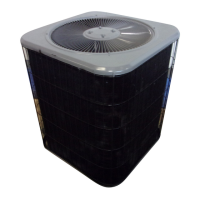
The 10ACC is a residential split-system condensing
unit available in sizes ranging from 1-1/2 to 5 tons. Con-
densing coil size, circuiting and air volume result in a
minimum SEER rating of 10.0. The series is designed
for use with an expansion valve or RFCIV system in the
indoor unit.
10ACC 1-1/2 to 3 ton units are equipped with reciprocating
compressors. All compressors are hermetically sealed for
long service life. The compressor is installed in the unit on re-
silient rubber mounts to assure quiet, vibration-free operation.
A built-in protection device assures protection from excessive
current and temperatures.
10ACC3-1/2to5ton units are equipped with scroll com-
pressors. The scroll operates likea standard compressorbut
it is unique in the way it compresses refrigerant.
WARNING
Refrigerant can be harmful if it is inhaled. Refriger-
ant must be used and recovered responsibly.
Failure to follow this warning may result in person-
al injury or death.
WARNING
Electric shock hazard. Can cause injury
or death. Before attempting to perform
any service or maintenance, turn the
electrical power to unit OFF at discon-
nect switch(es). Unit may have multiple
power supplies.
This manual is divided into sections which discuss the
major components, refrigerant system, charging proce-
dure, maintenance and operation sequence.
All specifications in this manual are subject to change.
IMPORTANT
Improper installation, adjustment, alteration, ser-
vice or maintenance can cause property damage,
personal injury or loss of life. Installation and ser-
vice must be performed by a qualified installer or
service agency.
Question and Answer IconNeed help?

Do you have a question about the Lennox 10ACC-024-230 and is the answer not in the manual?

Summary

Control Box Components

1 - Compressor Contactor K1

Explains the function and operation of the compressor contactor K1.

2 - Dual Capacitor C12

Describes the dual capacitor used for fan and compressor motors.

Compressor Details

1 - Scroll Compressor

Explains the design, operation, and unique properties of the scroll compressor.

Refrigerant System Procedures

Charging and Leak Testing

IV - Charging

Outlines procedures for charging the refrigerant system.

A - Pumping Down System

Details the process of pumping down the system for maintenance.

B - Leak Testing

Describes how to perform leak testing before evacuation.

System Evacuation and Charging Methods

D - Charging

Explains refrigerant charging based on line set length and ambient temp.

Refrigerant Charging Methods

Maintenance Procedures

Wiring Diagrams and Operation Sequence

Overview

The Lennox 10ACC is a residential split-system condensing unit designed for cooling applications. It is available in various sizes, ranging from 1-1/2 to 5 tons, and is engineered to achieve a minimum SEER rating of 10.0. The unit is compatible with either an expansion valve or an RFCIV system in the indoor unit.

Function Description:

The 10ACC unit's primary function is to provide cooling for residential spaces. It operates as part of a split-system, meaning it works in conjunction with an indoor evaporator coil and blower. The condensing unit, located outdoors, compresses and condenses refrigerant, which then circulates to the indoor coil to absorb heat from the indoor air, thus providing cooling.

Important Technical Specifications:

  • Capacities: Available in 1-1/2, 2, 2-1/2, 3, 3-1/2, 4, and 5 ton capacities.
  • Compressor Types:
    • 10ACC 1-1/2 to 3 ton units are equipped with hermetically sealed reciprocating compressors. These compressors are mounted on resilient rubber to minimize vibration and noise, and include a built-in protection device against excessive current and temperatures.
    • 10ACC 3-1/2 to 5 ton units feature scroll compressors, which are known for their efficiency and simple compression concept. Scroll compressors are tolerant to liquid return, as the orbiting scroll can separate from the stationary scroll to discharge liquid.
  • Refrigerant: Uses HCFC-22 refrigerant. The factory charge is sufficient for a 20 ft. (6.1 m) length of refrigerant lines. Specific charge amounts vary by model and are listed on the unit nameplate.
  • Electrical Data:
    • Line voltage: 208/230V-1ph, 60Hz.
    • Minimum circuit ampacity and maximum fuse sizes vary by model (e.g., 10ACC-018: 11.6 amps min. circuit, 20 amps max fuse; 10ACC-060: 35.5 amps min. circuit, 60 amps max fuse).
    • Compressor rated load amps and locked rotor amps vary significantly by model.
    • Condenser fan motor full load amps and locked rotor amps are also specified for each model.
  • Condenser Coil: Net face area, tube diameter (5/16 in. / 7.9 mm), number of rows (1), and fins per inch (22 / 866) are consistent across most models, though face area varies.
  • Condenser Fan: Diameter (16 in. / 406 mm to 22 in. / 559 mm), number of blades (3 or 4), motor horsepower (1/10 to 1/3 hp), CFM (L/s), RPM, and Watts vary by model.
  • Service Valves: Liquid line and suction line service valves are provided with sweat connections. Ball-type service valves are used on 5-ton units. Schrader valves are factory installed in service ports for leak testing, evacuation, and charging.
  • Control Box Components: Includes a compressor contactor (K1) and a dual capacitor (C12) for both the fan motor and compressor. Optional start capacitor (C7) and potential relay (K31) are used in reciprocating compressor units for enhanced starting.

Usage Features:

  • System Matching: Proper matching of indoor blower and coil with the condensing unit is crucial for warranty coverage and optimal operation. Refer to the Engineering Handbook for approved system matchups.
  • Charging Procedures:
    • Weighing in the Charge: Recommended for systems void of refrigerant or when outdoor ambient temperature is below 60°F (16°C).
    • Subcooling Method: Used for fixed orifice systems when outdoor ambient temperature is 65°F (18°C) or above. Requires measuring liquid line temperature and pressure.
    • Approach Method: Used for TXV (Thermostatic Expansion Valve) systems when outdoor ambient temperature is 60°F (16°C) or above. Requires measuring liquid line temperature and outdoor ambient temperature.
  • Deep Vacuum Operation: Scroll compressors are capable of drawing a deeper vacuum than reciprocating compressors. However, deep vacuum operation (compressor operating at 0 psig or lower) should be avoided as it can cause internal fusite arcing and compressor failure. The compressor should never be used for evacuating or "pumping-down" the system.
  • Service Valve Operation: Instructions are provided for opening and closing liquid and suction line service valves, as well as accessing schrader ports for gauge manifold connection.
  • Electrical Controls: The unit's 24 VAC controls are powered by the indoor unit, as 10ACC units are not equipped with a 24V transformer.
  • Wiring: Detailed wiring diagrams and sequence of operation are provided for cooling cycles, including initiation and termination of cooling demand.

Maintenance Features:

  • Regular Checks: At the beginning of each cooling season, the system should be checked by a qualified installer or service agency.
  • Condenser Coil Cleaning: The condenser coil should be cleaned and inspected. It can be flushed with a water hose after ensuring power is off.
  • Leak Inspection: Visually inspect connecting lines and coils for evidence of oil leaks.
  • Electrical System Checks:
    • Check wiring for loose connections.
    • Verify correct voltage at the unit (when operating).
    • Measure compressor and condenser fan motor amp-draw.
  • Refrigerant Charge Verification: If insufficient cooling is reported, the refrigerant charge should be checked using gauges and the appropriate charging method.
  • Evaporator Coil Maintenance: Clean the evaporator coil if necessary, check connecting lines and coils for oil leaks, and clean the condensate pan line.
  • Indoor Unit Maintenance: Clean or change filters, adjust blower speed for cooling (refer to service manual for pressure drop tables), check belt wear and tension for belt-drive blowers, and check wiring and voltage.

Safety Warnings:

  • Electrical Shock Hazard: Always disconnect all electrical power to the unit at the disconnect switch(es) before performing any service or maintenance. Units may have multiple power supplies. One leg of compressor, capacitor, and condenser fan are always connected to line voltage.
  • Refrigerant Handling: Refrigerant can be harmful if inhaled. It must be used and recovered responsibly.
  • Nitrogen Pressure: When using dry nitrogen for leak testing, a pressure-reducing regulator must be used to prevent excessive pressure in the gauge manifold, hoses, and system. Regulator setting must not exceed 150 psig (1034 kPa).
  • Service Valve Backseating: Do not attempt to backseat the service valves, as this can cause the snap ring to explode under refrigerant pressure, leading to personal injury and unit damage.
  • Qualified Personnel: Improper installation, adjustment, alteration, service, or maintenance can cause property damage, personal injury, or loss of life. Installation and service must be performed by a qualified installer or service agency.

Lennox 10ACC-024-230 Specifications

General IconGeneral
Cooling Capacity (BTU)24000
Voltage230
Stages1
Voltage (V)230
Phase1
Refrigerant TypeR-410A
Sound Level (dBA)76

Related product manuals