
 Need help?
Do you have a question about the Lennox 10ACC Series and is the answer not in the manual?
Overview of 10ACC condensing units, sizes, SEER rating, and compressor types.
Critical warnings on refrigerant hazards and electrical shock risks before servicing.
Details on 10ACC unit capacities, system matching, and electrical safety warnings.
Illustration and identification of key unit components and control box configurations.
Explanation of the compressor contactor's function and wiring in 10ACC units.
Description of the dual capacitor used for fan motor and compressor.
Details on the optional start capacitor and its role in compressor startup.
Information on the optional potential relay and its function with the start capacitor.
Explanation of the scroll compressor design, operation, and handling precautions.
Details on the condenser fan motor's requirements, control, and steps for accessing it.
Information on field refrigerant piping, line set types, and service port locations.
Instructions for operating liquid/suction line service valves and accessing Schrader ports.
Procedure for pumping down the system, including cautions about deep vacuum.
Steps for performing leak testing on the system using nitrogen before evacuation.
Detailed steps for evacuating the system, including vacuum level and leak checks.
Guidance on charging the system based on line set length and ambient temperature.
Method for weighing in refrigerant charge for fixed orifice or TXV systems in cooler temperatures.
Procedure for charging fixed orifice systems above 65°F using the subcooling method.
Procedure for charging TXV systems at or above 60°F using the approach method.
Checks for condenser coil, connecting lines, wiring, and electrical parameters.
Maintenance for evaporator coil, condensate pan, filters, and blower motor.
Describes the sequence of operation for the 10ACC unit during cooling mode.
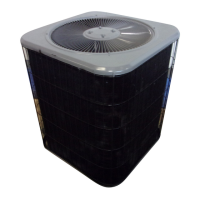
The Lennox 10ACC is a residential split-system condensing unit designed for cooling applications. It is available in various sizes, ranging from 1-1/2 to 5 tons, and is engineered to achieve a minimum SEER rating of 10.0. The unit is compatible with either an expansion valve or an RFCIV system in the indoor unit.
The 10ACC unit's primary function is to provide cooling for residential spaces. It operates as part of a split-system, meaning it works in conjunction with an indoor evaporator coil and blower. The condensing unit, located outdoors, compresses and condenses refrigerant, which then circulates to the indoor coil to absorb heat from the indoor air, thus providing cooling.


 To Next Page
 General