Page 17
XP15 SERIES
1 Check the airflow as illustrated in figure 26 to be sure the indoor airflow is as
required. (Make any air flow adjustments before continuing with the following
procedure.)
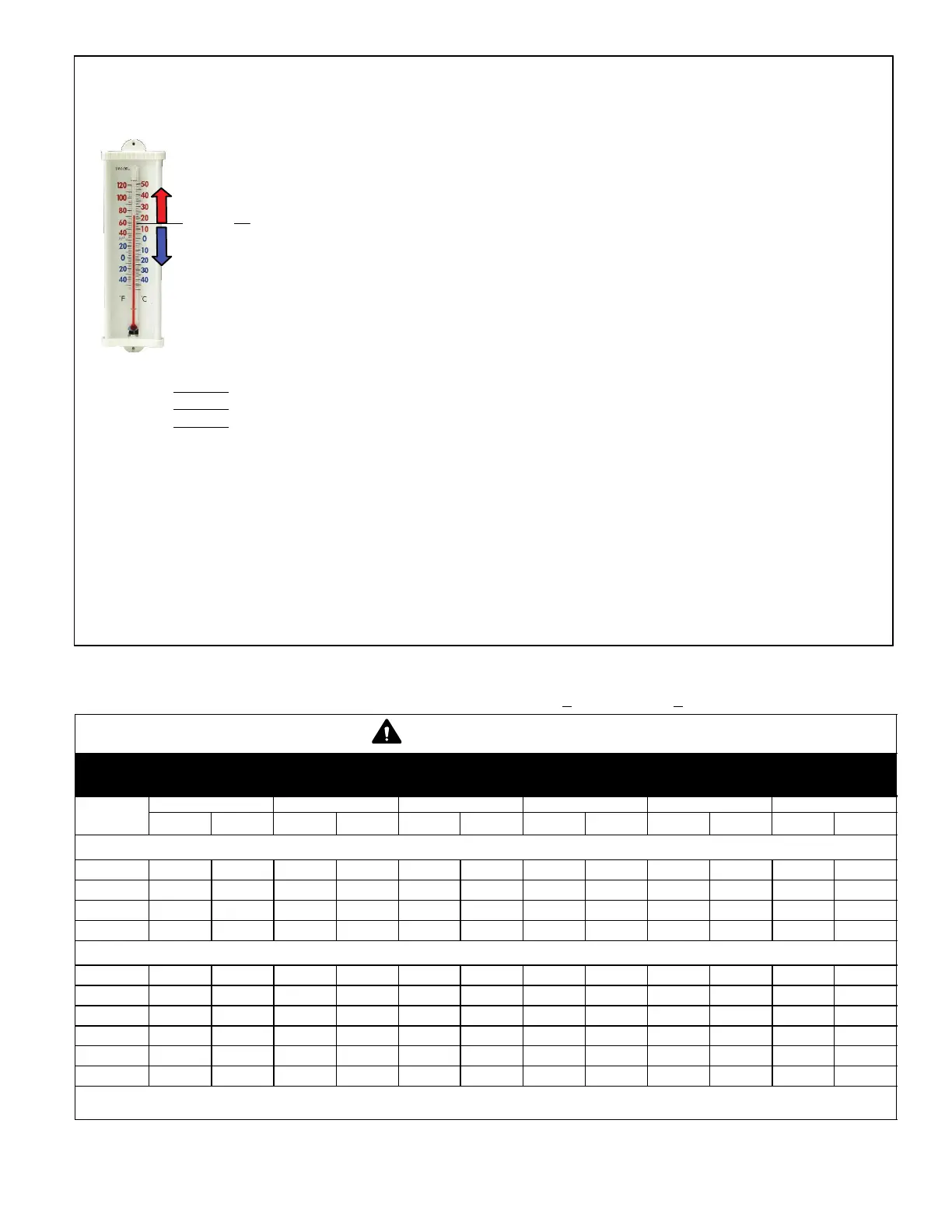
2 Measure outdoor ambient temperature; determine whether to use cooling mode
or heating mode to check charge.
3 Connect gauge set.
4 Check Liquid and Vapor line pressures. Compare pressures with Normal
Operating Pressures table 5, (The reference table is a general guide. Expect
minor pressure variations. Significant differences may mean improper charge or
other system problem.)
5 Set thermostat for heat/cool demand, depending on mode being used:
Using cooling modeWhen the outdoor ambient temperature is 60°F (15°C) and
above. Target subcooling values in table below are based on 70 to 80°F (21−27°C)
indoor return air temperature; if necessary, operate heating to reach that
temperature range; then set thermostat to cooling mode setpoint to 68ºF (20ºC).
When pressures have stabilized, continue with step 6.
Using heating modeWhen the outdoor ambient temperature is below 60°F (15°C).
Target subcooling values in table below are based on 65−75°F (18−24°C) indoor
return air temperature; if necessary, operate cooling to reach that temperature range;
then set thermostat to heating mode setpoint to 77ºF (25ºC). When pressures have
stabilized, continue with step 6.
6 Read the liquid line temperature; record in the LIQº space.
7 Read the liquid line pressure; then find its corresponding temperature in the
temperature/ pressure chart listed in table 12 and record it in the SATº space.
8 Subtract LIQº temp. from SATº temp. to determine subcooling; record it in SCº space.
9 Compare SCº results with table below, being sure to note any additional charge for
line set and/or match−up.
10 If subcooling value is greater than shown in tables 6 through 11 for the applicable unit,
remove refrigerant; if less than shown, add refrigerant.
11 If refrigerant is added or removed, repeat steps 6 through 10 to verify charge.
USE COOLING
MODE
USE HEATING
MODE
60ºF (15º)
SATº
LIQº –
SCº =
SUBCOOLING
Figure 28. Using Subcooling Method
Table 5. Normal Operating Pressure − Liquid +10 and Vapor +5 PSIG*
IMPORTANT
Minor variations in these pressures may be expected due to differences in installations. Significant differences
could mean that the system is not properly charged or that a problem exists with some component in the system.
5F (5C)**
XP15−024 XP15−030 XP15−036 XP15−042 XP15−048 XP15−060
Liquid Vapor Liquid Vapor Liquid Vapor Liquid Vapor Liquid Vapor Liquid Vapor
HEATING OPERATION
20 (−7.0) 315 65 308 62 284 59 293 58 312 62 349 61
30 (−1.0) 340 81 317 76 296 71 312 71 332 76 375 74
40 (4.4) 364 97 339 89 313 87 321 82 353 92 384 88
50 (10) 394 115 359 107 326 106 337 103 374 110 406 107
COOLING OPERATION
65 (18.3) 237 141 250 141 260 139 265 141 242 139 255 136
75 (23.9) 274 143 292 143 298 141 309 144 279 140 297 138
85 (29.4) 319 145 336 145 344 143 360 147 322 142 343 140
95 (35.0) 364 147 385 147 393 145 408 149 370 144 392 142
105 (40.6) 415 149 438 148 446 148 462 151 423 147 447 145
115 (49.0) 469 152 497 151 506 150 522 154 479 149 510 148
*These are most−popular−match−up pressures. Indoor match up, indoor air quality, and indoor load cause pressures to vary.
**Temperature of the air entering the outdoor coil.



 To Next Page