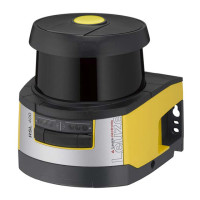
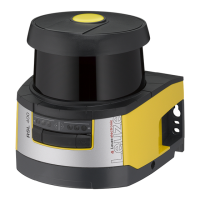
The Leuze RSL 311 Safety Laser Scanner is an optoelectronic, two-dimensional measuring safety laser scanner designed to protect persons or body parts in various industrial applications. It complies with safety standards such as EN IEC 61496 Type 3, EN ISO 13849-1:2015 Category 3 / Performance Level d, and IEC/EN 61508 / EN IEC 62061 SIL 2. The device has a mission time of 20 years and an average probability of a dangerous failure per hour (PFHd) of 9x10⁻⁸ 1/h.
Function Description:
The RSL 311 transmits periodic light pulses via a rotating deflection unit. These pulses scatter off obstacles, and a portion is received back by the sensor and evaluated. The sensor calculates the precise position of an object based on the propagation time of the radiated light and the current angle of the deflection unit. If an object is detected within a predefined protective field, the safety sensor performs a safety-related switching function, turning off its safety-related switching outputs (OSSDs). The OSSDs only reset when the protective field is clear again, either automatically or following acknowledgment, depending on the operating mode. The sensor can detect people even when they are wearing very dark clothes, which have a very weak diffuse reflectance.
The RSL 311 supports various protective functions, including stationary danger zone guarding, mobile danger zone guarding, access guarding, and stationary point of operation guarding. It features one OSSD pair and up to three configurable signal outputs. The device can operate in a "one protective function" mode or a "one protective function – four field mode," which monitors one protective field and three warning fields simultaneously.
Key parameters for the protective function include:
- Configurable protective fields and warning fields.
- Reference contour monitoring to prevent unintentional misalignment and manipulation.
- Configurable field pair changeover.
- Selectable resolution for hand, leg, or body detection (50 mm for leg detection close to floor, 70 mm for leg detection at 300 mm height).
- Safety sensor response time (minimum 80 ms, up to 1000 ms).
- Configurable start-up behavior (automatic start/restart, start interlock/automatic restart, start/restart interlock (RES)).
- Speed-dependent protective function for vehicles, where the maximum vehicle speed can be entered during configuration.
- Selectable dynamic contactor monitoring (EDM) for downstream switching elements.
Important Technical Specifications:
- Laser Protection Class: Class 1 (IEC/EN 60825-1)
- Wavelength: 905 nm (infrared)
- Impulse Duration: 2.5 ns
- Maximum Output Power (peak): 35 W
- Pulse Frequency: 90 kHz
- Scanning Rate: 25 scans/s (40 ms/scan)
- Scanning Angle: Max. 270°
- Angular Resolution: 0.2°
- Tolerance Field of Reference Contour: +200 mm
- Operating Range Class: S (3.00 m for 70 mm and 50 mm resolution)
- Warning Field Range: 0 – 15 m
- Object Size (Warning Field): 150 mm x 150 mm
- Diffuse Reflectance PF Minimum: 1.8%
- Diffuse Reflectance WF Minimum: 10%
- Detection Range (Measurement Field): 0 – 25 m
- Diffuse Reflection (Measurement Field): 90%
- Radial Resolution (Measurement Field): 1 mm
- Lateral Resolution (Measurement Field): 0.2°
- Voltage Supply: 24 V DC (+20% / -30%)
- Current Consumption: Approx. 700 mA (use power supply unit with 3 A)
- Power Consumption: 17 W with 24 V plus output capability
- Switch-on Current: Max. 2 A
- Interfaces: M12-8 connector for control (power, switching/signal lines), M12-4 D-coded Ethernet for communication (parameter configuration, protective/warning field definition, data transmission, diagnosis).
- Dimensions: 140 x 149 x 140 mm (W x H x D)
- Weight: Approx. 3 kg (incl. connection unit)
- Degree of Protection: IP 65 (IEC/EN 60529)
- Operating Temperature: 0 … +50 °C
- Storage Temperature: -20 … +60 °C
Usage Features:
The RSL 311 is configured using the Sensor Studio software, which runs on Microsoft® Windows 7 or higher. The software allows users to define safety configurations, change communication and diagnostics settings, and perform diagnostic routines.
- Display Elements: The device features a 24-digit alphanumerical display and six LED indicators (red/green, yellow, blue) on the connection unit to simplify start-up and fault analysis. The display shows monitored protective/warning field pairs, error messages, and alignment information.
- Mounting: The safety sensor is mounted, connected, and aligned using a connection unit. Optional mounting systems and brackets (e.g., BTU800M, BTF815M, BTF830M, BTF840M, BTF856M) are available to simplify installation and alignment. An integrated electronic spirit level assists with horizontal and vertical alignment.
- Safety Distance Calculation: The manual provides formulas and guidelines for calculating safety distances (S, SRO, SRT) based on approach speed, response times of the sensor and machine, and additional distances (C, CRO, CRT, ZSM, ZF, ZREFL) for different applications and resolutions.
- Configuration Projects: Configuration projects are created and managed in the Device Type Manager (DTM) within Sensor Studio. Access levels (Observer, Expert, Engineer) with different permissions and passwords ensure secure configuration.
- Field Definition: Protective and warning fields are defined using a field editor in the Sensor Studio software, allowing for custom contours and boundaries.
- Communication: The sensor connects to a PC via an Ethernet cable (M12-4 D-coded) for configuration and diagnostics. DHCP or permanent IP addresses can be assigned.
Maintenance Features:
- Optics Cover Cleaning: The optics cover should be cleaned as needed using a special cleaning set (cleaning fluid for plastic and fuzz-free cloths). Different cleaning procedures are provided for various types of contamination (loose particles, sticking particles, statically charged particles, smearing, water/oil drops, fingerprints). Scratches require changing the optics cover.
- Scanner Unit Replacement: If the scanner unit is defective, it can be replaced by a trained and competent person. The configuration data is stored in the connection unit and automatically transferred to the replacement scanner unit, provided the units are compatible in terms of range and performance class.
- Internal Monitoring: The device features internal monitoring of the optics cover, which checks a range larger than the configured protective field to ensure safety.
- Service File: A service file containing all sensor information, configuration, and settings can be generated and sent to Leuze customer service for support.
- Regular Testing: The manual includes checklists for integrators and operators to perform periodic tests, ensuring the safety sensor functions correctly after initial start-up, modifications, or during regular operation.

 Need help?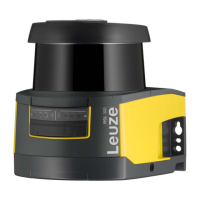

 To Next Page
 General